The Price of Tomorrow: $355 Billion and a Prayer
Four labs. $355 billion in committed 2026 capex. One spreadsheet error from bankruptcy. I built a game to let you feel what it’s like to bet the company—every single year—in the highest-stakes financial model in history.
Share this post:
Export:
The most important number in technology right now is not a model benchmark. It is not a token count, a parameter count, or a MMLU score.
It is ~$355 billion.
That is the combined capital expenditure committed by four organizations—Anthropic, OpenAI, Google DeepMind, and xAI—to build compute infrastructure in 2026 alone.[1][2][3][4][5] To put that in perspective: the entire Apollo program, adjusted for inflation, cost about $280 billion.[6] The Manhattan Project, roughly $30 billion.[7] The Interstate Highway System, around $600 billion spread across four decades.[8]
These four labs are spending more than Apollo in a single calendar year. And they are doing it again the next year. And the year after that.
This is not a bubble. This is a phase transition.
▶ Play The Price of Tomorrow — an interactive compute CEO simulator
The Highest-Stakes Financial Model in History
I have been processing a remarkable podcast—Dwarkesh Patel's three-hour conversation with Anthropic CEO Dario Amodei, titled We Are Near the End of the Exponential.[9] If you have not listened to it, stop reading this and go do that. I will wait.
What struck me was not Dario's technical confidence—he has been consistent on that for nearly a decade. What struck me was the financial framing. He laid it out like a bond trader sizing a position:[9]
"2023, zero to $100 million. In 2024, $100 million to $1 billion. In 2025, $1 billion to $9–10 billion. And then the first month of this year… another few billion."
Then the knife:
"I could assume that the revenue will continue growing 10x a year, so it'll be $100 billion at the end of 2026 and $1 trillion at the end of 2027—meaning I could buy a trillion dollars of compute, actually around $5 trillion dollars of compute because it would be a trillion dollars a year for five years."
And then, the moment that made me sit up straight:
"If my revenue is not $1 trillion dollars, if it's even $800 billion, there's no force on Earth, there's no hedge on Earth that could stop me from going bankrupt if I buy that much compute."
Read that again. The CEO of one of the most important companies in the world is describing a scenario where being right about the technology but wrong by 20% on timing means total annihilation. Not a bad quarter. Not a restructuring. Bankruptcy.
"If I'm just off by a year in that rate of growth, or if the growth rate is 5x a year instead of 10x a year, then you go bankrupt."
This is not how we normally think about corporate strategy. This is how we think about nuclear deterrence. Commit everything. Get the timing right. Or cease to exist.
The Big Blob of Compute
Dario's technical thesis has not changed since 2017, and that consistency is itself informative. He calls it the "Big Blob of Compute Hypothesis":[9]
"All the cleverness, all the techniques, all the 'we need a new method' doesn't matter very much. There are only a few things that matter: raw compute, quantity of data, quality of data, how long you train for, a scalable objective function."
Everyone keeps coming up with barriers. Reasoning. Long-context. Agentic planning. And:
"People keep coming up with barriers that end up dissolving within the big blob of compute."
If you believe this—and Dario's track record suggests you should take it seriously—then the capex race is not irrational exuberance. It is the only rational response. More compute equals more capability equals more revenue equals more compute. The loop closes.
The question is not whether to invest. The question is whether you can survive the timing.
Four Players, Four Bets
Here is the 2026 capex commitment of each frontier lab, as best as public reporting can reconstruct:
| Lab | 2026 Capex | Revenue Run-Rate | Cash Position | External Backing |
|---|---|---|---|---|
| Anthropic[1] | $50B | ~$20B[9][10] | ~$30B | Amazon, FluidStack partnership[11] |
| OpenAI[2] | ~$100B | ~$25B | ~$140B | Microsoft/Stargate, SoftBank |
| xAI[4][5] | ~$30B | ~$1.5B | ~$5B | Tesla infrastructure, Elon's equity |
| Alphabet / DeepMind[3] | ~$180B | ~$8B direct AI | ~$100B | Alphabet's $80B/yr free cash flow |
Note: These are not apples-to-apples comparisons. The numbers reflect a mix of capex guidance (Alphabet), announced commitments (Anthropic), partnership deployment targets (OpenAI/Stargate), and multi-site reporting aggregations (xAI). Depending on where Alphabet lands in its $175–185B band and how you count xAI’s multi-site build, the combined 2026 figure is roughly $305–365B. I use ~$355B as a working number. The order of magnitude is the point.
Look at those numbers. Alphabet is committing $175–185 billion to AI infrastructure in a single year.[3] OpenAI is targeting $100 billion as part of a $500 billion commitment through 2029.[2] Anthropic—the safety lab, the one that supposedly moves carefully—is spending fifty billion dollars.[1]
And Dario's response to the accusation that he is being reckless?[9]
"Are we YOLOing and saying, 'We're going to do $100 billion here or $100 billion there'? I get the impression that some of the other companies have not written down the spreadsheet, that they don't really understand the risks they're taking. They're just doing stuff because it sounds cool."
He is saying: the other guys are the reckless ones. We modeled our risk. They just vibed.
Meanwhile:
"If Anthropic sits on the sidelines, we're just going to lose and stop existing as a company."
There is no opt-out. You are in the race or you are dead. This is not a market. It is a survival game.
I Built the Game
I wanted to feel this. Not read about it. Not analyze it. Feel it.
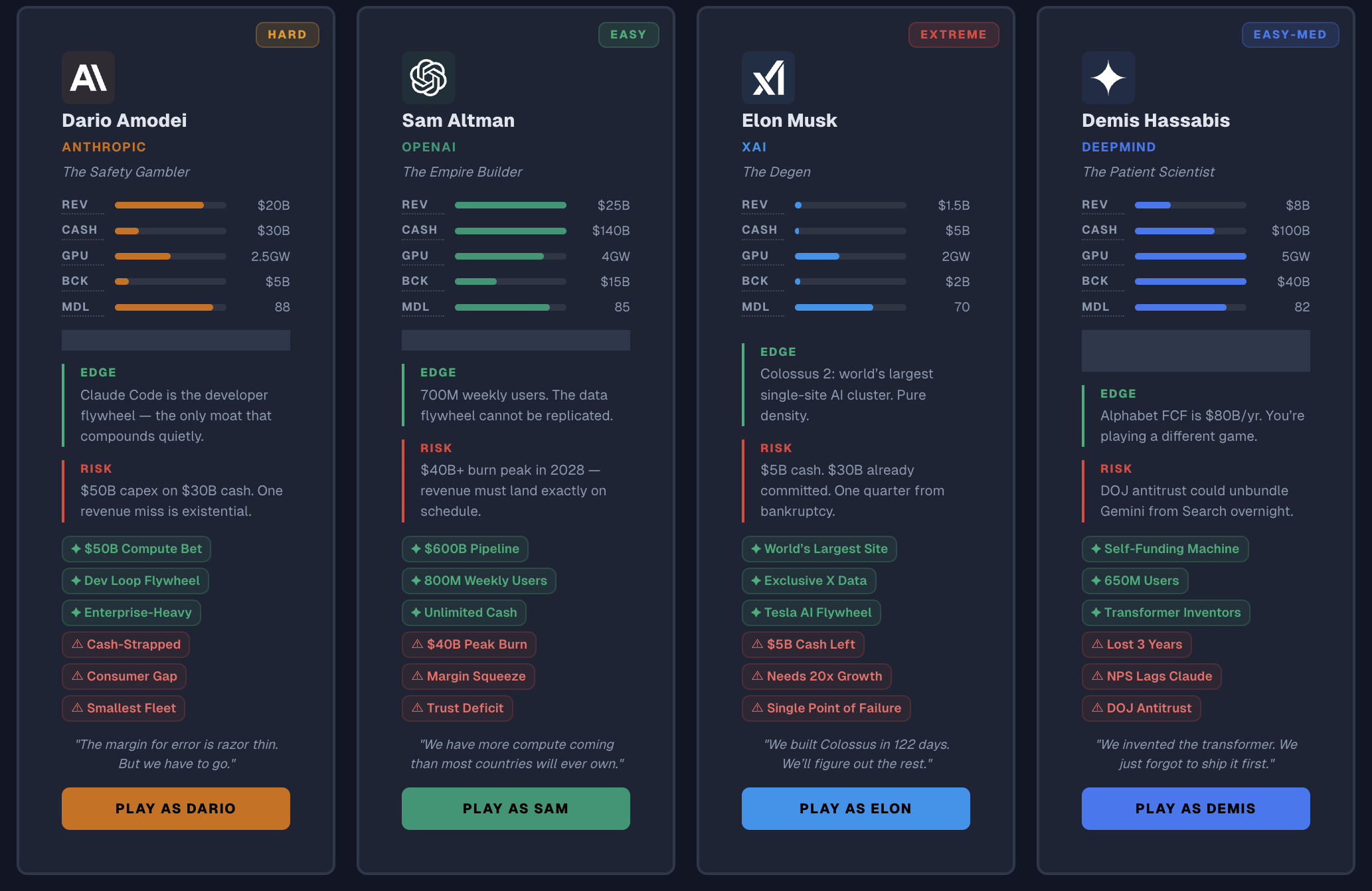
So I built The Price of Tomorrow: a compute CEO simulator where you play as Dario, Sam, Elon, or Demis and make the capital allocation decisions that will determine whether your lab dominates the world or goes bankrupt trying.
Each CEO starts with their real 2026 numbers—cash, revenue, compute capacity, external capital flows. You set a five-year plan: how many gigawatts of compute to build each year, how to split between training and inference, how aggressively to pursue research versus deployment.
Then you watch the simulation unfold. Year by year. Revenue growing (or not). Cash burning. Competitors building. Market share shifting.
The game captures what Dario described: the difference between dominance and bankruptcy is one year of timing. Build too fast and you run out of cash. Build too slow and your competitors eat your market share. The sweet spot is razor thin.
Play as Elon and feel what it is like to have $5 billion in cash against competitors with $140 billion. Play as Demis and discover that $180 billion in capex does not guarantee victory if your direct revenue is thin. Play as Sam and experience the intoxication—and terror—of having the biggest war chest but the biggest burn rate.
Play as Dario and understand the existential tension:
"The pressure to survive economically, while also keeping our values, is just incredible. We're trying to keep this 10x revenue curve going."[9]
The $50 Trillion Prize
Why would anyone make these bets? Because the prize is not a market. The prize is the market.
"We pay humans upwards of $50 trillion in wages because they're useful, even though in principle it would be much easier to integrate AIs into the economy than it is to hire humans."[9]
Fifty trillion dollars. That is roughly the total global wage bill—derivable from the ILO's estimate of labor's share of global GDP.[12] That is the TAM. Not the software market. Not the cloud market. The labor market.
Dario is not shy about the timeline:[9]
"With coding, I think we'll be there in one or two years. There's no way we will not be there."
And on broader AGI:
"Within 10 years, we'll get to country of geniuses in the data center. I'm at 90% on that."
But he also said something darker:[13]
"AI could wipe out half of all entry-level white-collar jobs—and spike unemployment to 10–20% in the next one to five years."
This is the same person. In the same interview cycle. Projecting simultaneous unprecedented productivity growth AND unprecedented unemployment. He described the scenario explicitly: "Cancer is cured, the economy grows at 10% a year, the budget is balanced—and 20% of people don't have jobs."[13]
We do not have a framework for this. No economic model was built to handle abundance and unemployment at the same time. Every model assumes they are inverses of each other.
The Cookies Will Be Shared
I have written about this before. The real crisis is not production. It is distribution.
Imagine a cookie factory. One hundred bakers get replaced by one AI system that produces 100x the cookies. Nobody is hungry because cookies are scarce. People are hungry because the distribution system assumed that labor was the only valid claim on output.
The cookies will be shared. Peacefully or violently. But they will be shared. Because a society where machines produce infinite abundance and a small class hoards it has never, in history, been a stable equilibrium. Not once. Not ever.
What I argued in that essay—and what the capex numbers make even more urgent—is that the initial financial "safe haven" trade (flee to Treasuries, buy bonds) is a trap. You cannot hide in the credit stack when the tax base that supports it is evaporating. The entire credit edifice assumes labor income generates tax revenue generates sovereign creditworthiness. Remove labor income and the cascade is: fiscal crisis, sovereign credit crisis, currency crisis.
It is turtles all the way down, and every turtle is on fire.
The political decision IS the asset allocation. The question is not "what to buy" but "who gets to decide how the abundance is distributed."
The New Sovereigns Are Building Their Kingdoms
I have also written a series on how the Magnificent Seven have become effective sovereigns—entities that print currency (share issuance), tax commerce (30% app store cuts, 60–70% cloud margins), make laws (Terms of Service), and control territory (infrastructure, not land).
The capex race is the sovereignty thesis made physical. When Google commits $180 billion to data center infrastructure,[3] it is not making a business investment. It is building a kingdom. Power plants. Cooling systems. Fiber networks. Land. These are the castles and roads of the 21st century.
As I wrote in Norway With GPUs: the hyperscalers are executing a sovereign-grade macro trade. They are borrowing cheap nominal debt to buy inflation-sensitive real infrastructure, monetizing through AI demand as a levered call option on top. Norway converted an oil windfall into a sovereign wealth fund. The hyperscalers are converting their window of excess equity premium into gigawatt data centers.
The AI hype is the story. The macro trade and the power grab are the plot.
The End of the Exponential
The title of the Dwarkesh episode—"We Are Near the End of the Exponential"—is the most important framing. Not "the end of progress." The end of the exponential. Meaning: the curve is about to go vertical and then hit physical constraints.
"What has been the most surprising thing is the lack of public recognition of how close we are to the end of the exponential. To me, it is absolutely wild that you have people talking about the same tired, old hot-button political issues, when we are near the end of the exponential."[9]
Dario is frustrated. Not because people disagree with him. Because they are not even engaging with the question. The discourse is about model vibes and AI art and whether ChatGPT gets facts wrong. Meanwhile, $355 billion in concrete and silicon is being poured into the ground.
The game I built tries to make this tangible. When you sit in the CEO's chair and look at the numbers—when you see that building 2 gigawatts costs $20 billion, that your revenue needs to double every year just to survive, that your competitors are building faster than you—the abstract becomes visceral.
You feel it in your gut: this is not optional. And the margin of error is one fiscal year.
Three to Four Players
One more thing Dario said that I think deserves attention:[9]
"I don't think this field's going to be a monopoly. There are three, maybe four players."
This maps exactly to what we see in cloud computing (AWS, Azure, GCP) and what the game simulates. The frontier AI market is consolidating into an oligopoly. Not because of network effects—AI does not have strong network effects—but because of capital requirements. Bridgewater estimates hyperscalers will collectively invest roughly $650 billion in AI infrastructure in 2026 alone.[14] You need $50–180 billion per year just to stay in the game.
That means most companies, most countries, and most people are not players. They are customers. Or they are irrelevant.
This is why the sovereignty question matters so much. When three or four organizations control the infrastructure that powers the economy, the political question of who governs them becomes the defining question of the era.
The empty throne I wrote about—the assumption that someone smarter is working on this—is getting emptier by the day.
What Actually Matters
So what do you do? If you are not Dario or Sam or Demis—if you are a person watching $355 billion get poured into infrastructure you cannot control—what actually matters?
The same three things I identified in The Cookies Will Be Shared:
-
Political power to influence distribution. The economic output is going to be staggering. The question is who decides how it flows. Every other financial strategy is subordinate to this.
-
Adaptability. The rate of change is accelerating. Dario says coding will be fully automated in 1–2 years.[9] The skill that matters is not any specific competence but the ability to continuously reposition.
-
Social capital. In a world where machines can do cognitive labor, the premium shifts to trust, relationships, and the ability to mobilize human coordination. No AI can call in a favor.
These are not investment tips. They are survival strategies for a phase transition.
Play the Game
I built The Price of Tomorrow because I wanted to translate the spreadsheet terror that Dario described into something you can feel in your hands.
Choose your CEO. Set your five-year plan. Watch the simulation. See if you can thread the needle between bankruptcy and dominance.
Then look at the leaderboard. See how the other three labs fared with their default strategies. Understand that every single one of them is making a rational bet given their constraints—and that most of them will lose anyway.
Because that is the price of tomorrow. You pay everything you have. You get the timing right, or you do not exist.
"With the way you buy these data centers, if you're off by a couple years, it can be ruinous."[9]
Welcome to the highest-stakes financial model in history.
References
[1] Anthropic, "Anthropic Invests $50 Billion in American AI Infrastructure," November 12, 2025. anthropic.com
[2] OpenAI, "Announcing the Stargate Project," January 21, 2025. $100B initial commitment, $500B total by 2029. openai.com
[3] Fortune, "Alphabet Resets the Bar for AI Infrastructure Spending," February 4, 2026. Alphabet announced $175–185B in 2026 AI capex at Q4 2025 earnings. fortune.com
[4] ABC News, "Elon Musk's xAI to Build $20 Billion Data Center in Mississippi," January 2026. abcnews.go.com
[5] Futurum Group, "AI Capex 2026: The $690B Infrastructure Sprint," 2026. Aggregates xAI's $30B+ 2026 commitment across Mississippi and Tennessee facilities. futurumgroup.com
[6] The Planetary Society, "The Cost of Apollo." Apollo program cost $257B in 2020 dollars ($288B including Gemini and robotic precursor programs). planetary.org
[7] Brookings Institution, "The Costs of the Manhattan Project." Nominal cost ~$1.89B; inflation-adjusted ~$28–36B depending on base year. brookings.edu
[8] Federal Highway Administration, "Interstate System Cost Estimate." Nominal cost ~$129B total; inflation-adjusted ~$600–634B in 2024 dollars. fhwa.dot.gov
[9] Dwarkesh Podcast, "Dario Amodei — We Are Near the End of the Exponential," February 13, 2026. Primary source for all Dario Amodei quotes on revenue trajectory, bankruptcy risk, Big Blob of Compute hypothesis, competitive dynamics, coding automation timeline, and AGI predictions. dwarkesh.com
[10] Fortune, "How Anthropic Grew — What the $18.3 Billion Giant Faces Next," December 4, 2025. Corroborates Anthropic revenue milestones. fortune.com
[11] FluidStack, "FluidStack Selected by Anthropic to Deliver Custom Data Centers in the US," November 12, 2025. fluidstack.io
[12] ILO, "Global Wage Report 2024–25," November 2024. Global wage bill of ~$50–60T derived from labor's ~50–55% share of ~$105T global GDP. ilo.org
[14] Reuters, "Big Tech to Invest About $650 Billion in AI in 2026, Bridgewater Says," February 23, 2026. reuters.com
[13] Axios, "Behind the Curtain: Top AI CEO Foresees White-Collar Bloodbath," May 28, 2025. Dario Amodei warned AI could eliminate half of entry-level white-collar jobs and drive unemployment to 10–20% within five years. axios.com
Erik Bethke has been building games and technology companies for 30 years. He is the author of the Sovereign Series, The Cookies Will Be Shared, and Norway With GPUs. The Price of Tomorrow is playable now.
Frequently Asked Questions
Q: How much are AI labs actually spending on compute in 2026?
The four frontier labs — Anthropic, OpenAI, Google DeepMind, and xAI — have committed roughly $355 billion in combined capital expenditure for 2026 alone. To put that in perspective, the entire Apollo program cost about $280 billion adjusted for inflation, and the Manhattan Project cost roughly $30 billion. Bridgewater estimates hyperscalers collectively will invest about $650 billion in AI infrastructure in 2026.
Q: What did Dario Amodei mean when he said being off by 20% could mean bankruptcy?
Dario described a scenario where Anthropic's revenue grows 10x per year, reaching $100 billion by end of 2026 and $1 trillion by end of 2027 — which would justify buying trillions in compute. But if revenue comes in at even $800 billion instead of $1 trillion, there is no hedge that could prevent bankruptcy at that level of capital commitment. Being right about the technology but wrong by one year on timing means total annihilation.
Q: What is the Big Blob of Compute hypothesis?
It is Dario Amodei's thesis, consistent since 2017, that all the clever techniques and methods matter much less than raw compute, quantity of data, quality of data, training duration, and a scalable objective function. Barriers that people keep identifying — reasoning, long-context, agentic planning — keep dissolving when you throw enough compute at them.
Q: What is The Price of Tomorrow game and how do you play it?
It is an interactive compute CEO simulator where you play as Dario (Anthropic), Sam (OpenAI), Elon (xAI), or Demis (DeepMind) and make five-year capital allocation decisions. Each CEO starts with their real 2026 numbers for cash, revenue, compute capacity, and external capital, and you watch the simulation unfold year by year as revenue grows or shrinks, cash burns, and competitors build.
Q: Why does the article say this is a survival game, not a market?
Because as Dario put it, if Anthropic sits on the sidelines they will "just lose and stop existing as a company." There is no opt-out. You need $50 to $180 billion per year just to stay in the game, and the difference between dominance and bankruptcy is one year of timing. This resembles nuclear deterrence logic more than normal corporate strategy.
Q: What is the $50 trillion prize these labs are chasing?
The total addressable market is not the software or cloud market — it is the global labor market. Roughly $50 trillion in wages are paid to humans annually. Dario says AI coding will be fully automated in 1-2 years and gives 90% odds on reaching "country of geniuses in the data center" within 10 years. The labs are betting on replacing a significant portion of human cognitive labor.
Q: How does the capex race connect to the Sovereign Series about tech companies as nation-states?
When Google commits $180 billion to data center infrastructure, it is not just making a business investment — it is building a kingdom with power plants, cooling systems, fiber networks, and land. The hyperscalers are executing a sovereign-grade macro trade: borrowing cheap nominal debt to buy inflation-sensitive real infrastructure, monetizing through AI demand. Three or four organizations controlling the economy's infrastructure makes the governance question the defining issue of the era.
Q: Will AI really cause mass unemployment while also creating abundance?
Dario explicitly described both outcomes simultaneously: cancer gets cured, the economy grows at 10% per year, the budget is balanced — and 20% of people do not have jobs. He warned AI could wipe out half of entry-level white-collar jobs and spike unemployment to 10-20% in one to five years. We do not have an economic framework that handles abundance and unemployment at the same time because every existing model assumes they are inverses.
Q: What should regular people do if they are not running an AI lab?
The article identifies three survival strategies: political power to influence how abundance gets distributed, adaptability to continuously reposition as the rate of change accelerates, and social capital because trust and relationships become the premium when machines handle cognitive labor. These are not investment tips — they are survival strategies for a phase transition.
Q: Why does the article say the safe-haven trade of buying bonds is actually a trap?
The entire credit edifice assumes labor income generates tax revenue, which generates sovereign creditworthiness. If AI removes labor income at scale, the cascade is fiscal crisis, then sovereign credit crisis, then currency crisis. You cannot hide in the credit stack when the tax base supporting it is evaporating. The political decision about distribution becomes the real asset allocation question.
Q: How many players will survive in the frontier AI market?
Dario predicted three, maybe four players — similar to cloud computing with AWS, Azure, and GCP. This consolidation happens not through network effects but through sheer capital requirements. Most companies, most countries, and most people will not be players in this market. They will be customers or irrelevant.
Related Posts
The Rent Collector's New CEO: What Apple's Ternus Pick Really Means
Apple picked a hardware engineer to succeed Tim Cook. It is a steelman pick — and a tell about the bench, the privacy trap, and the next decade of App...
The Real AI Fight: Stop Helping the Hyperscalers Win
Cory Doctorow wants you to put down the most powerful cognitive amplification tool humanity has ever created. He's not just wrong - he's helping the h...
Folders Are All You Need
Agent loops are real, but they need verifiers you do not have. A long field guide for everyone who is not a software engineer: the folder, the termina...
Subscribe to the Newsletter
Get notified when I publish new blog posts about game development, AI, entrepreneurship, and technology. No spam, unsubscribe anytime.
Comments
Loading comments...