SP3 posts
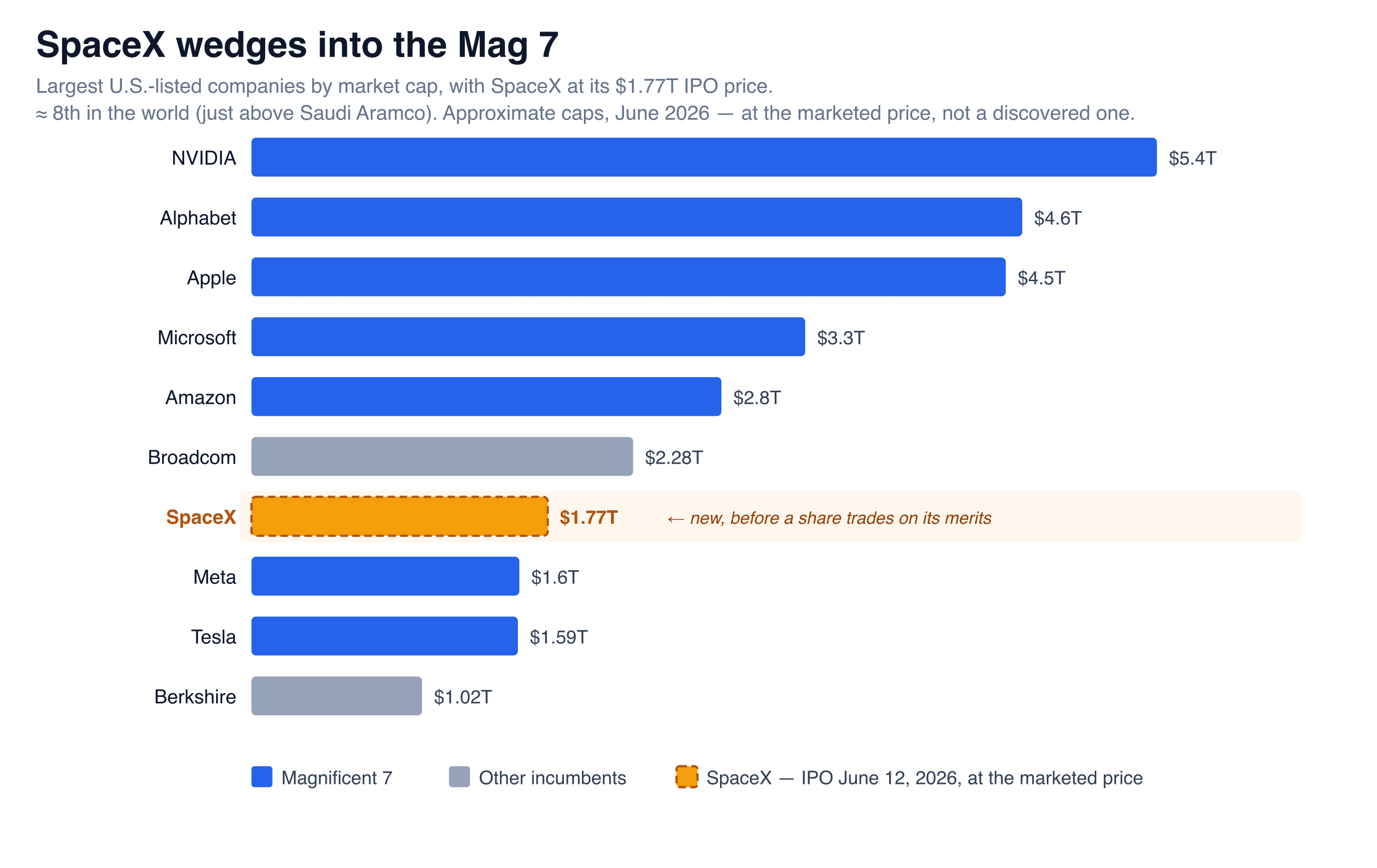
Lex SpaceX: Two Index Giants Bent the Rules for SpaceX — the Biggest Refused
June 5, 2026Nasdaq, S&P, and FTSE Russell rewrote their rulebooks so passive money must buy SpaceX at a price it had no hand in setting. My lens, on the record before the June 12 bell, with six falsifiable predictions.

The Rent Collector's New CEO: What Apple's Ternus Pick Really Means
April 20, 2026Apple picked a hardware engineer to succeed Tim Cook. It is a steelman pick — and a tell about the bench, the privacy trap, and the next decade of Apple.

When the King Falls: Backtesting the Sovereign Exit Rule
April 20, 2026I built the SP3 thesis on the idea of never selling. The backtest says tight rotation beats never-sell by 17% in terminal wealth — and both crush SPY.

Bound Outcomes
April 15, 2026How to align elite self-interest with the well-being of the working poor — by formula, not by hope. The historical bottom-50% wealth share at every major revolution in 250 years tells you exactly where the United States is sitting in 2026.

The Hundred-Billion Match
April 15, 2026The one policy change that would set off more American innovation than a decade of tax cuts, subsidies, or rate cuts combined — and why we're barely talking about it. Mega-caps are talent prisons. Break them up and watch the fire spread.

The Top Three And The Tundra
April 15, 2026The rigged game of passive-flow concentration, the quantitative proof that it's rigged, and how I've decided to play anyway — with a 2006 pickup truck at 360,000 miles as part of the hedge stack.
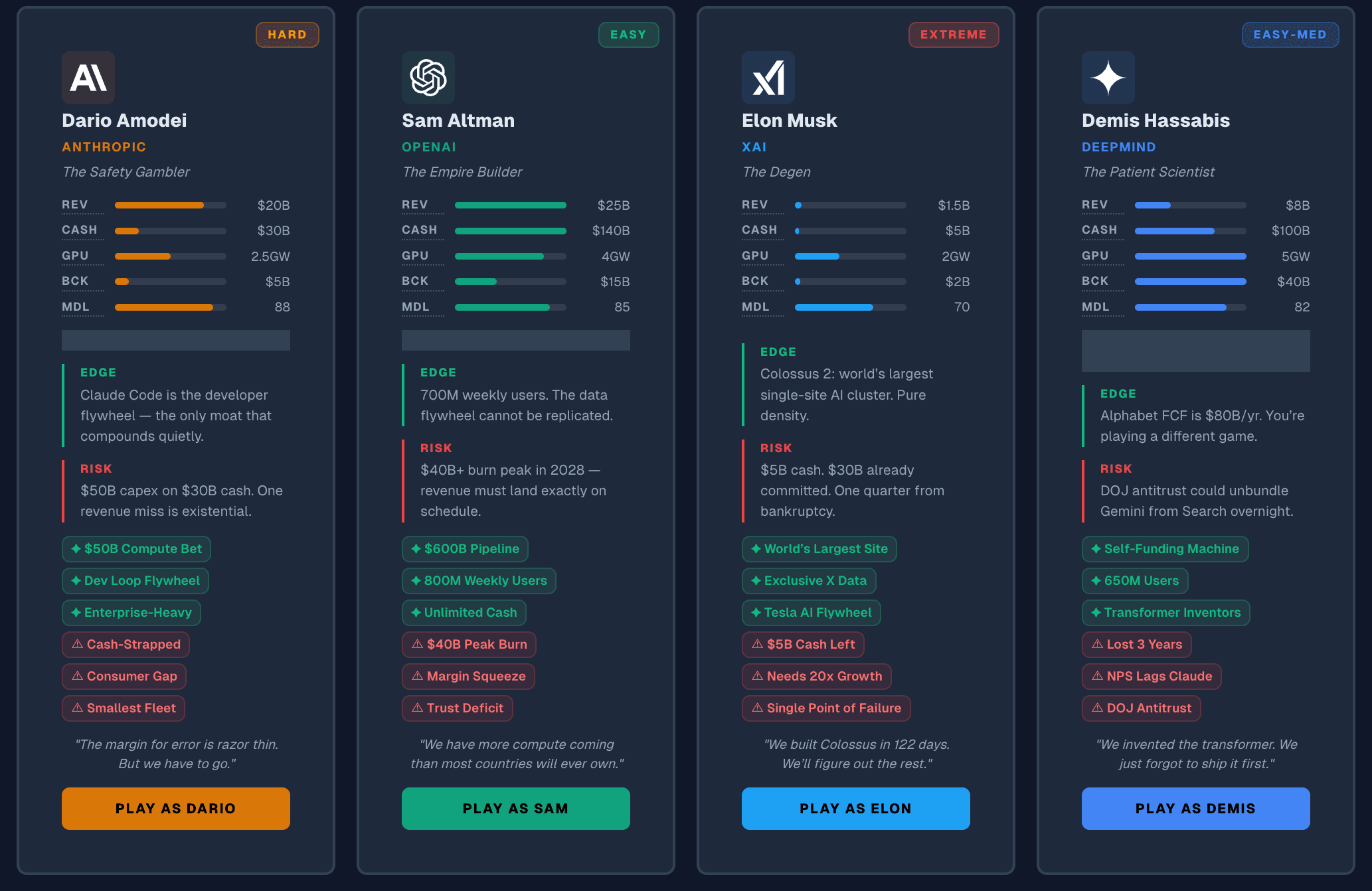
The Price of Tomorrow: $355 Billion and a Prayer
March 2, 2026Four labs. $355 billion in committed 2026 capex. One spreadsheet error from bankruptcy. I built a game to let you feel what it’s like to bet the company—every single year—in the highest-stakes financial model in history.

Yours Runs on Physics, Not Kompromat — V2: A Blueprint for Sovereign Intelligence, Powered by Bike4Mind
February 16, 2026
The Real AI Fight: Stop Helping the Hyperscalers Win
January 19, 2026Cory Doctorow wants you to put down the most powerful cognitive amplification tool humanity has ever created. He's not just wrong - he's helping the hyperscalers win. A systems architect's response to why individual AI empowerment is our only defense against cognitive monopoly.

Memetic Life Forms
January 2, 2026Part 4 of The Sovereign Series: What if corporations aren't tools we built, but living entities that evolved to farm us? What if ownership is a story the crop tells itself?

The Empty Throne
January 2, 2026Part 3 of The Sovereign Series: Why no one is driving, everyone assumes someone else has a plan, and three simple rules that could maintain optionality for the future.

The Strange Attractor
January 2, 2026Part 2 of The Sovereign Series: How passive investing grew from 3% in 2000 to over 50% today, creating a self-reinforcing loop that concentrates power, destroys price discovery, and has no natural exit.

The New Sovereigns
January 2, 2026Part 1 of The Sovereign Series: Seven companies now exercise more effective sovereignty than most nation-states. They print currency, tax commerce, make laws, and control territory. This is Part 1 of a four-part meditation on corporate sovereignty, market structure, and the light cone.

The Mu Strategy: How to Build on Hyperscalers Without Being Owned By Them
November 17, 2025The Norway essay showed hyperscalers running a sovereign-grade macro trade. This essay explains the third option: Mu — how to use hyperscalers as infrastructure (not gods) while keeping your strategic freedom. Rent their muscles. Own your brain. Build where they structurally cannot follow.
The Top Three And The Tundra
The OG essay — structural mechanism, 20-year backtest, the metaphor. If you read one thing about SP3, read this.
Why this works
The Mechanism
About half of US equity flows are now passive — non-price-seeking dollars that must buy market-cap-weighted, no matter the valuation. The top names receive a disproportionate share of every flow.
The Proof
20-year DCA backtest: SP3 grew to 6.7× starting capital. SPY DCA: 4.2×. IRR 16.5% vs 12.7%. Max drawdown −26.5% (vs SPY −28.7%).
The Sweet Spot
SP3 beats SP7 and SP10 on every metric — return, IRR, and drawdown. Names 8+ dilute the position without protecting it.
The Debasement Case
In M2-share terms, SP3 DCA grew +116% of money supply. SPY DCA +36%. Cash shrank −68%. Wealth-share preservation in a debasing regime.
The Discipline
Hold while they lead, rotate when they don't. The roster tracks the cap order monthly — staleness in the position kills the structural-flow edge. Drawdowns are accumulation phases funded by DCA.
What's happening
$300,000
April 2026