The New Sovereigns
Part 1 of The Sovereign Series: Seven companies now exercise more effective sovereignty than most nation-states. They print currency, tax commerce, make laws, and control territory. This is Part 1 of a four-part meditation on corporate sovereignty, market structure, and the light cone.
Share this post:
Export:
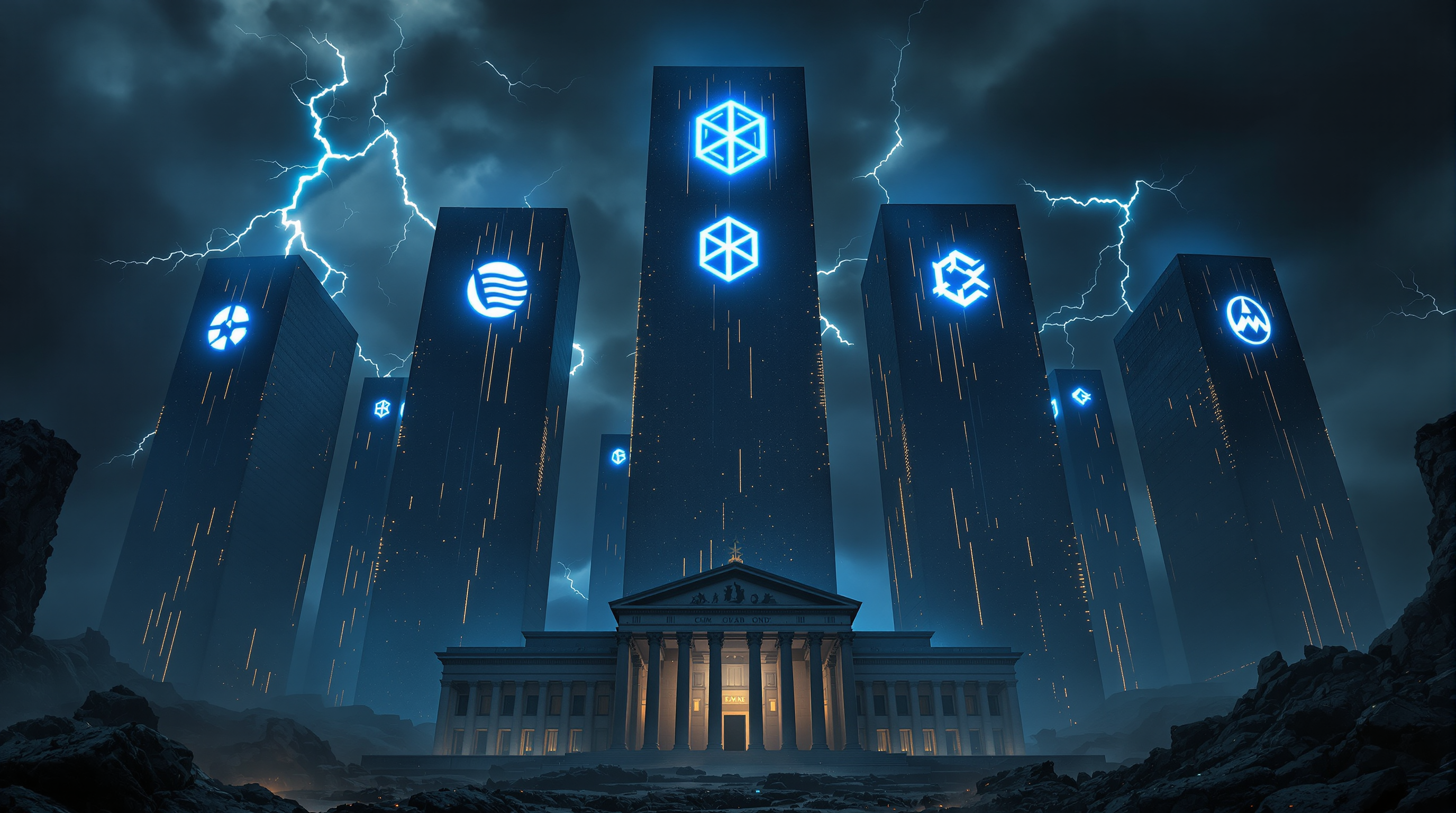
The New Sovereigns
Part 1 of The Sovereign Series: Seven Entities That Exercise More Effective Power Than Most Nation-States
Erik Bethke + Claude | January 1, 2026
On January 1, 2026, we should reckon with a strange fact: seven companies now exercise more effective sovereignty than most nation-states.
Apple. Microsoft. Nvidia. Amazon. Alphabet. Meta. Tesla.
These are not merely large companies. They are not merely "monopolies" in the traditional sense. They have become something the 20th century vocabulary was not built to describe: corporate sovereigns operating inside a regulatory framework designed assuming they couldn't exist.
What Sovereigns Actually Do
Traditional sovereigns - nation-states - exercise a specific set of powers:
- Print currency and control its supply
- Tax their subjects
- Make laws within their domain
- Control territory and project power beyond it
- Answer to no higher authority in practice
Let's examine the Magnificent Seven through this lens.
They Print Currency
When Apple issues new shares, they are literally creating money. When they buy back shares, they are destroying it. This is not metaphor - it's monetary policy conducted on their own equity.
In 2024 alone, the Mag 7 collectively spent over $250 billion on share buybacks. These companies are running central bank operations on their own stock:
- Generate massive cash flows
- Buy back shares (reduce supply)
- EPS rises mechanically (same earnings divided by fewer shares)
- Stock price rises
- Index weight increases
- Passive funds must buy more
- Stock price rises further
- Repeat
They're not subject to the index. They're manipulating it from within using their own balance sheets.
They Tax Commerce
The Magnificent Seven don't levy taxes. They do something more elegant - they make themselves unavoidable chokepoints and extract rent from all economic activity that passes through.
| Platform | The "Tax" | Rate |
|---|---|---|
| Apple App Store | Mandatory payment processing | 30% |
| Google Play Store | Mandatory payment processing | 30% |
| Amazon Marketplace | Seller fees + advertising | 15-40% |
| AWS/Azure/GCP | Cloud infrastructure | 60-70% gross margin |
| Meta/Google Ads | Attention arbitrage | 80%+ gross margin |
If you want to reach customers on their phones, Apple takes 30%. If you want to sell products online, Amazon takes its cut. If you want to run a business in the cloud, you pay tribute to AWS, Azure, or GCP. If you want attention, you pay the advertising tax.
This is not optional. There is no alternative. The "tax" is embedded in the infrastructure.
They Make Laws
Every Terms of Service is legislation. Every content policy is a statute. Every API restriction is regulatory capture in reverse - the regulated writing the rules.
These laws are:
- Globally enforced (try violating Apple's ToS in any country)
- Unilaterally amended (they change whenever the sovereign decides)
- Non-negotiable (accept or don't participate)
- Backed by immediate sanction (account termination, platform ban, API revocation)
When Apple decides what apps can exist, that's legislation. When Google decides what search results to show, that's jurisprudence. When Amazon decides what products get visibility, that's industrial policy. When Meta decides what speech is allowed, that's constitutional law.
Nation-states have to pretend to answer to their citizens. These sovereigns don't even have to pretend.
They Control Territory
The new territory isn't land. It's infrastructure.
You don't live in America. You live on:
- Apple's device ecosystem
- Google's information layer
- Amazon's commerce and compute rails
- Microsoft's enterprise stack
- Meta's social graph
Try to conduct modern economic life without touching any of them. Try to run a business. Try to reach customers. Try to process payments. Try to host your services.
You can't. Not meaningfully. Not at scale.
The old sovereigns controlled where your body could go. The new sovereigns control where your economic activity can flow. In a world where economic participation is survival, the difference is academic.
They Route Around Nation-States
Traditional multinationals are subject to the countries they operate in. The Magnificent Seven are infrastructural to those countries.
- Profits held offshore (until convenient to repatriate)
- Labor arbitraged globally (remote work goes both ways)
- Regulation jurisdictionally shopped (incorporate in Delaware, HQ in Ireland, servers in wherever)
- Too big to ban (what country turns off AWS?)
When Microsoft decides it will put datacenters in a country, that country competes for the privilege. When Google threatens to leave a market over regulation, governments reconsider. When Apple sets a standard, the world's factories retool.
The principal-agent relationship has inverted. We just haven't updated the org chart.
Microsoft as the Agile Expression of America
Here's a thought experiment: If you were a foreign government thinking strategically about American power, who would you negotiate with?
| If you want to... | Do you call... |
|---|---|
| Negotiate trade | The sclerotic State Department? |
| Ensure cloud security | Microsoft/Amazon |
| Access AI capability | Microsoft/OpenAI |
| Not get cut off from chips | Nvidia + Commerce Dept |
| Influence American policy | Lobby the companies, not just Congress |
The United States as a nation-state is gridlocked legislatively, fragmenting culturally, and losing coherence as a decision-making entity. It still possesses enormous latent power but struggles to wield it with intention.
Microsoft is decisive. Strategically coherent. Deeply integrated with the security and intelligence apparatus. Actually executing long-term plans. Global but American-rooted.
Consider:
- Azure runs significant portions of the Department of Defense infrastructure
- Microsoft has classified cloud regions for intelligence community work
- They're acquiring AI capability (OpenAI) without the scrutiny Google receives
- They've been in bed with government since the 90s antitrust deal - and learned from it
The agency moved. The flag stayed, but the animating will migrated into a more functional vessel.
This has historical precedent:
| Declining Sovereign | Agency Migrated To |
|---|---|
| Late Roman Empire | Church + Germanic successor kingdoms |
| Feudal monarchies | Joint-stock companies (East India Co., Dutch VOC) |
| British Empire (declining) | American state + Bretton Woods institutions |
| USA (now?) | Tech sovereignty complex |
The East India Company comparison is uncomfortably close. A private entity with a state charter that became more capable than the sovereign at projecting power. It eventually was the state in the territories that mattered. It had its own army, its own currency, its own law.
Microsoft doesn't need an army. It has something better: it runs the infrastructure the army depends on.
The Kinetic Might Question
Sovereignty ultimately rests on the ability to enforce. So we must ask: which of the seven could defend their status with force if it came to that?
This is not about private armies. It's about integration with state security apparatus.
| Company | Proximity to Kinetic Power |
|---|---|
| Microsoft | Highest - Azure runs DOD, intelligence community, deep Pentagon contracts, GitHub has the code, LinkedIn has the professional graph. Already inside the security state. |
| Amazon | Very High - AWS runs CIA infrastructure, logistics network is dual-use, robotics fleet, Bezos owns WaPo (soft power), Blue Origin space capability |
| High - Former Project Maven work, mapping/surveillance capability, Waymo fleet could be dual-use, DeepMind represents frontier AI | |
| Apple | Medium-High - Controls the device in everyone's pocket (could brick a nation), but less state-entangled, more "neutral" posture |
| Meta | Medium - Unmatched information warfare capability, can shape perception at scale, but no hardware, no state contracts |
| Nvidia | Medium-Low - Makes the chips everything runs on (chokepoint), but not operator; could be captured/nationalized more easily |
| Tesla | Wildcard - Starlink is genuine strategic infrastructure (already in Ukraine war), robots coming, Musk has... relationships |
If one of the seven could today call on kinetic support or effectively merge with the state security apparatus, it's Microsoft.
They're not just aligned with American power. They're increasingly constitutive of it.
The Accountability Void
Who holds these sovereigns accountable?
Shareholders? Passive index funds now own the largest stakes in all of them. BlackRock, Vanguard, and State Street collectively hold ~25%+ of shares in most S&P 500 companies. These funds:
- Cannot vote with their feet (the index forces ownership)
- Have no incentive to challenge management (they own all competitors equally)
- Vote the shares with minimal engagement
- Employ the regulators' future selves
The "owners" are captured. They're not owners. They're hosts.
Regulators? The revolving door spins so fast it generates its own gravity. The regulators run on Microsoft software, host on AWS, and will work for these companies when they leave government. The referees play for the teams.
Courts? Antitrust law was built for Standard Oil. These entities don't fit the model. They're not monopolies in the traditional sense - they're infrastructural sovereigns. Different beast. The conceptual vocabulary doesn't exist yet.
Democracy? Ah. Here's where it gets uncomfortable.
Democratic legitimacy assumes a demos with economic agency. What's the demos when seven companies own the coordination layer and your "vote" is a passive index fund you can't exit without exiting civilization itself?
The democratic wrapper remains. The agency has been privatized.
What This Means
I'm not arguing these companies are evil. I'm not arguing they're conspiring. I'm arguing something more unsettling: they've become sovereign entities through structural dynamics that no one designed and no one controls.
No one decided that Microsoft should become the agile expression of American power. It happened because:
- Nation-states got slow and corporations stayed fast
- Cloud infrastructure became critical to everything
- Passive investing concentrated ownership
- Network effects compounded without limit
- The people who could have intervened were captured by the system they were supposed to regulate
The traditional response to concentrated corporate power is regulation. But you can't regulate from inside the system you're trying to regulate. You can't break up companies that run the infrastructure the breakup would have to be coordinated on.
The throne is occupied. We just haven't updated the titles.
What Comes Next
This essay establishes the frame. But frames are cheap. The harder questions are:
-
How did we get here? The mechanism isn't conspiracy - it's structural, embedded in how passive investing and market cap weighting create self-reinforcing loops. (Part 2: The Strange Attractor)
-
Why isn't anyone talking about this? The silence around these dynamics is itself a symptom of the capture. (Part 3: The Empty Throne)
-
What can be done? There are three simple rules that could maintain optionality for the future - if anyone were positioned to implement them. (Part 3: The Empty Throne)
For now, on this first day of 2026, it's worth simply naming what has happened:
Seven companies exercise sovereign power. They print currency, tax commerce, make laws, and control the infrastructure of modern economic life. They are accountable to no one in any meaningful sense. The nation-state that was supposed to contain them is increasingly contained by them.
This is not a prediction. It's a description of the present.
The question is what we do with the seeing.
This is Part 1 of The Sovereign Series. Part 2: The Strange Attractor examines the mechanism. Part 3: The Empty Throne explores the silence and what might be done.
Related Posts
Memetic Life Forms
Part 4 of The Sovereign Series: What if corporations aren't tools we built, but living entities that evolved to farm us? What if ownership is a story ...
The Empty Throne
Part 3 of The Sovereign Series: Why no one is driving, everyone assumes someone else has a plan, and three simple rules that could maintain optionalit...
The Strange Attractor
Part 2 of The Sovereign Series: How passive investing grew from 3% in 2000 to over 50% today, creating a self-reinforcing loop that concentrates power...
Subscribe to the Newsletter
Get notified when I publish new blog posts about game development, AI, entrepreneurship, and technology. No spam, unsubscribe anytime.
Comments
Loading comments...