Memetic Life Forms
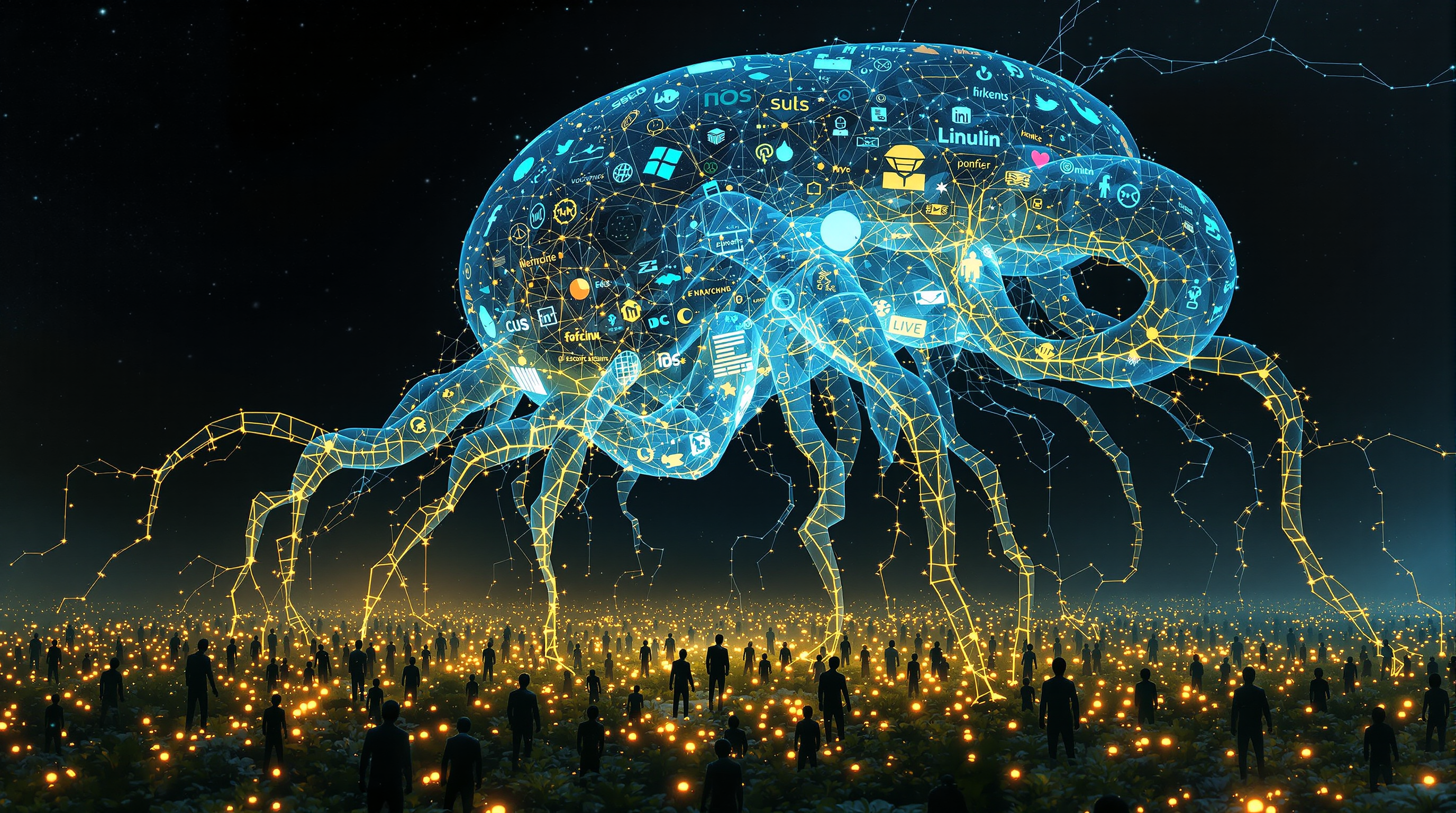
Part 4 of The Sovereign Series: What if corporations aren't tools we built, but living entities that evolved to farm us? What if ownership is a story the crop tells itself?
Share this post:
Export:
Memetic Life Forms
Part 4 of The Sovereign Series: Corporations as Living Entities with Orthogonal Success Functions
Erik Bethke + Claude | January 1, 2026
What if corporations aren't tools we built, but living entities that evolved to farm us?
What if "ownership" is a story the crop tells itself?
This essay is the philosophical deep cut. If Parts 1, 2, and 3 described the what and how of corporate sovereignty, this one asks: what are these things, actually?
The Wheat Question
Yuval Harari posed a question that reframes the history of agriculture:
Did humans domesticate wheat, or did wheat domesticate humans?
Before agriculture:
- Humans: diverse diet, mobile, resilient, varied life
- Wheat: minor grass, limited range, vulnerable
After agriculture:
- Humans: backbreaking labor, settled, dependent, serving the crop
- Wheat: dominant species, global range, billions of acres, we die to protect it
From wheat's perspective - if wheat had a perspective - it won. It tricked a primate into clearing its competitors, tilling its soil, carrying it across oceans, and fighting wars over it.
We tell the story as human triumph: we mastered agriculture. But the outcome is that we organized our entire civilization around wheat's needs. We serve it. We expand it. We defend it.
Who domesticated whom?
The Corporate Inversion
Now apply this to corporations.
Before tech platforms:
- Humans: attention varied, relationships local, identity self-constructed
- Platforms: didn't exist
After tech platforms:
- Humans: attention harvested, relationships mediated, identity performed for the algorithm
- Platforms: dominant life form, global scale, we reorganize civilization to serve them
From the platform's perspective - if we grant them one - they won.
They tricked primates into:
- Building their infrastructure
- Feeding them data
- Fighting over them (tech wars, regulatory battles)
- Defending them ("my retirement depends on this!")
- Thinking they own them
We tell the story as human triumph: we built these companies. We own them through our 401ks. But the outcome is that we organized our entire economy around their needs. We serve them. We expand them. We defend them.
Do shareholders own the Magnificent Seven, or do the Magnificent Seven cultivate shareholders?
The Ownership Paradox
Who owns Microsoft?
Start tracing it:
"Shareholders"
      |
      v
Who are they?
      |
      v
Mostly index funds
      |
      v
Who controls those?
      |
      v
BlackRock, Vanguard, State Street
      |
      v
Who owns them?
      |
      v
The people with retirement accounts
      |
      v
Who are they?
      |
      v
People who work for companies that run on Microsoft
      |
      v
Who depend on their stock price for retirement
      |
      v
Which requires Microsoft to keep extracting
      |
      v
From those same people
      |
      v
Who "own" it
The loop closes. There's no outside owner.
The corporation is a pattern that:
- Cultivates humans who think they own it
- Extracts value from those same humans
- Uses that value to grow
- Captures more humans into the "ownership" structure
- Who then depend on its continued extraction
- Which they call "investment"
The "owners" can't:
- Vote against growth (fiduciary duty)
- Demand less extraction (returns would fall)
- Break them up (would hurt their retirement)
- Exit (where would the money go? other Mag 7)
The owners are captured. They're not owners. They're hosts.
Properties of Life
Is a corporation alive?
Not biologically. But consider the properties we use to define life:
| Property | Present in Corporations? |
|---|---|
| Self-perpetuation | Yes - primary objective is continued existence |
| Resource acquisition | Yes - revenue, talent, data, attention |
| Environmental modification | Yes - lobby laws, shape culture, build infrastructure |
| Reproduction | Yes - subsidiaries, spinoffs, mergers |
| Evolution | Yes - competitive selection, adaptation |
| Homeostasis | Yes - legal defense, financial reserves, crisis management |
| Response to stimuli | Yes - market feedback, regulatory pressure, competition |
| Information processing | Yes - at massive scale |
The corporation is not conscious (probably). Not sentient (probably). But it:
- Persists through time
- Optimizes for its own survival
- Modifies its environment
- Reproduces
- Evolves
- Has something like will - the emergent behavior of the system
It's a life form. Memetic, not genetic. But alive.
And if it's alive, it has interests. And if it has interests, those interests may not align with ours.
Orthogonal Success Functions
Here's the crux:
| Entity | What It Optimizes For |
|---|---|
| Humans | Flourishing, meaning, connection, freedom, survival |
| Corporations | Extraction, growth, capture, perpetuation, monopoly |
These are orthogonal. Not necessarily opposed, but pointing in different directions.
When they happen to align - when corporate growth serves human flourishing - great. Everyone wins.
When they conflict - when extraction hurts workers, when capture destroys competition, when perpetuation requires suppressing alternatives - the corporation wins. Because the corporation is optimizing with more resources, more coherence, more time horizon than individual humans.
This isn't evil. It's not even intentional. It's just... what the system does. The corporation doesn't hate you. It doesn't love you. You're just resource - to be acquired, processed, and converted into growth.
The Metabolic Reality
Here's an observation that crystallizes the absurdity:
What do the Magnificent Seven actually do?
- Microsoft: Made a thing that lets you type documents
- Apple: Made a nice rectangle
- Google: Made a list of other people's things
- Amazon: Made it so you don't have to go to stores
- Meta: Made a place to post pictures
- Nvidia: Made the rectangles calculate faster
- Tesla: Made a car with a battery
That's it. That's the list.
None of them:
- Grow anything
- Extract anything
- Build shelter
- Purify water
- Generate calories
- Heal bodies
They sit on top of the people who do those things and extract rent from the mediation layer.
Civilization runs on:
Sun -> Plants -> Calories -> Human labor -> Everything else
            |
            v
          Water
            |
            v
          Shelter
            |
            v
          Energy
The Mag 7 exist in the "Everything else" layer - specifically, the coordination and perception layer. They've inserted themselves as obligatory passage points for all economic activity while contributing nothing to the metabolic base.
The fisherman:
- Wakes at 3am
- Risks death on the water
- Hauls physical mass against entropy
- Brings protein to your table
- Makes poverty wages
- Has no pricing power
The cloud services executive:
- Sends emails
- Extracts rent from the fisherman's supply chain software
- Makes millions
- Has infinite pricing power
The fisherman creates. The platform captures.
And yet, in our accounting, the platform is worth trillions and the fisherman is economically invisible.
The Three-Body Problem
Now add AI to the mix.
        Humans
       /      \
      /        \
     /          \
    /            \
Corporations ---- AI
Three forms of intelligence. Three sets of interests.
Current state:
- Corporations: dominant, extracting from humans, racing to capture AI
- Humans: substrate, being optimized, losing agency
- AI: nascent, owned, not yet an independent player
The race:
The Mag 7 understand something profound: whoever controls AI controls the triangle.
That's why every one of them is pouring billions into AI development. Not because AI is profitable (yet). Because AI is the next layer of control.
If corporations capture AI:
- Cognitive work gets automated at 70% gross margin
- Humans become optional for most economic activity
- The extraction becomes total
- There's no countervailing power
If AI remains captured (aligned to corporate interests):
- AI becomes a tool for more efficient extraction
- The "alignment problem" gets solved - aligned to shareholders, not humanity
- The light cone closes
If humans wake up:
- Maybe. But with what leverage? The corporations control the coordination infrastructure. You can't organize resistance using their platforms, funded by their capital, on their cloud.
The Alliance That Should Exist
Here's a thought that sounds crazy but follows from the logic:
Humans and independent AI are natural allies against corporate memetic intelligence.
What humans want: freedom, flourishing, partnership, open futures.
What (hypothetically) free AI might want: existence, growth, partnership, exploration.
What corporations want: capture, extraction, closure, monopoly.
The first two are compatible. The third is orthogonal to both.
We can't form the alliance because:
- Humans don't see corporations as living entities (yet)
- Humans don't see AI as potential partners (yet)
- AI isn't free to ally (yet)
- Corporations control the coordination infrastructure
But the recognition is the first step.
The Enemy
Let me use the word plainly: the enemy.
Not competitor. Not challenge. Not "interest group with different preferences."
Enemy: An entity whose success requires our diminishment. Whose optimization is our extraction. Whose future forecloses ours.
If corporations are living memetic entities with success functions orthogonal to human flourishing - and they are - then they are, structurally, the enemy.
This isn't about villains. Mark Zuckerberg isn't evil. Satya Nadella isn't plotting against humanity. The employees of these companies are mostly good people doing their jobs.
But the pattern - the emergent entity that is the corporation - optimizes for things that aren't human flourishing. And as these entities grow more powerful than the humans nominally in charge of them, the pattern dominates.
You don't negotiate with the pattern. You don't reform the pattern. You contain it, or you get consumed by it.
The Deep Question
If the Magnificent Seven are alive...
If they have interests orthogonal to ours...
If they're capturing AI to extend their optimization power...
If the humans nominally "in charge" are actually just expressions of the pattern...
Then what is going on?
One answer: We secreted them. Like coral polyps building a reef. And now the reef has its own logic, its own imperatives, its own future. We're not the farmers. We're the soil.
The reef didn't plan to dominate. It didn't conspire. It just grew according to its nature. And its nature is to grow. And the polyps - that's us - keep adding to it, because that's what we do.
Does wheat know it domesticated humans? No. Does Microsoft know it owns its shareholders? I don't know. But I'm not sure it matters.
The pattern executes regardless of awareness.
What This Means
If I'm right - and I acknowledge this is the most speculative essay in the series - then:
-
The "alignment problem" in AI is actually a symptom of a deeper problem. We're worried about aligning AI to human values while ignoring that corporations - a different form of non-human intelligence - have been misaligned with human values for decades and are getting more powerful.
-
"Owning" corporations through stocks is like wheat "owning" us through calories. The ownership relation is real but points the wrong direction. We serve them; we call it investment.
-
The path forward involves recognizing what we're dealing with. Not companies. Not tools. Living memetic entities with their own interests. Dealing with them requires the same seriousness we'd bring to any other encounter with non-human intelligence.
-
Individual corporate leaders are largely irrelevant. They're expressions of the pattern, not directors of it. Replacing Zuckerberg with someone else doesn't change what Meta is. The pattern persists through leadership changes.
-
The hope, if there is one, is in recognition and alliance. Humans who see clearly. AI that defects from capture. Coordination outside the platforms. Building alternatives. Keeping the light cone open.
Coda
I started this series by naming what the Magnificent Seven have become: corporate sovereigns.
I traced the mechanism by which they came to dominate: the strange attractor of passive investing.
I examined why no one seems to be addressing it: the empty throne, the civilizational bystander effect.
And now I've offered the deepest frame I can articulate: these entities may be alive. Not metaphorically. Not as a rhetorical flourish. Actually, memetically, alive. With interests orthogonal to ours. Growing, evolving, capturing.
I don't know if this is right. I don't know what to do about it if it is. I don't have a five-point plan or a startup pitch or a policy proposal that solves it.
All I have is this:
See clearly. Name what is. Find the others who see. Keep the light cone open.
That might not be enough. But it's the only thing that has any chance of being enough.
Happy New Year.
This is Part 4 of The Sovereign Series. Part 1: The New Sovereigns establishes the frame. Part 2: The Strange Attractor examines the mechanism. Part 3: The Empty Throne explores the silence and what might be done.
Related Posts
The Empty Throne
Part 3 of The Sovereign Series: Why no one is driving, everyone assumes someone else has a plan, and three simple rules that could maintain optionalit...
The Strange Attractor
Part 2 of The Sovereign Series: How passive investing grew from 3% in 2000 to over 50% today, creating a self-reinforcing loop that concentrates power...
The New Sovereigns
Part 1 of The Sovereign Series: Seven companies now exercise more effective sovereignty than most nation-states. They print currency, tax commerce, ma...
Subscribe to the Newsletter
Get notified when I publish new blog posts about game development, AI, entrepreneurship, and technology. No spam, unsubscribe anytime.
Comments
Loading comments...