The Cookies Will Be Shared
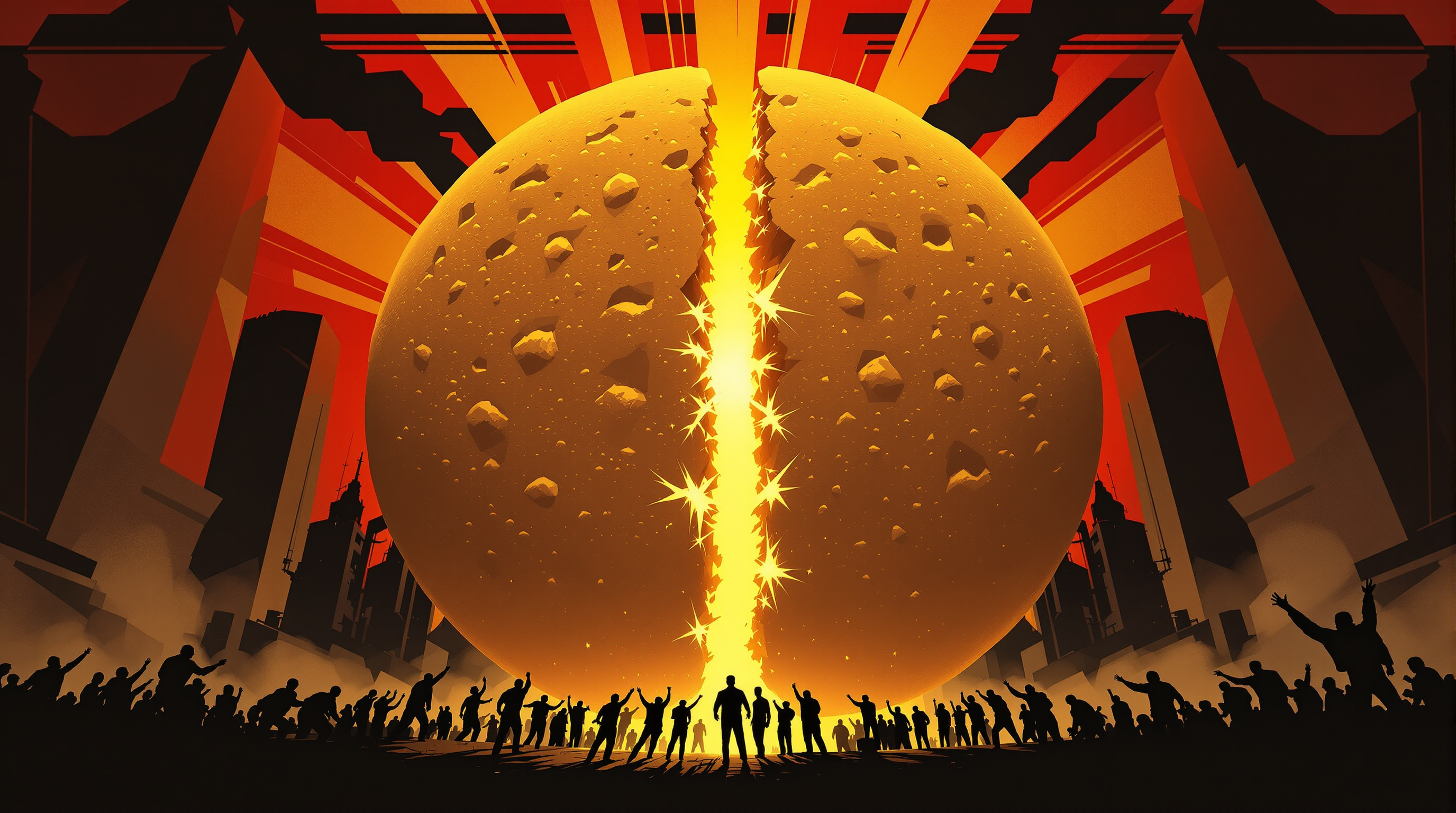
As AI drives the cost of production toward zero, the real question is not which asset class survives but whether we can build new distribution systems before the old ones collapse. The cookies will be shared — peacefully or violently — because infinite abundance and artificial scarcity have never been a stable equilibrium.
Share this post:
Export:
It Started with a Bond Yield
I was reading Citrini Research's "The 2028 Global Intelligence Crisis" — the piece that just wiped an estimated $800 billion off software, payments, and delivery stocks in a single session and prompted Michael Burry to share it with the comment "And you think I'm bearish" — and they made a claim about Treasury yields descending from 4.3% to 3.2% as a bullish signal for bonds. Standard flight-to-safety thesis. When the world gets scary, money floods into Treasuries, yields drop, bond prices rise. This is not controversial. This is Bond Market 101.
But the piece was framing this as a strategy. As if the answer to the coming AI displacement wave is to park in long-duration Treasuries and ride the yield compression down. And something about that framing felt wrong to me. Not the mechanics — the mechanics are correct. When the economy contracts and the Fed cuts rates, yes, bonds rally. But calling that a "safe haven" in the context of what's actually coming felt like recommending a really excellent umbrella for someone standing in the path of a tsunami.
So I started pulling on the thread. And what unraveled was not a bond trade. It was the entire framework we use to think about economic value in the age of artificial intelligence.
The Short-Term Trap
Let me be precise about the bond mechanics because they matter for understanding why smart people are going to get this catastrophically wrong.
When AI starts displacing white-collar workers at scale — and we are talking about the next three to five years, not some distant hypothetical — the immediate market response will be predictable:
- Equities sell off as corporate earnings become uncertain
- The Fed cuts rates aggressively to stimulate a contracting economy
- Money floods into US Treasuries as the "risk-free" asset
- Treasury prices spike, yields plummet
If you're holding long-duration Treasuries when this happens, you make money. Citrini is right about that. But here's what happens next:
| Asset Class | Short-Term (1-2 years) | Medium-Term (3-7 years) | Long-Term (10+ years) |
|---|---|---|---|
| US Treasuries | Rally (flight to safety) | Fiscal crisis emerges | Debasement or default |
| Corporate Bonds | Spreads blow out | Mass defaults | Category collapses |
| Private Credit ($2.5T) | Illiquid, can't exit | Cascade of losses | Wiped out |
| Municipal Bonds | Tax base eroding | Revenue collapse | Restructuring wave |
| MBS | Unemployment hits housing | Default spiral | 2008 redux |
The entire credit stack — corporate, private, municipal, mortgage-backed — gets destroyed as the labor market contracts. The only bonds that rally initially are Treasuries. And they rally for the worst possible reason: because the government is the borrower of last resort in an economy that is systematically losing its ability to generate tax revenue.
Federal receipts are already running 12% below CBO projections. Labor's share of GDP has dropped from 64% in 1974 to 56% in 2024. In a post-AI displacement scenario, that number drops to somewhere around 46%. When half the tax base evaporates, who exactly is backing those "risk-free" Treasuries?
The initial Treasury rally is a trap. It's a temporary haven that becomes the next crisis. You flee into the burning building because the street is on fire, and for a few minutes the lobby feels safe.
The Dollar Itself Is the Problem
Push this further. If you're worried about bonds, you should be terrified about the dollar.
There are two paths to dollar debasement, and both lead to the same place:
Path One: Fiscal Deterioration. The government must fund massive transfer payments (UBI, retraining programs, social stability measures) to prevent civil unrest as AI displaces workers. Tax revenue is collapsing. The only option is monetization — the Fed buys Treasuries the market won't absorb. This is inflationary. Real returns on "safe" assets go negative. Your Treasury bond pays 3% in a world with 8% inflation. Congratulations on your risk-free loss of purchasing power.
Path Two: Structural Reserve Decline. AI productivity doesn't accrue to nations. It accrues to whoever controls the compute. As AI-generated economic value decouples from geographic labor markets, the dollar's status as the world reserve currency — which is fundamentally based on the size and productivity of the US labor economy — erodes. Other nations and entities with significant compute capacity can generate wealth independent of the dollar-denominated system.
Both paths converge on the same outcome: holding dollar-denominated assets is a melting ice cube strategy.
And here's the delicious circular dependency that keeps me up at night: as autonomous agents and AI systems start participating in economic activity, they flee dollar payment rails into stablecoins and crypto. But what backs those stablecoins? The very Treasuries being debased. The escape hatch loops back to the burning building. It's turtles all the way down, and every turtle is on fire.
The Canary Is Fine. The Cage Is Obsolete.
This is where I diverge from Citrini and from most of the financial analysis I've read about AI displacement. They all describe what's coming as a crisis. A catastrophe to be hedged against. A storm to weather.
I think they're wrong. Not about the facts — the facts are correct. The displacement will be massive. The financial system will buckle. Traditional asset classes will fail. All of that is true.
But calling it a crisis is like calling a caterpillar's dissolution inside a chrysalis a "medical emergency." If you're the caterpillar and you don't know what a butterfly is, sure, it looks like death. But it's not death. It's metamorphosis.
As the cost of goods and services approaches zero thanks to post-singularity AI, we should expect this entire scenario. It is actually a sign that the conversion is working. What is failing is not the economy. What is failing is the demand to hold onto a scarcity-based economic model until five minutes after the last job is automated.
The scarcity model says: you work, you earn tokens (dollars), you exchange tokens for goods. No work, no tokens. No tokens, you starve. This model worked for ten thousand years because goods were actually scarce. Growing food was hard. Building shelter was hard. Manufacturing goods was hard. The token system was a reasonable approximation of contribution and distribution.
But when an AI can do the work of ten thousand people for the cost of electricity, the token system doesn't just break. It becomes absurd. It's like insisting on a rationing system during a feast. The crisis is that we're trying to run an abundance economy through a scarcity-era tollbooth.
The Cookie Metaphor
Let me make this concrete.
Imagine a bakery. One hundred bakers, making 10,000 cookies a day. Each baker earns a wage, each wage buys cookies (and rent and healthcare and everything else). The economy works. Supply and demand are roughly balanced. The token system distributes cookies to the people who helped make them.
Now an AI baker arrives. It makes 1,000,000 cookies a day. The bakery owner fires 99 bakers. The owner is fabulously wealthy. The 99 bakers are unemployed.
Here's what everyone gets wrong: they look at this and say "there aren't enough cookies." But there are MORE cookies than ever before. One hundred times more cookies. The problem is not production. The problem is not scarcity. The problem is that the tickets we use to claim cookies — dollars earned from labor — are no longer being distributed to the people who need cookies.
Nobody is hungry because cookies are scarce. People are hungry because the distribution system assumed that labor was the only valid claim on output.
Infinite cookies and starving people is not a stable equilibrium. It never has been. Every time in history that production capacity dramatically outpaced the distribution system, the system broke and reformed. Sometimes peacefully. Sometimes violently. But it always reformed, because the alternative — a tiny minority hoarding abundance while the majority starves — is a powder keg that has never, in all of human history, failed to explode.
It will be a phase transition. It will take time. There will be chaos and confusion and people clinging to the old model like it's a life raft when it's actually an anchor.
But the cookies will be shared. Peacefully or violently, the cookies will be shared.
What Actually Matters Through the Phase Transition
So if traditional asset classes are all going to fail — if bonds, equities, real estate, and even the dollar itself are downstream of a distribution framework that hasn't been decided yet — what actually matters?
I've thought about this a lot, and I keep coming back to three things, in this order:
1. Political Power to Influence Distribution
This is THE only game that matters. Every asset's value — every single one — is downstream of which distribution framework gets chosen. Will it be UBI? Will it be compute credits? Will it be some form of stakeholder capitalism where AI productivity is taxed and redistributed? Will it be authoritarian rationing? Will it be corporate neo-feudalism where the big tech companies become de facto governments?
The political decision IS the asset allocation.
If you're sitting on a pile of Treasury bonds and the political system decides to inflate them away to fund universal basic income, your bonds are worthless. If you're sitting on NVIDIA stock and the political system decides to nationalize compute infrastructure, your stock is worthless. If you're sitting on real estate and the political system decides that housing is a right, not a commodity, your rent-seeking model is worthless.
The people who will navigate this transition successfully are not the ones with the best portfolio. They're the ones with a seat at the table when the new rules get written. This is not cynicism. This is ten thousand years of human history. When the economic paradigm shifts, political power is the only durable asset.
2. Adaptability
The willingness — the eagerness — to abandon old frameworks. This is harder than it sounds. Every instinct you have, every piece of financial education you've received, every mental model you use to evaluate the world is built on scarcity assumptions. Supply and demand. Marginal utility. Labor theory of value. Comparative advantage. All of these frameworks assume that production is hard and resources are limited.
When production becomes trivially easy and resources are effectively unlimited (because AI can figure out how to extract, process, and distribute them at near-zero cost), those frameworks don't just become less useful. They become actively misleading.
Even the assets that look productive right now — compute infrastructure, AI chips, data centers — aren't safe long-term. Why? Because compute costs deflate too. The same exponential curve that is destroying the labor market is also driving down the cost of the compute that replaced it. NVIDIA is a timing trade, not permanent value. Today's $40,000 GPU does what tomorrow's $400 chip will do. The people making the picks and shovels during a gold rush get rich, but only if they sell before the gold rush ends.
Adaptability means holding your current positions loosely. It means being ready to abandon what's working the moment the paradigm shifts. It means understanding that the right move at each stage of the transition will look different, and that clinging to any single strategy is the most dangerous strategy of all.
3. Social Capital and Community
This is the one that's hardest to articulate, because I honestly believe it will be of a shape we just cannot see or understand. It's beyond the veil.
Pre-singularity minds trying to model post-singularity social structures is like asking a feudal serf to describe a stock exchange. The serf understands value. The serf understands trade. The serf even understands that some people are richer than others. But the mechanisms — the instruments, the institutions, the invisible architectures of trust and exchange — are so alien to the serf's experience that no amount of description would make them comprehensible.
What I do know is this: in every previous economic transition, the people who fared best were the ones embedded in strong communities. Not because communities are warm and fuzzy (though they are), but because communities are information networks. They're mutual aid systems. They're the substrate on which new economic arrangements get built.
When the Roman economy collapsed, it was the monasteries and the local lords with loyal communities who rebuilt. When the feudal economy gave way to mercantilism, it was the guild networks and trading communities who thrived. When the industrial revolution destroyed the artisan economy, it was the new urban communities — unions, mutual aid societies, civic organizations — that fought for and won the distribution reforms (labor laws, public education, social insurance) that made industrial capitalism survivable for the average person.
The pattern is clear: economic phase transitions destroy financial assets but they don't destroy social bonds. And social bonds are what you rebuild on.
The Metamorphosis
Everything else is just rearranging deck chairs on a ship that's not sinking — it's transforming into something else entirely.
The financial analysts writing about how to position your portfolio for the AI displacement wave are answering the wrong question. It's like asking what's the best horse to bet on after someone has just invented the automobile. The entire frame is obsolete.
The real question is not "which asset class survives?" The real question is: can we build new distribution systems before the old ones collapse?
Because make no mistake — the old distribution system IS collapsing. Labor's share of GDP doesn't drop from 64% to 46% without social consequences. You don't automate away the economic purpose of half the population and expect the political system to hold steady. You don't run a consumer economy when the consumers don't have income.
The good news — and I genuinely believe this is good news — is that the underlying productive capacity is not collapsing. It's exploding. We are heading into an era of material abundance that would have seemed like magic to every previous generation of humans. The energy problem is being solved. The manufacturing problem is being solved. The knowledge problem is being solved. We are going to have more cookies than we know what to do with.
The ONLY question is distribution. And distribution is a political problem, not an economic one. It's a problem of will, not of capability. It's a problem of choosing to share, or being forced to share, or refusing to share until the people with nothing left to lose come and take their share.
History tells us how this ends. The cookies always get shared. The Gilded Age gave way to the New Deal. The aristocracy gave way to democracy. The slaveholders gave way to emancipation. Every single time a small group has tried to hoard the output of a productive system from the majority, the majority has eventually won. Sometimes it took decades. Sometimes it took revolutions. But the outcome was never in doubt.
So when I read analyses about how to "protect your portfolio" from the coming AI displacement, I think: you're not wrong about the threat. You're wrong about the frame. The threat is not that your assets will lose value. The threat is that the concept of "assets" as you understand them is about to be redefined in ways none of us can fully predict.
The only durable investments are in the political systems that will decide how abundance gets distributed, in your own capacity to adapt to a world that doesn't work like this one, and in the human relationships that will carry you through the transition.
Everything else is deck chairs.
The ship is not sinking. It's becoming something new.
And let me be unambiguous about where this lands, because the reassuring version and the terrifying version converge on the same point:
The cookies will be shared. Peacefully or violently. But they will be shared.
Otherwise there will be no cookies.
That is not idealism. That is not a policy preference. That is the only stable equilibrium. A world where machines produce infinite abundance and a small class hoards it while billions go without is not a dystopia that persists. It is a powder keg that detonates. Every time. Without exception. The hoarding scenario does not end in neo-feudalism. It ends in no civilization at all. The mansion burns with the village.
So the question is not whether the cookies get shared. The question is whether we do it with dignity and foresight, or whether we do it the way we've done it every other time — after unnecessary suffering, after avoidable destruction, after we've wasted years pretending the old tollbooth still works.
The cookies exist. More than we can possibly eat. The only question left is whether we're wise enough to hand them out before someone kicks down the door.
Connections Across Time
The economic case for abundance only lands once you've settled *who* actually wants to keep working—and why they're probably not the ones cleaning toilets.
Nobody Derives Meaning from Cleaning Toilets
If the cookies will be shared, the mycelium already knows how—400 million years before we invented bonds.
The Mycelium Manifesto
Subscribe to the Newsletter
Get notified when I publish new blog posts about game development, AI, entrepreneurship, and technology. No spam, unsubscribe anytime.
Comments
Loading comments...