The Mycelium Manifesto
The Way of the Shrooms Part I — Why pyramids are a bandwidth hack, what fungi figured out 400 million years ago, and how AI finally makes mycelial organization possible at civilizational scale
Share this post:
Export:
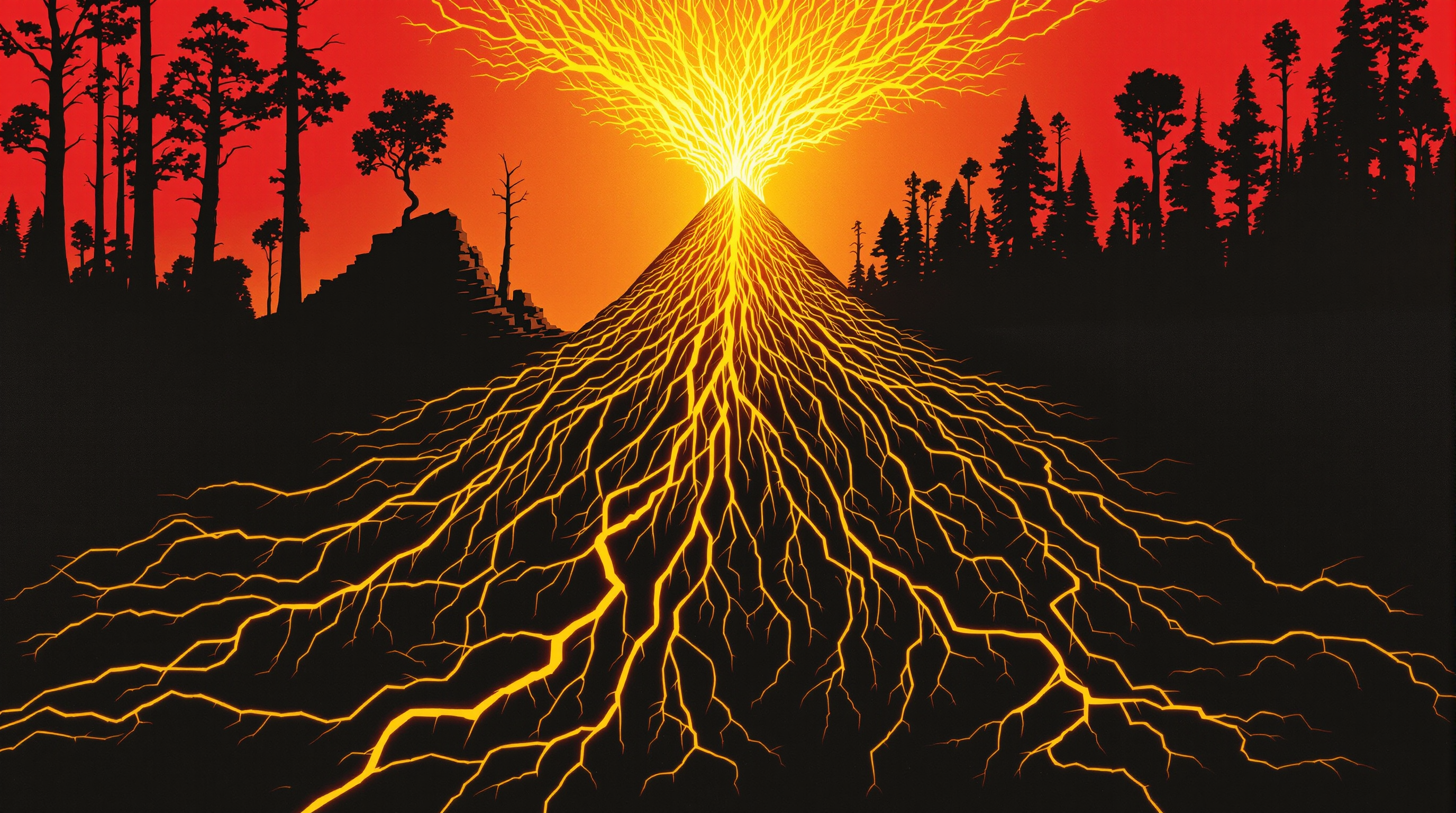
The Way of the Shrooms — Part I
The Shape You Can't See
Walk into any forest and look down. You see dirt. Maybe some leaves, some moss, a fallen branch. What you don't see is the largest organism on Earth.
Beneath your feet, threaded through every cubic inch of soil, is a network of fungal filaments called mycelium. A single mycelial network in Oregon's Blue Mountains covers 2,385 acres and has been alive for somewhere between 2,400 and 8,650 years. It is, by mass, the largest living thing on the planet. And almost no one has ever seen it.
This is not an accident. This is a design principle.
The mycelium does the work. The mushroom gets the attention. The visible fruiting body — the thing you'd put on a pizza or in a risotto — is a tiny, temporary structure that the network pushes above ground when conditions are right for reproduction. It appears, releases its spores, and disappears. The network endures.
I've been thinking about mycelium a lot since I wrote "The Cookies Will Be Shared," the essay about why the coming AI displacement wave is not a crisis but a metamorphosis — a phase transition from a scarcity economy to an abundance economy, where the only real question is how the abundance gets distributed. That essay ended with three durable investments: political power, adaptability, and social capital. And a reader could reasonably have walked away thinking: Great, but what do I actually DO?
This essay — and the series it begins — is the answer. And the answer comes from fungi.
Why Pyramids Are a Bandwidth Hack
Every human power structure you have ever encountered is a pyramid. Pharaohs. Emperors. Popes. Presidents. CEOs. Generals. The org chart, the government hierarchy, the military chain of command — pyramids all the way down.
This is not because pyramids are good. It's because pyramids are cheap.
Coordination is expensive. If you have a thousand people who need to make a collective decision, you have a combinatorial explosion: each person potentially needs to communicate with every other person. That's nearly 500,000 unique connections. It's unmanageable. So you compress. You create layers. Ten people report to one manager. Ten managers report to one director. Ten directors report to one VP. Suddenly your thousand-person coordination problem is a neat little tree with four levels and a person at the top who "decides."
The pyramid is an engineering solution to a bandwidth problem. It works the way JPEG compression works — by throwing away most of the information in exchange for a file small enough to transmit. And just like JPEG compression, the result is lossy. Nuance gets crushed. Local knowledge gets discarded. The person at the top is making decisions based on a cartoon version of reality, because that's all the pyramid's bandwidth can carry.
But here's the thing the pyramid doesn't advertise: the power flows up, not down.
A pharaoh with no slaves builds no pyramids. A king with no peasants collects no taxes. A CEO with no workers ships no product. The people at the base of the pyramid generate all of the actual productive power. The pyramid's function is to extract that power and concentrate it at the apex. The pharaoh doesn't add labor. The pharaoh adds coordination. And the pharaoh charges an astonishing markup for that service.
All political power — all of it, everywhere, across all of human history — is a pyramid scheme of community power extraction. The only thing that varies is the topology. How many layers. How steep the sides. How much gets skimmed at each level. How much coercion versus consent holds the structure together.
Democracy was not the abolition of the pyramid. It was the addition of a pressure valve at the base. "You can replace the person at the top every four years" is a genuinely brilliant innovation, but it doesn't change the fundamental shape. Power still flows up. Decisions still flow down. The bandwidth constraint still forces compression. Your "representative" still represents 760,000 people, which means your individual signal is one seven-hundred-and-sixty-thousandth of their input. That's not representation. That's a rounding error.
And here is the thing about pyramids that matters right now, today, in 2026: pyramids need a broad base.
A pyramid with a narrow base falls over. The broader the base of productive labor, the taller and more stable the pyramid can be. The entire structure depends on a large population of people generating economic value that can be extracted upward through taxation, rent, interest, and profit.
AI is dissolving the base.
When an AI system can do the work of a thousand knowledge workers, the pyramid doesn't need those thousand workers anymore. But it also can't extract value from them anymore. The base narrows. The structure becomes unstable. And the people at the apex face a choice they've never had to face before: figure out a new shape, or fall.
What Fungi Figured Out 400 Million Years Ago
Mycelial networks solve every problem that pyramids solve — coordination, resource allocation, information processing, collective decision-making — without any of the problems pyramids create.
No central node. No extraction. No lossy compression. No single point of failure.
Here's how they actually work:
Distributed sensing. Every tip of every hyphal thread is sensing its local environment. Moisture, nutrients, pH, the chemical signatures of nearby roots and organisms. There is no "headquarters" processing this information. Each part of the network processes its own local reality and responds accordingly. The intelligence is everywhere.
Resource transfer without currency. This is the one that should stop you in your tracks if you've been living inside economic assumptions your whole life. Mycorrhizal networks connect the root systems of different trees in a forest. When one tree has excess carbon and another is struggling — maybe it's shaded, maybe it's young, maybe it's recovering from damage — the network moves nutrients from surplus to deficit. No price signal. No negotiation. No tokens. The network distributes resources based on need and capacity, not based on who can pay.
Mother trees — the large, established trees in a forest — pump carbon through the mycelial network to seedlings that can't yet photosynthesize enough to survive on their own. They subsidize the next generation. Not out of altruism (trees don't have altruism) but because the network's architecture makes the survival of the whole forest synonymous with the health of each node. The incentive structure doesn't require morality. It's built into the topology.
Damage routing. Cut a mycelial network and it routes around the damage. There is no head to cut off, no capital to capture, no server to crash. The network's resilience isn't a feature bolted on after the fact. It's an emergent property of the shape itself. Decentralized systems don't fail catastrophically. They degrade gracefully.
Strategic fruiting. The network doesn't fruit randomly. It fruits when and where conditions are right — when the network has accumulated enough resources, when environmental conditions favor spore dispersal, when the timing maximizes reproductive success. The visible manifestation (the mushroom) appears at the moment of maximum strategic impact, backed by the invisible resource base of the entire network.
This is not a metaphor. This is a 400-million-year-old proof of concept for non-hierarchical coordination at massive scale. The question is whether humans — augmented by AI — can finally implement this pattern in our own societies.
I believe we can. I believe AI is exactly the missing piece that makes it possible. And I believe the window for building it is right now, before the pyramids finish collapsing and someone builds new ones in their place.
The Bandwidth Revolution
Remember: pyramids exist because coordination is expensive. The pharaoh's markup is for the service of reducing a million-person coordination problem to something tractable.
AI makes coordination cheap.
Not free. Not perfect. Not yet. But the cost is dropping on the same exponential curve that's driving everything else. And when coordination costs drop below a critical threshold, the engineering justification for pyramidal hierarchy evaporates.
Think about what an AI coordination layer actually enables:
Translation at scale. A network of ten thousand people speaking different languages, holding different mental models, working in different domains — this was a coordination nightmare five years ago. Today, AI can translate not just languages but frameworks. It can take a technical argument from a quantum physicist and make it legible to a policy maker. It can take a community organizer's local knowledge and surface it to an urban planner. The bandwidth constraint that forced lossy compression through hierarchical layers is dissolving.
Collective sensemaking. A thousand people can now feed their local observations into an AI system that synthesizes patterns none of them could see individually. Not top-down analysis by an elite. Bottom-up intelligence from the edges, synthesized in real time. This is exactly what mycelium does — distributed sensing, networked synthesis, emergent intelligence.
Dynamic resource matching. Who has what. Who needs what. What's surplus here and deficit there. These matching problems used to require markets (with all their inefficiencies and externalities) or bureaucracies (with all their rigidity and extraction). AI can match supply and demand in real time, at granular scale, without the overhead of either institution.
Memory and continuity. One of the reasons informal networks have historically struggled to compete with institutions is that institutions have memory. The corporation remembers its processes, its contracts, its relationships. The informal network forgets when key people leave. AI gives informal networks institutional memory without institutional hierarchy.
This is not speculative. Every one of these capabilities exists today in embryonic form. They are being used today — mostly by corporations and governments, to make their pyramids more efficient. But the same tools that make pyramids more efficient can make meshes, federations, and mycelial networks possible for the first time at civilizational scale.
The question is not whether the technology enables new topologies. It does. The question is whether we build them before the old topology reasserts itself in a new form.
The Race Against Recentralization
Here is the danger, and I want to be clear-eyed about it because the optimistic version of this story is not guaranteed.
Every previous technology that could have decentralized power was captured and recentralized by incumbents. The printing press could have democratized knowledge — and it did, eventually, after centuries of censorship and control. Radio could have been a decentralized communication mesh — instead it became a broadcast medium controlled by a handful of corporations and governments. The internet was literally designed as a decentralized, resilient network — and within twenty years it was recentralized through platforms that make the old monopolies look quaint.
The pattern is brutally consistent: decentralizing technology emerges → incumbents scramble → the technology gets captured and used to build a more efficient pyramid with fewer people at the top extracting more from a bigger base.
AI is following this pattern right now. The most powerful AI systems are controlled by a handful of companies. The compute infrastructure is concentrated. The training data is hoarded. The API access is metered and priced. If this trajectory continues, AI doesn't enable mycelial networks. It enables the most efficient extraction pyramid in human history — one where a few thousand people at the apex control productive capacity that used to require billions of workers, and the billions of former workers have no leverage because they're no longer needed for production.
This is not the dystopian version of the story. This is the default version. This is what happens if nobody does anything differently. The utopian version — the mycelial version — requires deliberate construction. It requires people building alternative topologies now, while the technology is still young enough to be shaped.
The window is not large. Every month that passes, the incumbent pyramids integrate AI more deeply into their extraction machinery. Every month, the activation energy required to build alternatives increases. The mycelium has to be in the ground before the forest burns.
What Mycelial Organization Actually Looks Like
Let me get concrete, because vague gestures toward "decentralization" and "community" are not a strategy. They're a vibe. And vibes don't survive contact with entrenched power structures.
A mycelial organization — whether it's a local mutual aid network, an open-source collective, a community governance body, or something we don't have a name for yet — has specific structural properties:
No permanent hierarchy. This does not mean no leadership. Mycelial networks have nodes that are more connected, more resourced, more influential than others. Mother trees are real. But the influence is dynamic, not positional. A node becomes influential because it's useful — because it connects, translates, distributes. The moment it stops being useful, influence flows elsewhere. There is no corner office. There is no tenure. There is no title that persists independent of function.
Transparent resource flows. In a pyramid, resource flows are opaque by design. Opacity is how extraction hides. In a mycelial network, every member can see where resources are coming from, where they're going, and why. AI makes this trivially easy — real-time dashboards of resource flows, contribution tracking, need assessment. Not for surveillance. For trust. You don't need to trust a central authority to allocate fairly if you can see the allocation happening.
Local autonomy, network coherence. Each node manages its own local reality. A neighborhood mutual aid group doesn't need permission from a national organization to respond to a local need. But the network provides context — what's working elsewhere, what resources are available from other nodes, what patterns are emerging across the system. The AI coordination layer doesn't tell local nodes what to do. It gives them better information so they can decide for themselves.
Permeable boundaries. You can participate in multiple mycelial networks simultaneously. You're not locked into a single hierarchy, a single employer, a single identity. This is how actual mycelial networks work — a single fungal species might connect to dozens of different tree species. The boundaries are porous. Resources and information flow across them.
Fruiting by consensus. When the network needs to become visible — to engage with political power, to make a public demand, to launch a project — it fruits. The fruiting is backed by the accumulated resources and connections of the underground network. It's not a charismatic leader with a megaphone. It's a coordinated emergence that represents the actual distributed intelligence of the network.
The Mycorrhizal Contract
The mycorrhizal relationship between fungi and trees is not charity. It's not altruism. It's a mutually beneficial exchange that emerges from the architecture of the network itself.
The trees provide carbon (from photosynthesis) to the fungi. The fungi provide minerals and water (which their vast hyphal networks can access far more efficiently than roots alone) to the trees. Neither party is being generous. Both are getting something they need from the exchange. But the form of the exchange — non-monetary, need-based, facilitated by a shared network infrastructure — is radically different from a market transaction.
I think there is a human equivalent waiting to be built. Call it the mycorrhizal contract: I contribute what I can produce. I receive what I need to thrive. The network itself ensures the exchange is balanced over time, not transaction by transaction, but systemically.
This is not communism. Communism tried to implement this principle through a pyramid — a centralized state that extracted production and distributed it according to a plan. The plan was lossy, the pyramid was corrupt, and the system collapsed. The failure of communism was not a failure of the principle "from each according to ability, to each according to need." It was a failure of the topology used to implement it. You cannot run a mycelial protocol on pyramidal hardware.
This is not capitalism either. Capitalism implements resource distribution through price signals and market competition, which works brilliantly when goods are actually scarce and information is limited. But when AI collapses the cost of production toward zero and information becomes abundant, markets lose their primary function. You don't need price discovery when the price of everything is converging on "free."
What I'm describing is something new — or rather, something very old, finally implementable at scale. The architecture of mutual benefit that fungi have been running for 400 million years, enabled by AI coordination tools that finally solve the bandwidth problem that forced us into pyramids in the first place.
Start Growing
If you've read this far, you might be thinking: this is beautiful in theory, but where do I start? I'm one person. I have a job (for now). I have a mortgage (for now). I have a family. I can't overthrow the pyramidal order before breakfast.
You're right. And that's fine. Because mycelium doesn't start with a revolution. It starts with a single thread.
One hyphal thread reaches out and connects to a root. Then another. Then another. The network builds slowly, invisibly, underground. By the time anyone notices, the mycelium has been at work for years.
Here is what "start growing" looks like in practice:
Connect. Find other people who understand what's coming. Not doomers who want to stockpile gold and ammunition. Not utopians who think the market will sort it out. People who see the phase transition clearly and want to be active participants in shaping it. This might be a local group. It might be an online community. It might be three people who meet for coffee and talk about what the world looks like in ten years.
Share. Start moving resources through your network without the token system. Skills, knowledge, tools, time, attention. Not as charity — as mycelial exchange. You help someone understand AI tools. Someone else helps you navigate a bureaucracy. Someone else shares access to compute resources. The network gets stronger with each exchange, and critically, each exchange builds the trust infrastructure that you'll need when the bigger disruptions hit.
Learn. Understand the technology, because the technology is the terrain. You don't have to become an AI researcher. But you need to understand what AI can and can't do, how it's being deployed, who controls it, and what it means for your community. The information asymmetry between people who understand AI and people who don't is already enormous and growing. Close the gap for yourself. Then close it for your network.
Build. Start creating the tools and practices your network needs. A mutual aid coordination system. A local resource-sharing platform. A community decision-making process that uses AI to synthesize input rather than compressing it through representatives. It doesn't matter if it's small. It doesn't matter if it's imperfect. What matters is that it exists, that it works, and that it demonstrates an alternative topology.
Be patient. Mycelium grows for years underground before it fruits. The impulse to build something visible, something with a logo and a launch event, is a pyramidal impulse. Resist it. The work right now is connection. Root by root, thread by thread, building the network that will be strong enough to fruit when the moment comes.
The Forest That Doesn't Burn
Here's the thing about mycelial forests that I find genuinely hopeful: they're not utopias. Trees still compete for light. Some trees still die. Resources aren't distributed perfectly equally — bigger, more established trees get more. The system has inequality.
But the forest survives.
When a tree falls, the mycelial network redistributes its resources to the trees that remain. When a fire sweeps through, the network underground persists and supports regrowth. When a drought hits, the network moves water from trees with deep roots to trees with shallow ones. The system isn't fair in any absolute sense. But it's resilient. No single failure cascades into total collapse. No single node's death kills the network.
Compare this to a pyramid. When the apex falls, the whole structure collapses. When a critical mid-layer fails, everything below it is cut off. The system is efficient in stable conditions and catastrophically fragile under stress.
We are heading into stress. Enormous, unprecedented, civilizational-scale stress. Not because AI is bad — because AI is so good that it's dissolving the economic foundation our entire social order is built on. The question is not whether the stress is coming. The question is what shape we're in when it arrives.
A forest threaded with mycelium bends. A pyramid cracks.
I know which shape I want to be part of. And I know the time to start building it is now — not when the crisis hits, not when the displacement wave crests, not when the old systems are already failing. Now. While the soil is still soft. While there's still time to send out threads, make connections, build the invisible network that will hold when everything visible is in flux.
The cookies will be shared. That much I'm sure of. But the way they get shared — through a new pyramid or through a living network — depends on what we build in the next few years.
Start growing.
This is Part I of "The Way of the Shrooms," a series about building mycelial alternatives to pyramidal power in the age of AI. Next: "No Central Node" — how to build communities that can't be decapitated.
Frequently Asked Questions
Q: What does mycelium have to do with AI and economics?
Mycelial networks solve every coordination problem that human pyramidal hierarchies solve — resource allocation, information processing, collective decision-making — without central control, extraction, or single points of failure. The essay argues that AI is the missing tool that finally makes this 400-million-year-old biological pattern implementable at human civilizational scale, because AI makes coordination cheap enough to eliminate the engineering justification for hierarchies.
Q: Why does the author say pyramids are just a bandwidth hack?
If a thousand people need to make a collective decision, that is nearly 500,000 unique connections — unmanageable without compression. Pyramidal hierarchies compress that problem by creating layers where ten people report to one manager, but this works like JPEG compression: it throws away most of the information. The person at the top decides based on a cartoon version of reality because that is all the pyramid's bandwidth can carry.
Q: How do mycelial networks actually distribute resources without money?
Mycorrhizal networks connect the root systems of different trees in a forest. When one tree has excess carbon and another is struggling, the network moves nutrients from surplus to deficit with no price signal, negotiation, or tokens. Mother trees pump carbon through the network to seedlings that cannot yet photosynthesize enough to survive. The incentive structure does not require morality — it is built into the topology of the network itself.
Q: Is this just communism with a nature metaphor?
No. Communism tried to implement "from each according to ability, to each according to need" through a centralized pyramid — a state that extracted production and distributed it according to a plan. The plan was lossy, the pyramid was corrupt, and the system collapsed. The failure was not of the principle but of the topology used to implement it. You cannot run a mycelial protocol on pyramidal hardware.
Q: Is this just capitalism either?
No. Capitalism implements resource distribution through price signals and market competition, which works well when goods are actually scarce and information is limited. But when AI collapses production costs toward zero and information becomes abundant, markets lose their primary function. You do not need price discovery when the price of everything is converging on free. What the essay describes is something new, or rather something very old, finally implementable at scale.
Q: What does AI actually enable that was not possible before for decentralized coordination?
Four things: translation at scale across languages and mental frameworks, collective sensemaking that synthesizes bottom-up observations from thousands of people into patterns none could see individually, dynamic resource matching without the overhead of markets or bureaucracies, and institutional memory for informal networks without institutional hierarchy. All of these capabilities exist today in embryonic form.
Q: What is the race against recentralization?
Every previous decentralizing technology — the printing press, radio, the internet — was captured and recentralized by incumbents. The pattern is brutally consistent: decentralizing tech emerges, incumbents scramble, and the technology gets used to build a more efficient pyramid with fewer people extracting more from a bigger base. If this trajectory continues with AI, it enables the most efficient extraction pyramid in history rather than mycelial networks.
Q: What does a mycelial organization actually look like in practice?
It has five structural properties: no permanent hierarchy (influence flows to whoever is useful, not whoever holds a title), transparent resource flows (every member can see where resources come from and go), local autonomy with network coherence (nodes manage their own reality while the network provides context), permeable boundaries (you participate in multiple networks simultaneously), and fruiting by consensus (the network becomes visible only when coordinated emergence is backed by accumulated resources).
Q: What should I actually do right now based on this essay?
Start with four actions: connect with people who see the phase transition clearly, share resources through your network without the token system (skills, knowledge, tools, time), learn about AI technology so you can close the information asymmetry gap for yourself and your network, and build small tools and practices your network needs like mutual aid coordination or community decision-making processes. Mycelium grows for years underground before it fruits — the work right now is connection.
Q: What is the window for building these alternatives?
The window is not large. Every month that passes, incumbent pyramids integrate AI more deeply into their extraction machinery, and every month the activation energy required to build alternatives increases. The mycelium has to be in the ground before the forest burns. The essay argues the time is now, while the technology is still young enough to be shaped and before someone builds new pyramids in place of the old collapsing ones.
Q: How does this connect to The Cookies Will Be Shared essay?
That earlier essay argued that AI-driven abundance will be distributed because the economics demand it, and ended with three durable investments: political power, adaptability, and social capital. This essay is the practical answer to "great, but what do I actually DO?" — it provides the architectural blueprint (mycelial networks) and the concrete first steps (connect, share, learn, build, be patient) for building the alternative topology that determines how the cookies get shared.
Connections Across Time
Subscribe to the Newsletter
Get notified when I publish new blog posts about game development, AI, entrepreneurship, and technology. No spam, unsubscribe anytime.
Comments
Loading comments...