Nobody Derives Meaning from Cleaning Toilets
The second essay in the post-scarcity series. There are two fundamentally different things we call work - coerced survival labor and chosen creative expression - and confusing them is the intellectual error at the heart of every critique of AI-driven abundance.
Share this post:
Export:
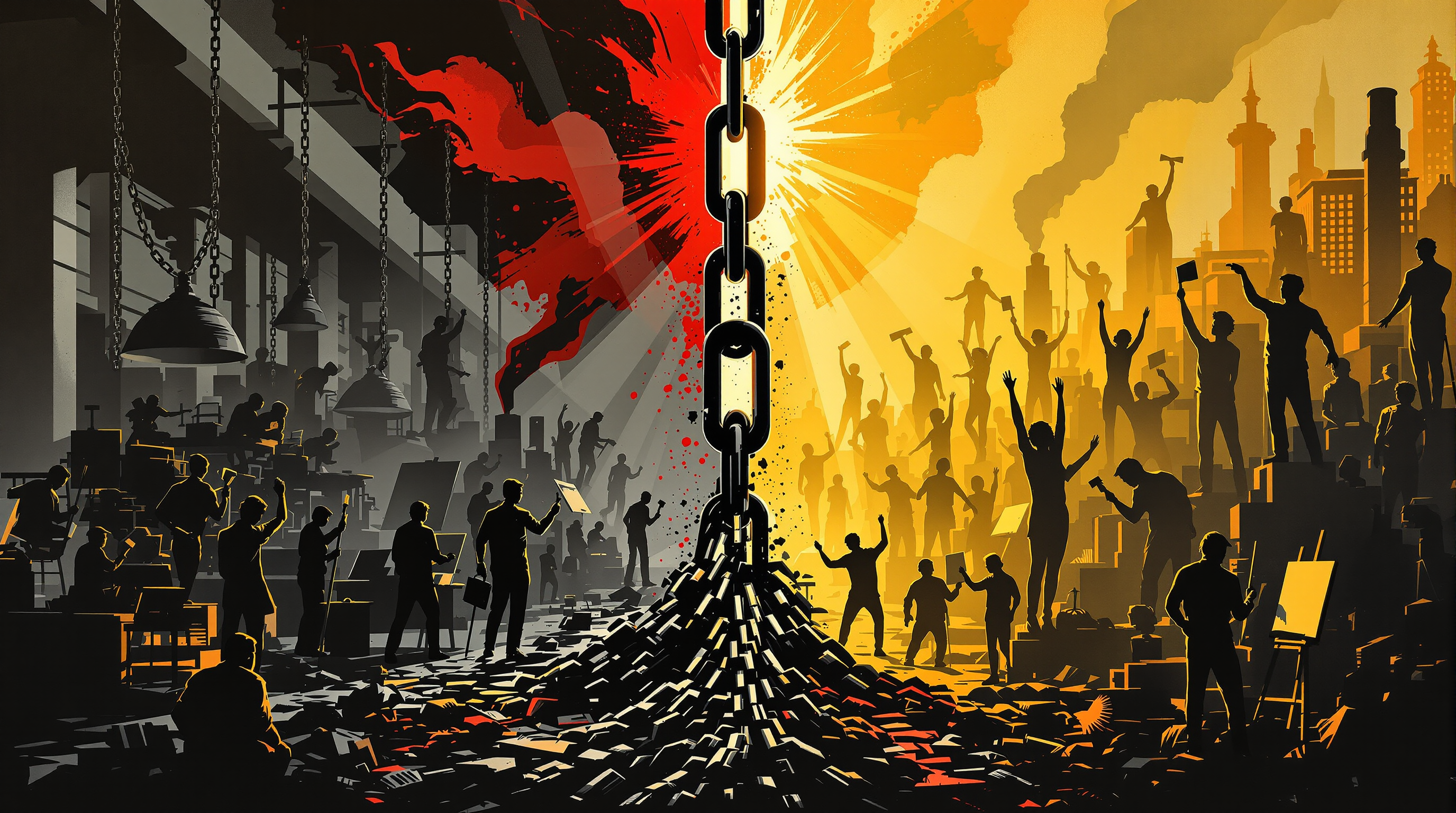
This is the second essay in a series about post-scarcity economics and AI. The first, The Cookies Will Be Shared, argued that AI-driven abundance will be distributed because it has to be — the economics demand it. This essay tackles the next objection: "But what about the meaning of work?"
The Two Things We Call "Work"
Every time I write or talk about post-scarcity economics — about AI handling more and more of what we currently pay humans to do — someone hits me with the same objection. It comes from economists, philosophers, pundits, your uncle at Thanksgiving. It sounds like this:
"But people derive meaning from work! What happens to the human spirit when there's nothing to do?"
And every single time, I want to grab them by the shoulders and say: Have you ever cleaned a toilet for a living?
Because here's the thing. There are two fundamentally different activities that English-speaking humans have decided to cram under the same four-letter word. And confusing them is the intellectual error at the heart of every "but what about meaning?" critique of AI abundance.
Let me introduce you to the distinction that will clarify everything.
Work! (The Coerced Kind)
I'm going to write this with an exclamation mark — Work! — because it's a command. It's what someone else tells you to do. It's labor performed under the implicit threat of "do this or you don't eat."
Work! is:
- Cleaning other people's shit out of toilets at 6 AM
- Picking orders in an Amazon warehouse while an algorithm monitors your bathroom breaks
- Answering call center phones for eight hours while someone screams at you about their cable bill
- Standing on an assembly line doing the same four motions 4,000 times per shift
- Driving Uber at 2 AM because your landlord doesn't accept "I'm finding myself" as rent payment
- Data entry. Form processing. Manual bookkeeping. Filing. Sorting. Counting.
Nobody — and I mean nobody — derives existential meaning from this.
They derive survival.
The "meaning of work" crowd has never — not once, not ever — sat down with a janitor at 11 PM in a strip mall and asked, "Does scrubbing that urinal give you a deep sense of purpose?" You know what the janitor would say? They'd look at you like you'd lost your mind. Then they'd tell you what actually gives their life meaning: their kids. Their partner. Their church. Their weekend fishing trip. The novel they're reading. The garden they're growing.
The paycheck gives them access to meaning. The work itself is a tax on their time. A ransom note from the universe: "Do this thing you'd never choose, or we take away the things you love."
Let me be even more blunt. If you offered every Amazon warehouse picker on Earth a deal — "You get the same paycheck, same benefits, same everything, but you don't have to show up" — what percentage would keep coming in? What percentage would say, "No, no, I need to scan barcodes at 4 AM. It completes me."
Zero. The answer is zero. And everybody knows it.
Art (The Chosen Kind)
Now here's the other thing we call "work." I'm going to call it what it actually is: Art.
Art is the work you'd do even if nobody paid you. It's the thing you sneak off to do on weekends. It's the project you can't stop thinking about in the shower. It's:
- An economist building models of market behavior because she finds the patterns beautiful
- A writer crafting an essay at midnight because the argument won't let go
- A game designer building worlds because the act of creation is the whole point
- A scientist running experiments to answer a question that gnaws at them
- A programmer solving an elegant problem and feeling that click of satisfaction
- A chef inventing a new dish, tasting, adjusting, tasting again
- A teacher who genuinely lights up when a student gets it
- A carpenter running her hand across a joint and knowing it's right
This is what the privileged knowledge-worker class does all day and calls "work." But it's not Work! It's Art. It's creation. It's play with stakes. It's the thing humans do when the survival question is already answered.
Here's how you can tell the difference: Work! is what you do despite yourself. Art is what you do as yourself.
Work! leaves you drained. Art leaves you energized. Work! makes Sunday night feel like a funeral. Art makes you forget what day it is. Work! is clock-watching. Art is clock-forgetting.
And the dirty secret of the professional class — the professors, the analysts, the executives, the writers, the engineers — is that most of them are doing Art and getting paid for it. They hit the cosmic lottery: their particular flavor of curiosity happens to have market value. They're essentially doing their hobby in business casual.
The Conflation Error
Here's where it gets infuriating.
When AI critics say "but what will people DO? Work gives life meaning!" they are committing what I'll call the Conflation Error. They're doing four things simultaneously, and all four are wrong:
1. Confusing Work! with Art. They use the word "work" to describe both toilet-scrubbing and theoretical physics, as if these are the same category of human activity. They are not. They are as different as imprisonment and freedom.
2. Projecting their privileged experience onto billions. The person writing the think piece about the "meaning crisis" is almost certainly a knowledge worker — a journalist, professor, economist, consultant. Someone who does Art for a living. They're looking at their own experience (Art disguised as employment) and projecting it onto the warehouse picker, the janitor, the data entry clerk. It's a staggering failure of empathy dressed up as compassion.
3. Missing that eliminating Work! is liberation, not crisis. If AI can clean the toilets, pick the orders, answer the phones, process the forms — that's not a tragedy. That's the greatest liberation in human history. That's billions of hours of human life returned to their owners.
4. Ignoring what humans actually do when freed from Work! They make Art. Every single time. Throughout all of recorded history. When you remove the coercion, humans create. It's what we are.
Let me put this in a table, because I think the contrast is clarifying:
| Work! (Coerced) | Art (Chosen) | |
|---|---|---|
| Motivation | Survival: "Do this or starve" | Curiosity: "I have to know" |
| Feeling at start of day | Dread | Anticipation |
| Relationship to time | Clock-watching | Clock-forgetting |
| If pay stopped | Gone instantly | Would keep doing it (and many do) |
| Source of meaning | The paycheck (buys real meaning) | The activity itself |
| What AI elimination means | Liberation | Disruption (but humans adapt) |
| Historical examples of elimination | Washing machines, child labor laws | Scribes replaced by printing press |
| Who writes op-eds defending it | Nobody who actually does it | The people who do it |
That last row is the tell. Nobody who scrubs toilets for a living writes essays about the spiritual importance of toilet-scrubbing. But plenty of writers write about the spiritual importance of writing. Plenty of professors write about the spiritual importance of research. The "meaning of work" argument is always made by people defending their own Art while pretending to defend everyone's Work!
The Economist Paradox
Let me push this further, because there's a specific irony here that makes me cackle every time I encounter it.
Some of the loudest voices warning about the "meaning crisis of displaced workers" are economists. Professional, tenured, grant-funded economists. Let me describe their typical day:
They wake up, commute to a beautiful campus, walk into a climate-controlled office surrounded by books, sit down with a cup of coffee, and spend hours — hours — thinking about interesting problems. They build mathematical models. They argue with colleagues about theory. They write papers that scratch an intellectual itch. They present at conferences in nice hotels. They got into economics because they find it fascinating.
They are doing Art. Premium, high-grade, socially-respected Art. Many of them would do it for free — and in fact, many academics essentially do, given what adjunct professors earn.
So when one of these economists publishes a paper titled "The Psychological Impact of Work Displacement in the Age of AI" and argues that "workers derive fundamental meaning from their labor," they are — without a single shred of self-awareness — saying: "I derive meaning from MY labor, therefore everyone must derive meaning from THEIR labor."
It's the definition of projection. They love their Art, so they assume the UPS driver loves his Work! The UPS driver, if asked, would point out that he loves his kids and his fantasy football league and the guitar he plays on Saturday mornings, and the driving is what he does to fund those things.
The economist and the driver both derive meaning from the same source: chosen creative engagement. The difference is the economist gets paid for hers, and the driver has to do his on his own time.
The Historical Evidence Is Not Subtle
The beautiful thing about the "what will people do without work?" question is that we've answered it. Repeatedly. Across centuries. And the answer is always the same.
The Washing Machine
Before automatic washing machines, laundry was a full-day ordeal. Hauling water, heating it, scrubbing by hand, wringing, hanging, ironing. For most of human history, this consumed 15+ hours per week of women's time. It was pure Work! — backbreaking, repetitive, coerced by biological necessity.
When the washing machine eliminated this labor, did women experience a meaning crisis? Did they wander around their homes, lost and purposeless, mourning the spiritual void left by the absence of scrubbing?
No. They went to school. They started businesses. They entered professions. They ran for office. They made art, built communities, changed the world. The washing machine didn't create a meaning vacuum. It created the conditions for women to pursue meaning on their own terms.
I have yet to encounter a single historian who argues that women were happier before the washing machine.
Child Labor
In the 19th century, children as young as five worked in factories, mines, and mills. Twelve-hour days. Dangerous machinery. Toxic conditions. This was Work! in its most brutal form.
When child labor laws eliminated this, did children experience an identity crisis? Did little Tommy, freed from the coal mine, sit in his living room and think, "But what is my purpose now?"
No. He played. He learned to read. He went to school. He climbed trees and skinned his knees and dreamed about the future. Removing coerced labor from children didn't rob them of meaning — it gave them back their childhood. It let them be human.
The Forty-Hour Workweek
In the early 20th century, sixty-hour workweeks were standard. When labor movements fought this down to forty hours, hand-wringing commentators worried that workers wouldn't know what to do with all that free time. They'd drink. They'd gamble. They'd descend into depravity.
Instead, people invented hobbies. They formed bowling leagues and book clubs. They planted gardens and built furniture in their garages. They coached little league and organized neighborhood cookouts. They created the entire concept of "weekend culture" — a massive, vibrant ecosystem of chosen activity that now represents some of the most meaningful parts of American life.
The pattern is so consistent it should be a law of social physics:
Remove coerced labor. Humans fill the space with chosen creation. Every. Single. Time.
The Real "Meaning Crisis"
OK, so if the Work! crowd is wrong, is there any legitimate concern here?
Yes. One. And it's much more specific than the broad "meaning of work" hand-waving.
The legitimate concern belongs to knowledge workers — people who currently do Art for a living — who may find their particular Art disrupted by AI. The copywriter whose specific craft gets automated. The junior analyst whose particular skill set gets absorbed by a model. The illustrator whose style can be approximated by an image generator.
This is real. This is painful. And I don't want to minimize it.
But here's the thing: this isn't a meaning crisis. It's a market crisis. The human urge to create doesn't go away because a specific market for that creation shrinks. The copywriter doesn't stop being a writer. The illustrator doesn't stop drawing. They lose a revenue stream, not a soul.
And — this is the part from the first essay — this is exactly why the cookies get shared. When AI eliminates enough labor that the consumer base can't afford the products, the system has to redistribute. Not out of charity. Out of math. UBI, negative income tax, public equity funds, whatever the mechanism — the money flows, because it has to, because the alternative is economic collapse.
So the knowledge worker who loses their specific market doesn't lose their ability to eat. They lose their particular path to getting paid for their Art. Which sucks. But it doesn't destroy meaning. It redirects it.
What 8 Billion Humans Create When Survival Is Handled
Here's the question worth asking. Not "what replaces the meaning of work?" — that question is broken, because Work! never provided meaning in the first place. The right question is:
What do 8 billion people create when survival is handled?
And the honest answer is: we don't know. We genuinely cannot know. We are on this side of the veil, trying to imagine the other side, and our imaginations are constrained by the world we live in.
But every historical precedent points the same direction: something extraordinary. Something we can't predict from here.
A 19th-century factory worker, if you'd told him that future humans would spend their leisure time:
- Watching other people play video games (Twitch)
- Recording themselves talking and millions would listen (podcasting)
- Competing professionally at digital games for millions of dollars (esports)
- Creating elaborate fictional universes collaboratively in real-time (D&D streams, worldbuilding communities)
- Writing and sharing poetry, fiction, and art with instant global audiences
- Building functional robots as a hobby in their garage
…he would have thought you were insane. Not because those things are strange, but because his frame of reference couldn't accommodate them. He couldn't imagine leisure activities that require technologies, communities, and cultural contexts that don't exist yet.
We're in the same position. We're trying to imagine what post-Work! humans will create, and we can't, because the answer involves forms of expression, community, and creation that don't exist yet. That will be invented by the very humans who are freed to invent them.
What I can tell you, based on every scrap of historical evidence, is this: it won't be nothing. Humans don't sit in dark rooms staring at walls when survival is handled. That's not what we are. We are the species that painted caves 40,000 years ago for no survival reason whatsoever. We are the species that invented music, storytelling, and games before we invented agriculture. Creation isn't what we do when we're bored. Creation is what we are.
The Child Test
If you want to see what humans do in the absence of coerced labor, watch a child.
Before we train it out of them — before school schedules and homework and "sit still and be quiet" — every child on Earth does the same thing. They create. They explore. They build. They destroy and rebuild. They tell stories. They invent games with elaborate rules. They draw. They sing. They ask an infinite number of questions.
No child has ever needed a manager to assign them play. No child has ever needed a performance review to motivate their curiosity. No child has ever experienced a "meaning crisis" because they didn't have a job.
We are born as artists. Society turns us into workers. AI might just turn us back.
Bringing It Home
So here's where we are.
In The Cookies Will Be Shared, I argued that AI-driven abundance will be distributed because the economics demand it. The pie gets bigger. The cookies get shared. Not because we're nice, but because the system breaks if they don't.
In this essay, I'm arguing that the "but what about meaning?" objection is based on a fundamental confusion. The thing people are worried about losing — Work! — never provided meaning in the first place. It provided survival. And the thing that actually provides meaning — Art, creation, chosen engagement with the world — doesn't go away when Work! does. It flourishes.
The cookies get shared. The toilets get cleaned by robots. And humans — finally, after ten thousand years of coerced labor — get to be human.
The "meaning of work" crisis isn't a crisis at all. It's a liberation. And the thing that replaces Work! isn't a policy program or a government initiative or a TED talk about "finding purpose." It's the thing every child does before we train it out of them:
Create. Explore. Play. Build. Imagine.
That's not a crisis. That's the whole point.
Next in the series: What specific forms might post-scarcity creation take? What does the economy look like when Art replaces Work! as the primary human activity? Stay tuned.
Frequently Asked Questions
Q: What is the difference between Work! and Art in this essay?
Work! (with an exclamation mark, like a command) is coerced labor performed under the implicit threat of "do this or you don't eat" — cleaning toilets, warehouse picking, call centers, data entry. Art is the work you would do even if nobody paid you — the project you cannot stop thinking about, the creation that energizes rather than drains you. The key test: Work! is what you do despite yourself, Art is what you do as yourself.
Q: Do people actually derive meaning from their jobs?
People derive meaning from Art, not Work! The dirty secret of the professional class is that most professors, analysts, writers, and engineers are doing Art and getting paid for it — their particular flavor of curiosity happens to have market value. Meanwhile, the warehouse picker, janitor, and data entry clerk derive meaning from their kids, hobbies, and relationships. The paycheck gives them access to meaning; the labor itself is a tax on their time.
Q: What is the Conflation Error?
The Conflation Error is using the word "work" to describe both toilet-scrubbing and theoretical physics as if they are the same category of human activity. Critics who say "people derive meaning from work" are doing four things wrong simultaneously: confusing Work! with Art, projecting their privileged experience onto billions, missing that eliminating Work! is liberation, and ignoring that humans always create when freed from coercion.
Q: What happened historically when coerced labor was eliminated?
The pattern is consistent across centuries. When washing machines eliminated 15+ hours per week of hand-scrubbing laundry, women went to school, started businesses, and entered professions. When child labor laws freed children from factories, they played, learned, and dreamed. When the 40-hour workweek replaced 60-hour weeks, people invented hobbies, bowling leagues, book clubs, and weekend culture. Remove coerced labor and humans fill the space with chosen creation every single time.
Q: Is there any legitimate concern about AI replacing jobs?
Yes, one specific concern: knowledge workers who currently do Art for a living may find their particular Art disrupted. The copywriter whose craft gets automated, the junior analyst whose skill set gets absorbed, the illustrator whose style can be approximated. This is real and painful, but it is a market crisis, not a meaning crisis. The human urge to create does not go away because a specific market for that creation shrinks.
Q: Why does the essay say knowledge workers losing jobs is not a meaning crisis?
Because the copywriter does not stop being a writer and the illustrator does not stop drawing when their market shrinks. They lose a revenue stream, not a soul. And as argued in the companion essay "The Cookies Will Be Shared," when AI eliminates enough labor that the consumer base cannot afford products, the system must redistribute through UBI, negative income tax, or public equity funds — not out of charity, but out of math.
Q: What is the Economist Paradox the essay describes?
Some of the loudest voices warning about the "meaning crisis of displaced workers" are tenured economists who spend their days thinking about interesting problems in climate-controlled offices surrounded by books. They are doing premium Art and getting paid for it. When they publish papers arguing "workers derive fundamental meaning from labor," they are projecting their own experience onto the UPS driver, who actually derives meaning from his kids, fantasy football league, and Saturday morning guitar.
Q: What does the author mean by "we are born as artists"?
Watch any child before society trains it out of them: they create, explore, build, destroy and rebuild, tell stories, invent games with elaborate rules, draw, sing, and ask infinite questions. No child has ever needed a manager to assign them play or a performance review to motivate their curiosity. Humans are born as creators, society turns us into workers, and AI might turn us back.
Q: What will 8 billion people actually do when survival is handled?
The honest answer is we genuinely cannot know because our imaginations are constrained by the world we live in. A 19th-century factory worker could never have predicted Twitch, podcasting, esports, or collaborative worldbuilding communities. But every historical precedent points toward something extraordinary and unpredictable, involving forms of expression and creation that do not exist yet and will be invented by the very humans freed to invent them.
Q: How does this essay connect to The Cookies Will Be Shared?
The first essay argued that AI-driven abundance will be distributed because the economics demand it. This essay tackles the next objection: "but what about the meaning of work?" The answer is that Work! never provided meaning in the first place — it provided survival. When AI handles the coerced labor and the cookies get shared, humans finally get to be human: creating, exploring, playing, building, and imagining.
Q: Is the essay saying all jobs are meaningless?
No. The essay distinguishes between two fundamentally different activities crammed under the word "work." Jobs that involve chosen creative engagement — Art — genuinely do provide meaning. The argument is that the coerced labor most humans perform to survive does not provide meaning, and eliminating it through AI would be the greatest liberation in human history, freeing billions of hours of human life for actual meaning-making.
Connections Across Time
Subscribe to the Newsletter
Get notified when I publish new blog posts about game development, AI, entrepreneurship, and technology. No spam, unsubscribe anytime.
Comments
Loading comments...