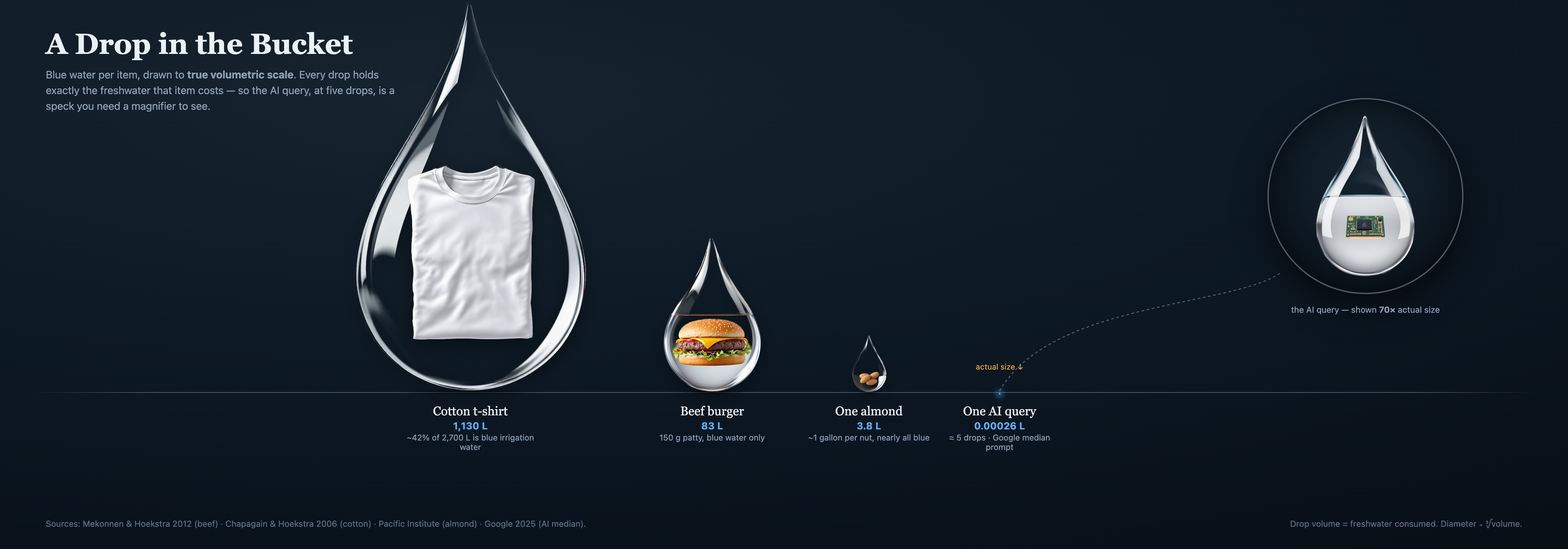
Reports of AI's Thirst Have Been Greatly Exaggerated | Futurum Group Semiconductors, Supply Chain, & Emerging Tech · Resource Costs Reports of AI's Thirst Have Been Greatly Exaggerated Withdrawn water is not destroyed, and five drops is not a bottle. The real costs are local water stress and your power bill. A data-backed field guide to AI's resource footprint, modeled out to 2030. AuthorMichael Conard · Futurum Group PracticeSemiconductors, Supply Chain, & Emerging Tech PublishedMay 31, 2026 On erikbethke.comRepublished with permission · data & infrastructure model courtesy of The Futurum Group PracticeSemiconductors, Supply Chain, & Emerging Tech DataRequest model access Blue water per item, drawn to true volumetric scale — the AI query is the speck you need a magnifier to see. In April 2023, three researchers at UC Riverside published a paper with a memorable title: “Making AI Less Thirsty.” Buried in it was a line that would travel further than almost any sentence written about artificial intelligence since. Training GPT-3, they estimated, could evaporate around 700,000 liters of clean freshwater. And running the model, they wrote, meant that “GPT-3 needs to drink a 500ml bottle of water for roughly 10 to 50 medium-length responses.”1 The university’s own announcement landed in the same range, at twenty to fifty queries per half-liter.2 Read that last figure again, because the internet did not. A 500ml bottle for 10 to 50 responses works out to somewhere between 10 and 50 milliliters per answer. By the time the number reached The Washington Post3 and a thousand social feeds, it had mutated into “ChatGPT drinks a bottle of water every time you use it,” and then into “every AI email costs a bottle of water.” The published science said 10 to 50 milliliters. The viral version said 500. That is a 10-to-50-fold exaggeration of a figure the authors themselves flagged as “varying both spatially and temporally,”1 and the gap widens toward 100-fold, measured against the roughly 5 milliliters a realistic short chat actually uses, once you account for the fact that the paper modeled a long, multi-page interaction, not the short exchange most people picture when they read “one email.” That gap, between what the research said and what the public heard, is the engine of most of AI’s resource panic. The real costs of AI infrastructure are not zero. In a handful of places they are serious. But nearly every alarming number in circulation comes from the same small set of measurement mix-ups, the kind that are easy to make and easy to repeat, and once you have a few anchors to hold onto, the picture resolves into something a lot more useful than dread. In this report What Is Coming, and How to Read It Interactive Exhibit E0: Drag the Build-Out Anchor One: Water “Used” Is Not Water Destroyed Exhibit 1: Withdrawal vs. Consumption What a Query Actually Costs Exhibit 2: The Exaggeration Ladder Anchor Two: A Denominator Worth Checking And the Numbers Are Already Out of Date Interactive Exhibit E3: Size a Query Exhibit 4: Per-Prompt Energy Is Collapsing A Drop in the Bucket Exhibit 5: Blue Water per Item What the Water Buys Where It Is Actually Real, Part One: Water Interactive Exhibit E6: The Map of Real Harm Anchor Three: Capacity Is Not Energy Exhibit 7: Data Center Electricity as % of Total Exhibit 8: Nameplate Capacity Is Not Peak Load Where It Is Actually Real, Part Two: Your Power Bill Exhibit 9: Who Pays, the PJM Spike The Build-Out Is Solvable, and It Is Happening Anyway What Is Coming, and How to Read It Futurum’s semiconductor model puts hard numbers on what is coming. Installed AI data center capacity grows from roughly 27 gigawatts at the end of 2025 to about 190 gigawatts by 2030 in the base case, a build-out that carries a capital expenditure bill near 10 trillion dollars. A gigawatt of data center load is roughly the electricity a large nuclear reactor puts out, or the draw of a mid-sized city, so the 2030 figure is on the order of two hundred reactors’ worth of always-on demand.36 That is the context that makes the resource question worth getting right. Not because AI is about to boil the oceans, but because a 10-trillion-dollar infrastructure cycle deserves better than numbers that are wrong by two orders of magnitude. This piece is built around three anchors and one moving target. Hold onto them: water that isn’t destroyed, a denominator worth checking, and capacity that doesn’t imply energy, and you can read almost any AI resource number without a calculator; the moving target tells you why even the accurate numbers are already out of place. Whether you are generally for or against the advance of AI, this piece will confirm part of what you believe and push back on the rest. The deflationary half is the per-query “bottle of water per email” meme, wrong by about a hundredfold, and the global-aggregate panic that counts withdrawn water as if it were destroyed. The other half gets conceded here without hedging: AI’s aggregate demand is climbing fast and concentrating in a handful of dry basins and stressed grids, where it is already a serious local problem, and a large total is of course built from many local draws. The resolution is a sharper test than the headline numbers allow: judge the build-out on value per liter rather than raw volume, re-price the cost onto whoever runs the queries, and choose the sites and cooling designs that spare local water and grids. This piece maps where those places are. ... --> Interactive Exhibit E0 Drag the Build-Out: How Big Is AI's Water Footprint? Installed AI data center capacity (IT power) 27 GW Off-site power water: Optimistic (clean-power) Central (EIA mix) Cautious (static grid) On-site cooling (consumed) Power generation (consumed) Assumptions: Load factor 0.70 (annual-average IT utilization, not the peak-to-nameplate ratio Anchor three takes apart) · PUE 1.24 in 2025 falling to 1.07 by 2030 · On-site cooling WUE 0.375 L/kWh (LBNL fleet-implied; range 0.10–0.50; Microsoft reports 0.27 fleet-wide; closed-loop trends toward zero) · Off-site power-generation water is a declining moving target, not a fixed multiplier: central intensity falls from about 1.99 L/kWh in 2025 to about 1.42 by 2030 as the grid decarbonizes, built from EIA generation-mix projections and NREL per-technology factors (hydro reservoir evaporation excluded, since AI rarely draws it at the margin; full sourcing below). Treat the downward path as a projection, not a floor: a slower-decarbonizing grid, the gas-turbine ramp, and new nuclear are all upside risks · Every bar is water consumed, not withdrawn; the larger off-site withdrawal returns to source and is excluded, keeping comparisons like-for-like. E0 Sources: Futurum base case GW spine36; on-site cooling WUE and the on-site/off-site consumption split from LBNL 202438; off-site power-generation water intensity series built from NREL per-technology consumption factors39, EIA Annual Energy Outlook 2026 generation-mix projections40, and WRI embedded-electricity guidance41, lowered over time as hyperscalers move toward hourly-matched clean power per Google's 2025 environmental report42; Pacific Institute and C-WIN18 (CA almonds; 2024, irrigation, blue/consumptive); GCSAA16 (US golf; 2024 survey, ~1.63 million acre-feet applied, down 31% since 2005; ~80% applied-at-turf consumed is the article's estimate at the upper end of the USGS 59-84% irrigation range, conveyance loss excluded); de Vries21 (Bitcoin; 2023, consumption). Every bar is water consumed. The AI bar splits on-site cooling water from the consumed (evaporated) portion of off-site power-generation water; the much larger off-site withdrawal is excluded because it returns to source. The picture is time-dependent. AI is the smallest bar today, passes US golf irrigation around 2028, reaches the Bitcoin network only in the 2030 high case, and stays well below California almond irrigation through 2030 in the central case. Anchor One: Water “Used” Is Not Water Destroyed Start with the word everyone gets wrong: consume. The US Geological Survey, which has measured American water use for over a century, draws a sharp line between two things. Withdrawal is water removed from a river, lake, or aquifer for some use. Consumption is the part of that withdrawal that evaporates, gets built into a product, or otherwise does not return to the local source. Consumption is a subset of withdrawal. A once-through power plant might withdraw enormous volumes of river water, run it past hot equipment, and return almost all of it a few degrees warmer, which is not the same as harmless (more on that below). Withdrawal: huge. Consumption: small.4 (Exhibit 1) ... --> Exhibit 1 Withdrawal vs. Consumption: Where the Water Actually Goes Withdrawal vs consumption: power plant and data center panels Panel A: Thermoelectric Power Plant Panel B: Data Center Water Footprint River / Aquifer WITHDRAWAL large Power Plant (once-through) RETURNED ~95%+ to river River (return) CONSUMPTION evaporation: tiny "Withdrawal" headline != "water destroyed" Most removed water returns; consumption is a small subset. Data Center (x=530..620) Evaporation from data center top goes up to y=40 (clear of title band). Centre y of boxes = 97 (same row as Panel A for alignment). --> Off-site Power Plant up to ~four-fifths data center (thin dashed, muted) --> electricity Data Center down to ~one-fifth On-site evap. ~20% (consumed) The follow-up question to ask Withdrawn or consumed? On-site or off-site? Four numbers, ~10x spread. AI 2027 projection (Ren et al. [1]): Withdrawal: 4.2–6.6 billion m³/yr Consumption: 0.38–0.60 billion m³/yr ~10x gap Off-site share [5]: ~two-thirds to four-fifths of DC water footprint (bar shows high end) (power plant withdrawal, mostly returned to source) Withdrawal (removed from source) Returned to source Consumption (evaporated / not returned) Sources: USGS water-use terminology [4]; Ren et al. 2023 [1]; off-site share two-thirds to four-fifths of the total [5] Arrow widths are proportional to relative magnitude: WITHDRAWAL (wide) vs CONSUMPTION (narrow) illustrates the ~10x gap. E1 Sources: USGS water-use terminology (withdrawal vs. consumption) [4]; Ren et al. 2023 [1] (4.2–6.6 B m³/yr withdrawal, ~0.38–0.60 B m³/yr consumption, AI 2027 projection); off-site share [5] (roughly two-thirds to four-fifths of the DC water footprint is off-site at power plants). The ~10× withdrawal-to-consumption ratio is the key distinction behind most overblown water headlines. Off-site power-plant water is mostly withdrawal (returned to source), not consumption. This matters because a data center “uses” water in two completely different ways, and the headlines almost never say which one they mean. Some of that is genuine confusion, because the units really are slippery. Some of it is a real harm reported correctly, which we get to later. And some of it is a frightening number chosen because frightening numbers travel. Pulling those apart is the whole job. The first way is on-site cooling. Many large facilities run evaporative cooling towers, which throw heat away by letting water turn to vapor. That water genuinely leaves the local system. It is consumption in the strict sense. The second way is off-site, and it is usually larger: the electricity a data center buys was generated at power plants that themselves use water for cooling. Between roughly two-thirds and four-fifths of a data center’s total water footprint sits at the power plant, not at the data center.5 And most of that power-plant water is withdrawal, not consumption. It goes back to the river. One important caveat on “goes back to the river.” Consumption is the right axis for ranking one use against another, and it is the axis this piece measures. It is not the only axis, and the difference can be severe. Returned water is not unchanged water. It comes back warmer, and thermal discharge is no minor effect: a heated river holds less oxygen, and a large enough thermal plume can kill fish and aquatic life along a stretch of water, which is why the Clean Water Act regulates it as pollution in its own right. Cooling-tower blowdown returns saltier and chemically treated, and an intake is sized by peak withdrawal rather than annual consumption. Where they land, these harms can matter as much as the raw volume does, and each is a study of its own that this piece does not take on. The narrow point to carry forward is only this: “returns to source” means “not consumed,” it does not mean “no impact.”46 So when a report says a data center “uses” a billion gallons, the necessary follow-up is the same whether the speaker is a careful researcher or a careless one: withdrawn or consumed, and on-site or off-site? Those two questions give four different numbers, and they can differ by a factor of ten. The best critics ask exactly these questions; it is the secondhand retelling that drops them. Here is that factor of ten in the wild. The Riverside paper’s most quoted forecast is that global AI could account for 4.2 to 6.6 billion cubic meters of water in 2027, “more than the total annual water withdrawal of four to six Denmarks.” Notice the word withdrawal. The same paper’s consumption projection is roughly 0.38 to 0.60 billion cubic meters, about a tenth as large.1 The number that went viral was the big one, quoted against national totals as if every drop vanished. It did not. Most of it is power-plant intake that flows back where it came from. And the projection itself is a 2023 model, pointing in two directions at once. It was built before the industry began pulling evaporative towers out of the designs, a topic we’ll cover shortly, which makes its per-query water too high. It also rested on a 2023 estimate of just 85 to 134 terawatt-hours of global AI electricity by 2027;47 the build-out has since blown past that, which is why our own forward model puts 2027 consumption well above Ren’s figure on the same scope. The per-unit number is falling; the total is climbing, because the machines multiplied faster than anyone modeled. None of this means AI water use is fake. It means the unit matters more than the number, and the habit that keeps you on solid ground is simple: with any water figure, ask which water, from where, and whether it ever comes back. Almost nobody quoting these numbers tells you. What a Query Actually Costs With the definitions straight, the real per-query figures are almost anticlimactic. In August 2025, Google published the most detailed accounting any AI provider has released. A median text prompt to its Gemini app consumes about 0.26 milliliters of water. Five drops, though that figure counts only the water its cooling towers evaporate on-site, not the larger share consumed at the power plants behind its electricity. It also draws about 0.24 watt-hours of electricity, roughly what a microwave uses in one second.6 Google measured water as true consumption, input minus what is returned, using the ISO standard. Mistral, the French lab, published its own life-cycle assessment built to the ISO 14040/44 standard that folds in the power-generation and manufacturing water Google leaves out, and still reported only about 45 milliliters per response for a larger model.7 The gap between Google’s 0.26 and Mistral’s 45 is itself instructive: it comes from different model sizes and accounting boundaries, which is exactly why a single “water per query” number is close to meaningless without its methodology attached. (Exhibit 2) ... --> Exhibit 2 The Exaggeration Ladder: Water per ChatGPT-Style Query (Log Scale) Water per ChatGPT-style query: viral claim vs research estimates (log scale, mL) 0.1 mL 1 mL 10 mL 100 mL 500 mL Water per query (mL, log scale) → Viral "one bottle" misread of Ren 2023 500 mL Ren 2023 paper per response (range) 10–50 mL Ren assumptions corrected realistic short chat ~5 mL Mistral LCA 2025 larger model, ISO 14040 (company-reported) 45 mL Google Gemini median 2025 company-reported, on-site consumption, ISO std 0.26 mL ~100x vs. realistic chat E2 Sources: Ren et al. 2023 arXiv:2304.03271 [1] (10–50 mL per response, varies by model and query length); realistic short-chat correction applies Ren's methodology to a short exchange (not the multi-page interaction the paper modeled) [1]; Mistral LCA 2025 [7] (company-reported, ISO 14040, larger model); Google 2025 [6] (company-reported, on-site consumption, ISO standard, median Gemini prompt). These three modern figures are not interchangeable: 0.26 mL is one short prompt, ~5 mL is a whole multi-message chat, and 45 mL is a single response from a larger model, which is exactly why one “water per query” number means little without its model size and query length. Log scale required: the 500 mL viral figure sits about two orders of magnitude (~100x) above a realistic short chat; the modern per-prompt medians sit lower still. Vendor figures are self-reported; Google and Microsoft scope to on-site cooling only (excludes off-site power-plant water). The energy side tells the same story. The widely repeated claim that a ChatGPT query burns 3 watt-hours traces to a 2023 estimate by Alex de Vries. Epoch AI re-ran the math in early 2025 with realistic token counts and current hardware and landed near 0.3 watt-hours, about ten times lower.8 To picture the difference: 3 watt-hours is leaving a single 10-watt LED bulb on for about 18 minutes, while 0.3 watt-hours is that same bulb for less than two minutes. The 3-watt-hour figure assumed a heavier query on older chips. The claim is not so much wrong as it is expired. A few qualifications keep this credible. Google’s and Microsoft’s headline water numbers count on-site cooling only and leave out the power-plant water behind their electricity, a scope choice that Riverside’s Shaolei Ren has publicly criticized as hiding the part that matters most.6 These are vendor disclosures, self-reported and not yet independently audited. Treat them as the best available evidence, not as gospel. These are also inference figures, the cost of answering one prompt, not of training the model in the first place; training is a large one-time bill, but spread across the billions of queries a popular model serves over its life it adds only a small fraction to each one, which is why per-query accounting centers on inference. And five drops, multiplied by the three to five times needed to add back the power-plant water behind the electricity, is still a rounding error next to a whole bottle. Anchor Two: A Denominator Worth Checking The second anchor is the denominator. Take a giant pile of infrastructure energy, divide by the number of transactions, and you can announce a shocking per-transaction cost. Crypto critics know this move better than anyone, because they invented the rebuttal to it. For years, headlines claimed a single Bitcoin transaction used as much electricity as a US household would over weeks. Bitcoin’s own most prominent critic, Alex de Vries, and the Cambridge team that runs the standard Bitcoin energy index both concede the per-transaction metric is misleading, for a precise reason: Bitcoin’s energy use is set by mining economics, by the block reward and the price, not by how many transactions clear. Adding miners does not add transactions. Dividing total network power by transaction count therefore tells you almost nothing about the marginal cost of a payment.1920 The same logic dismantles the per-query AI panic. Total data center energy divided by total queries produces a number, but it conflates the fixed cost of building and idling the fleet with the marginal cost of answering you. And the marginal cost is collapsing in a way the division method cannot see. And the Numbers Are Already Out of Date Each anchor steadies a claim you can check on its own terms. The moving target named at the start is a different kind of argument: the anchors are about how a number is framed, while this one is about timing, something the framing leaves out. The per-query cost is easy to overstate, and it is also collapsing, with most numbers in circulation frozen before the collapse. This is where caching enters, and it is the most under-reported efficiency story in the whole debate. When a model reads a prompt, it does heavy computation to process the input before it generates a word. That input-processing step, called prefill, is pure overhead that gets repeated every time the same context shows up. Modern AI workloads repeat context constantly. An agent re-sends the same system instructions and tool definitions on every step. A document chat re-reads the same document on every question. Caching saves the processed result the first time and reuses it, skipping the recomputation entirely. The major labs have put a price on exactly how much compute this saves, and those prices tell the story. A cached input token at Anthropic costs one tenth of a fresh one.10 At DeepSeek, whose disk-based caching was a genuine engineering milestone in 2024, the same ratio: roughly 1.4 cents per million cached tokens against 14 cents uncached.11 Google’s Gemini API and OpenAI both land in the same zone, with cached input running from half price down to a tenth.1213 DeepSeek reported that caching cut the time to first token on a long 128,000-token prompt from 13 seconds to half a second.11 Price is not a perfect proxy for energy, since vendors set prices with margin and strategy in mind. But a tenfold price gap, confirmed across four competitors who do not coordinate, is strong evidence that serving a cached token takes a small fraction of the compute, and therefore the energy, of computing it fresh. How much that matters depends on the shape of the query, because caching cuts only the input half: it transforms an enterprise workload that re-reads the same documents and instructions all day, and barely touches a long chain of reasoning that spends most of its budget generating. Size a query for yourself below, with caching and without, and watch the on-site cooling water and the larger off-site power-plant water move with it. (Exhibit 3) Interactive Exhibit E3 Size a Query: How Much Water and Power, With Caching and Without? Workload: Typical chat Enterprise repetition Deep reasoning Input tokens (the prompt, documents, tools, history the model reads) 120,000 tokens Output tokens (the answer the model writes) 800 tokens On-site cooling (consumed) Off-site power generation (consumed) Fixed reference points Assumptions: Per-query electricity from a transparent two-part model: prefill (reading input) plus decode (writing output), with decode costing about 5x as much per token, which reproduces the 77–91% decode share a 2025 measurement study reports for long outputs. The scale is set against independent per-query energy estimates for a median prompt, roughly 0.2–0.3 Wh (Google's median Gemini prompt; Epoch's re-estimate of a ChatGPT query); a short chat (50 in / 200 out) sits below that, near 0.1 Wh · Water uses the same assumptions as E0: on-site cooling WUE 0.375 L/kWh and a present-day (2025, central) off-site power-generation intensity of 1.99 L/kWh, so off-site power-plant water is about 5x the on-site cooling water for every query · Caching applies to the input side only: a cache hit serves prefill at ~10% of fresh, the ratio four competitors converge on; generation is never cached · Because the axis is logarithmic, the on-site / off-site split is shown by a colour boundary at the on-site value, not by additive segment length; the bar end is the total · Token-to-text uses ~0.75 words per token and a ~500-word single-spaced page · Every value is water consumed, not withdrawn. Google's median is on-site only; the lighter segment is the off-site power-plant water that scope leaves out. E3 Sources: Cache read at ~10% of fresh input, confirmed across four independent vendors: Anthropic10, DeepSeek ($0.014 vs $0.14/M tokens; disk-based cache cut time-to-first-token on a 128k prompt from 13s to 0.5s)11, Google Gemini13, and OpenAI (50% at its Oct 2024 launch, ~10% on newest models)12; decode share of inference compute (77–91% for long outputs) from the 2025 measurement study14; per-query energy set against Google's median Gemini prompt (~0.24 Wh)6 and Epoch's independent ~0.3 Wh re-estimate8, with water then following E0's shared on-site / off-site intensities (LBNL, NREL, EIA)3839; heavy/long reference from Mistral's ISO 14040 LCA (~45 mL)7; one almond ~3,785 mL blue (Pacific Institute)18; one 150 g beef patty ~83 L blue (Mekonnen & Hoekstra)15. Note: price is a proxy for compute and energy, not a direct measurement; boundaries differ (Google reports on-site only, on a higher site-specific WUE than the LBNL fleet figure used here, so the modeled on-site runs below Google's 0.26 mL; Mistral is a full LCA; food is blue-water), so read the chart for order-of-magnitude scale, not milliliter precision. Put the division logic together with caching and the conclusion is sharp: tokens served does not always represent compute performed. The number of tokens flowing through AI systems will rise far faster than the energy required to serve them, because the fastest-growing workloads, the agentic and retrieval-heavy ones, are precisely the most repetitive and therefore the most cacheable. Caching is not magic, and two things keep it grounded. Caching only saves the prefill step. The generation step, where the model writes its answer token by token, is not cached, and for long reasoning outputs that step dominates, taking 77 to 91 percent of the work by one 2025 measurement study.14 So the savings are real but bounded: large on a document-heavy agent loop, slim on a long chain of reasoning. The second is about credit. When Google reported that the energy behind its median prompt fell 33-fold in a single year, it pointed to better models and fuller hardware, not to caching.6 Caching is one tool in a deep box, not the headline act. But the 33-fold figure is the real point. Per-query energy at Google dropped by more than an order of magnitude in twelve months, while quality went up. (Exhibit 4) That is the trend the per-transaction method structurally cannot capture, and it is why static “tokens times fixed cost” extrapolations out to 2030 are almost always too high. Futurum’s model assumes AI delivers 9 to 19 times more useful output per watt by 2030.36 The projection in this piece is not one of those static extrapolations: it prices that efficiency curve in, so capacity climbs even as the cost per token falls. The efficiency stack that makes that credible: better models, better silicon, higher utilization, and yes, caching, is already shipping. One fair objection here is the rebound effect, the Jevons paradox: when each query gets cheaper, people run far more of them, so total demand can climb even as per-unit cost falls. That is exactly what is happening, and this article does not dispute it. The aggregate growth is conceded up front and treated as a real harm, locally concentrated in the places building the capacity. The per-query point is narrower: it is about the viral per-query numbers that are wrong by a hundredfold, not about total demand. And the rebound is precisely why the right test is value per liter rather than volume, and why the cost is better handled by re-pricing it onto the power bills of whoever is running all those extra queries. ... --> Exhibit 4 Per-Prompt Energy Is Collapsing: Google Gemini, May 2024 to May 2025 33x less energy per median prompt May 2024 → May 2025 (company-reported) 23x model efficiency improvements (better architecture, smaller footprint) × 1.4x hardware utilization gains = ~33x total per-prompt collapse Carbon fell 44x over the same period. Current median: 0.24 Wh per prompt. Energy per AI prompt: de Vries 2023 vs Epoch 2025 vs Google 2025 0 0.5 1.0 2.0 3.0 Energy per prompt (Wh) → de Vries 2023 widely cited estimate (older hardware/assumptions) 3.0 Wh Epoch AI 2025 re-ran with realistic token counts, current hardware ~0.3 Wh (~10x less than 2023 est.) Google Gemini 2025 median prompt, company-reported, May 2025 0.24 Wh E4 Sources: Google Environmental Report 2025 [6] (company-reported; median Gemini prompt 33x energy reduction and 44x carbon reduction, May 2024–May 2025; decomposition: 23x model efficiency × 1.4x utilization = ~33x; current median 0.24 Wh per prompt). de Vries 2023 [8] (3 Wh per ChatGPT-style query; widely repeated, now considered expired due to heavier-query assumption and older hardware). Epoch AI 2025 [8] (~0.3 Wh per query; realistic token counts and current hardware). Per-prompt efficiency improvements do not offset aggregate demand growth; the article treats both directly. A Drop in the Bucket Numbers without comparison are just noise. So here is AI water against the water in an ordinary life. A beef patty has a water footprint of around 15,400 liters per kilogram, the highest of any common meat. This is anchor one again, wearing different clothes. The footprint literature counts three kinds of water, and only one of them competes with a city or a data center. Green water is rain the pasture would have caught anyway. Grey water is a notional volume assigned to dilute pollution. Blue water is the real contest, the surface and groundwater pumped out of rivers and aquifers, and it is the slice where withdrawal and consumption actually live. It is the same axis Anchor one drew, now applied to a hamburger. For beef, blue water is just 3.6 percent of the total, about 550 liters per kilogram; most of the rest is green rain (93.5 percent), with a small grey-water slice (2.9 percent) on top.15 Scaled down to a single burger (the roughly 150-gram patty the exhibit plots), that is about 83 liters of blue water out of a 2,310-liter total. The scary beef number is mostly water that was never anyone’s to lose. The same rule applies to every bar here, including AI: count only the blue, consumed water, like for like. That is what makes the ranking a measurement instead of a framing choice. (Exhibit 5) ... --> Exhibit 5 Blue Water per Item: AI Query vs Ordinary Purchases (Log Scale, mL or L) Blue freshwater per item (log scale): AI query (median and heavy), almond, pistachio, beef, t-shirt x end 219 AI query, heavy/long (Mistral LCA): 45 mL -> x end 323 One pistachio (~0.7 gal blue): ~2,650 mL -> x end 405 One almond (~1 gal blue): ~3,785 mL -> x end 412 Beef 1kg blue (550 L; 3.6% of total): 550,000 mL -> blue end 512; total 15,400 L/kg runs off-scale Cotton t-shirt blue (1,130 L; 42%): 1,130,000 mL -> blue end 526; total 2,700 L runs off-scale Rows: bar height 24, spacing 46. Row y = 30, 76, 122, 168, 214, 260. Decade gridlines: 0.1mL=200, 1mL=246, 10mL=292, 100mL=338, 1L=384, 10L=430, 100L=476, 1,000L=522, 10,000L=568, 100kL=614. --> 0.1 mL 1 mL 10 mL 100 mL 1 L 10 L 100 L 1,000 L 10,000 L 100k L AI query (median) Google Gemini, 0.26 mL [6] (blue, consumptive, company-reported) 0.26 mL AI query (heavy / long) Mistral LCA, ~45 mL [7] (larger model / long response, ISO 14040) ~45 mL One pistachio ~0.7 gal blue water (irrigated) ~2,650 mL One almond ~1 gal blue water, Pacific Institute [18] (irrigated) ~3,785 mL One burger (~150 g) beef patty; orange = blue water (3.6%); dashed = total, mostly green rain [15] ~83 L blue (total ~2,310 L; ~93% green rainwater) Cotton t-shirt purple = blue (42%); dashed = total; Chapagain-Hoekstra 2006 [17] ~1,130 L blue (~2,700 L total) Blue freshwater per item (mL, log scale); dashed bars show each item's full (mostly green-rain) footprint Even a heavy AI query (~45 mL) is a rounding error next to one burger, one shirt, or one almond, on a fair blue-water basis E5 Sources: AI query, median: Google 2025 [6] (0.26 mL, company-reported, on-site consumption, ISO standard, short prompt). AI query, heavy/long: Mistral 2025 [7] (~45 mL per response for a larger model, ISO 14040 LCA). A long reasoning query lands at or above this end, since generation (decode) dominates long outputs and is not cached. A single "water per query" number is meaningless without its model size and query length; the two bars bracket the realistic range. One burger (~150 g beef patty): Mekonnen & Hoekstra 2012 [15] (550 L/kg blue × 0.15 kg ≈ 83 L blue; total 15,400 L/kg × 0.15 ≈ 2,310 L; ~93% green rainwater). Cotton t-shirt: Chapagain & Hoekstra 2006 [17] (~2,700 L total; ~42% blue = ~1,130 L). Almond & pistachio: Pacific Institute [18] (~1 gal/nut blue; ~0.7 gal pistachio; irrigated, nearly all blue). Blue water = pumped surface/groundwater; green = rain that would have fallen anyway; grey = notional pollution-dilution volume. Per-item scope only: annual aggregates (golf, almond crop, Bitcoin) belong to E0. The other comparisons survive the same test, even counting only the blue water. American golf courses applied about 1.63 million acre-feet of water in 2024, down 31 percent since 2005, of which this article counts roughly 80 percent as consumed through turf evapotranspiration. That 80 percent is an applied-at-the-turf basis, conveyance loss excluded since managed turf minimizes runoff, set at the upper end of the 59 to 84 percent irrigation consumptive-use range USGS reports (national average 72 percent of withdrawals). Only about one course in eight irrigates with recycled water, so most is pumped from wells, lakes, and rivers.16 Cotton is genuinely thirsty in the way that counts: of the roughly 2,700 liters behind a single t-shirt, about 42 percent is blue irrigation water, so the shirt still embeds more than a thousand liters of pumped freshwater, and a pair of jeans several times that.17 California almonds are the cleanest comparison of all, because they are irrigated, so almost every drop is blue water. A single almond takes roughly a gallon of water, a pistachio about two-thirds of that, and the state’s almond orchards alone consume between 4.7 and 5.5 million acre-feet a year, well over 1.5 trillion gallons, as of 2024.18 Counted on total consumption, the picture is time-dependent. Today all the world’s AI data centers together consume under a tenth of what California almond irrigation alone consumes, on-site cooling water plus the share evaporated at the power plants behind their electricity.363738 Across the 2025 to 2030 build-out that AI total grows: it passes US golf irrigation around 2028 and reaches the Bitcoin network only in the 2030 high case, while staying well below California almond irrigation through 2030 in the central case. Smallest today, growing toward agricultural and industrial scale, still short of one California nut crop. Then there is Bitcoin, which is useful here precisely because its critics taught everyone to check the denominator. Estimates of the network’s annual electricity run from about 155 terawatt-hours (Cambridge, bottom-up) to about 200 (Digiconomist, top-down), and a peer-reviewed 2023 study put Bitcoin’s annual water footprint above 1,600 billion liters in 2021.192021 Those are real, large, aggregate numbers. The per-transaction versions are the ones to distrust, on Bitcoin and on AI alike. The shape of the comparison is clear. The water and power behind every AI query you will run this year do not approach what sits behind your hamburgers, your jeans, or the lawn at the nearest golf course. That is not a reason to ignore AI’s footprint. It is a reason to size it correctly before deciding how alarmed to be. Sizing it correctly also means asking what kind of water, not just how much. Almonds and golf turf take raw irrigation water that was allocated to agriculture and was never headed for a household tap. A large share of data-center cooling is treated municipal drinking water drawn from the same systems people and businesses use, and some operators have run a majority of their cooling on potable supply.44 The draw is concrete and local: Loudoun County’s data centers used about 900 million gallons of potable water in 2023, up more than 250 percent in four years, and Google’s sites in The Dalles, Oregon now take roughly a third of that city’s water.45 Volume parity is not contest parity. A smaller flow of drinking water pulled from a stressed municipal system can matter more, locally, than a larger flow of irrigation water sent to an orchard. The volume ranking answers the global question; which water, and where, is the local question. What the Water Buys One fair objection to the chart above: you buy a few shirts a year, but you can fire off hundreds of queries a day, so lining up one query against one t-shirt flatters AI. True, and it splits the resource question in two. Total consumption is the aggregate question, and the build-out trajectory already answers it: every AI data center on earth still uses less freshwater than a single California nut crop through 2030 in the central case. Whether any given query earns its water is the per-item question, and the test there is value per liter. A liter spent is not a liter wasted, and the comparison above hides the question that actually matters: what does each use of water give back? Pistachios and almonds are not staple calories. They are a pleasant luxury, grown for export in one of the driest places the crop could have been planted. A cotton t-shirt is closer to a necessity, and a well-made pair of jeans that lasts ten years returns far more value per liter than five cheap shirts that fall apart in a season. Golf turns water into recreation for a relatively small number of players. None of these are on trial here. But each one converts freshwater into something, and the something varies enormously in how many people it serves, for how long it serves, and what the overall value gain is. AI deserves exactly the same scrutiny, and it cuts both ways. A prompt that drafts a contract, debugs a hospital’s scheduling software, or screens a chemical library for a drug candidate has bought a great deal with its five drops. A prompt that spins up a throwaway meme for 7 upvotes on Reddit or to post in the group chat has bought less. What makes AI unusual is how completely the value floats free of the cost. Two prompts that burn the same compute cost the same water, whether one produces a cancer-pathway literature review and the other a spam email, because the bill tracks the tokens and the cache hits, not the worth of the answer. So the sharp version of the resource question is not how much water AI uses. It is how much value comes back per liter, and whether the marginal query is worth its marginal drop. By that test AI looks strong where it amplifies skilled human work, letting a researcher cover far more ground and sparing an analyst the grunt work so their hours go to judgment instead, and weak where it is novelty for its own sake. This is why value, not volume is the number that decides whether a 10-trillion-dollar build-out is rational. Water and power are inputs. If the output is worth more than the inputs, in discoveries made and lives improved, and yes in dollars too, the consumption is justified in the same plain way the water behind a hospital or a university is justified. If it is not, no efficiency gain will rescue it. The five drops are cheap. The real question is whether what they produce is worth more than five drops, and for the fastest-growing uses of AI, the answer is increasingly yes. Where It Is Actually Real, Part One: Water Now the concession, because a debunk that concedes nothing is just propaganda. Before the data, here is the other side at its strongest. These are the voices the rest of this section has to answer, not the secondhand retellings. Disagrees The vendor numbers leave out the part that matters most Shaolei Ren, UC Riverside, lead author of “Making AI Less Thirsty” A median-prompt figure that counts only on-site cooling excludes the off-site, power-plant water behind the electricity, which is the larger share. Reporting on-site water while reporting grid-wide carbon, Ren argues, hides the part of the footprint that matters most. Ren et al. 2023 Sharpens the question Annual averages hide the days that strain the system Han, Li, Wierman and Ren, UC Riverside, peak-demand study, March 2026 Daily cooling demand can run three to ten times above average on the hottest days, and far higher at a few sites. Meeting those peaks could require an estimated 10 to 58 billion dollars of new municipal water infrastructure. The authors’ fix: report peak water use, not just annual totals. UC Riverside, 2026 We agree Drinking a town’s tap water during a drought is indefensible Montevideo residents, 2023, “It’s not drought, it’s pillage” When a data center draws the same treated potable water as residents during the worst drought in seventy years, the protest is the right response to a siting decision that should not have been made that way. Uruguay, 2023 Self-reported, unaudited Take the “five drops” figure as a claim, not a fact The disclosure gap: vendor numbers are company-reported, not independently verified The most reassuring per-query numbers come from the vendors themselves, on their own methods and boundaries, none of it peer-reviewed or audited. They are the best evidence available, which is not the same as settled fact. Vendor disclosures AI water use is a genuine problem in specific places, and the problem is geographic, not global. About one in five US data centers already draws from a watershed under moderate-to-high stress, with heavy clustering around Dallas, Phoenix, Reno, and the San Francisco Bay.32 A 2025 Bloomberg analysis found that roughly two-thirds of data centers built or under development since 2022 sit in high-water-stress areas.31 (Exhibit 6) The industry is not spreading its thirst evenly. It is concentrating it, often in exactly the dry places that can least absorb it. Interactive Exhibit E6 The Map of Real Harm: Where AI's Water Footprint Actually Lands 1 in 5 US data centers in moderate-to-high stress watersheds ~20% of the US fleet already draws from stressed basins [32] 2/3 of new DC builds since 2022 in high-water-stress areas Bloomberg analysis of builds and pipelines under development [31] Case studies: from carefully managed to avoidable harm Click a marker (or a name below) to see what happened on the ground. Yellow = water use put in context or mitigated by design. Red = avoidable local harm, usually potable water drawn from a community under drought stress. Data-center water case studies: managed (yellow) vs avoidable harm (red) Managed / in context Avoidable local harm E6 Sources: Watershed stress32 and Bloomberg 202531 (concentration and clusters). Case studies, west to east: The Dalles, OR and Loudoun, VA45; Phoenix, AZ33; Mt. Pleasant, WI (Microsoft closed-loop)52; Memphis, TN (xAI)50; Newton County, GA (Meta)48; Talavera de la Reina, Spain (Meta)51; Middenmeer, Netherlands (Microsoft)49; Montevideo, Uruguay and Cerrillos, Chile (Google)34. Land outlines: Natural Earth 110m. The water harm is geographic, not global: concentrated local withdrawal in dry basins, not a planet-scale drawdown. The fix is engineering -- closed-loop cooling, reclaimed water, and better siting -- all already in production use. Arizona shows why this needs a steady hand. Data centers in metro Phoenix are projected to use somewhere between 385 million gallons a year today and, in a worst case, 3.8 billion. The large number sounds frightening until you set it down next to the region: even the worst case is about 1 percent of residential water use in the Phoenix area and under half a percent of the region’s total. Agriculture, meanwhile, takes more than 70 percent of Arizona’s water. Data centers are a real new draw on a water supply that is already stretched, but a small one, and the chip fabs nearby that each consume the water of 10,000 homes now recycle about 90 percent of it. Arizona is a real new draw to manage with care, well short of the crisis the big number implies.33 Uruguay is the story that should make the industry wince. In 2023, Montevideo became the first national capital in the world to reach what officials called day zero, running its reservoirs so low during the worst drought in seventy years that authorities relaxed drinking-water standards and let residents drink brackish water from the estuary. In the middle of that, a planned Google facility was projected to draw 7.6 million liters of potable water a day for cooling. The protest signs put it bluntly: “It’s not drought, it’s pillage.” Three years earlier, in drought-hit Santiago, Chile, residents of Cerrillos voted against a Google data center in a February 2020 referendum, and the company switched to a less thirsty cooling design.34 When a data center drinks the same treated tap water as the people around it, during a drought, the outrage is not a math error. It is the correct response to a siting decision that should never have been made that way. The sharpest version of the water worry is the peak rather than the annual total. A 2026 study from the same Riverside group found that a data center’s daily cooling water can run three to ten times its average on the hottest days, and at one disclosed site more than thirty times, so a utility has to size pipes and storage for that peak. Across the build-out they put the bill for the extra municipal water infrastructure at 10 to 58 billion dollars. Their recommended fix is modest: report peak water use, not just annual averages, and site for it.43 This is the mirror image of the capacity point made earlier: the grid only has to serve the real draw, which sits below nameplate, but a water system has to be built for the worst day, which sits above the average. Both are true, and both are about building for the right number. The fix is not to stop building. It is to stop building evaporative cooling towers in deserts. Microsoft’s next-generation design seals its cooling water in a closed loop, filled once at construction and recirculated, which the company says avoids more than 125 million liters per data center per year. Its reported fleet water-use efficiency already varies from 0.34 liters per kilowatt-hour in the water-rich Americas to 0.03 in cool, reclaimed-water Europe, a more than tenfold spread that proves siting and design, not AI itself, decide the water bill.9 The closed-loop approach trades a little more electricity for almost no local water, which is the right trade in a dry basin and the wrong fight to be having in the first place. Anchor Three: Capacity Is Not Energy The water debate is loud. The electricity debate is the one that will actually land on household budgets, and it splits in two. Start with the scale. Capacity is not energy, and neither is peak load, yet the three get mixed together constantly. Capacity is a power rating in gigawatts. Energy is the electricity actually drawn over a year, in terawatt-hours. Peak load is the single highest moment of demand the grid has to be built for. Conflate them, as most coverage does, and a list of announcements starts to read like a catastrophe. US data centers consumed about 176 terawatt-hours of electricity in 2023, which was 4.4 percent of the national total, up from 1.9 percent in 2018 (Lawrence Berkeley National Laboratory).22 The same lab projects 6.7 to 12 percent by 2028; EPRI projects 9 to 17 percent by 2030.23 (Exhibit 7) Those are wide ranges on purpose, because they depend on how many AI chips ship and how hard they run. And EPRI makes the anchor-three point explicitly: announced nameplate capacity ran around 44 gigawatts in 2024 while actual aggregate peak load was only about 22 gigawatts. Half. (Exhibit 8) A capacity rating is a ceiling, the most a data center could ever pull if every rack ran flat out at once. The grid only ever has to serve the real draw, and that has been running at about half the headline number. ... --> Exhibit 7 US Data Center Electricity as % of National Total: History and Scenario Fan (2018–2030) What this shows. The slice of all US electricity that data centers consume, year by year. This tracks how much power is actually used, not how much is installed. The solid line is measured history; the dashed lines are forecast scenarios that fan out because the future hinges on how many AI chips ship and how hard they run. How to read it: watch the trajectory, not any single point. Today's level is still modest (4.4% in 2023), but the climb is fast, and that slope, not the current number, is the real story. Who made the forecasts: LBNL is Lawrence Berkeley National Laboratory (a US Department of Energy national lab); EPRI is the Electric Power Research Institute, an independent nonprofit that runs R&D for the electric-utility industry. Neither is an AI vendor. US data center electricity share of national total, 2018 to 2030, with scenario fan 0% 5% 10% 15% 20% % of US electricity 2018 2023 2028 2030 NOW 2028 range, 2028 -> 2030 range) --> 2023(4.4%) -- solid --> 6.7% 2028 -> 9% 2030) --> 12% 2028 -> 17% 2030) --> 1.9% 76 TWh 4.4% 176 TWh LBNL low 6.7% LBNL high 12% EPRI low 9% EPRI mid 13% EPRI high 17% Alarm is in the slope rather than the level Wide range is scenario-driven (chips, utilization) These are ENERGY figures (TWh consumed) -- not capacity (GW installed) or peak load E7 Sources: Historical (2018: 1.9% / 76 TWh; 2023: 4.4% / 176 TWh): Lawrence Berkeley National Laboratory (LBNL, a US Department of Energy national lab) [22]. 2028 range (6.7–12% / 325–580 TWh): LBNL projection [22]. 2030 range (9% low / 13% medium / 17% high): EPRI, the Electric Power Research Institute, an independent nonprofit conducting R&D for the electric-utility industry [23]. Ranges are scenario-driven by how many AI chips ship and at what utilization. Important: these are energy figures (electricity consumed, in TWh) -- not installed capacity (GW) or peak load. US data centers drive close to half of national demand growth over this period; globally they account for less than a tenth of total electricity demand growth (IEA: 1.5% of world electricity in 2024, ~3% by 2030 [24]). ... --> Exhibit 8 Nameplate Capacity Is Not Peak Load: Announced vs Actual (GW) Anchor Three: the grid only serves the real draw, which runs at roughly half the headline number US data center nameplate IT capacity vs aggregate peak load, 2024 and 2030 (GW) Gigawatts (GW) 25 50 75 100 125 150 35–44 ~39 GW nameplate ~22 GW peak 2024 Half. Peak is roughly half of nameplate. 56–132 GW Nameplate range 94 GW (high) 71 GW (med) 45 GW (low) 2030 nameplate (wide range) peak (L/M/H) Nameplate IT capacity (ceiling; all racks at max) Aggregate peak load (actual max draw the grid must serve) High scenario peak (2030) E8 Sources: EPRI (updated Feb 2026) [23]. 2024: nominal IT capacity 35–44 GW; aggregate peak load ~21–22 GW. 2030: nominal 56–132 GW; peak 45 GW (low) / 71 GW (medium) / 94 GW (high). Nameplate capacity is the ceiling -- the most a data center could ever draw if every rack ran flat out simultaneously. The grid only ever needs to serve actual peak load, which has been running at roughly half of nameplate. Conflating capacity with peak load (anchor three) makes the grid-stress problem appear roughly twice as large as it is. Globally the picture is smaller than the coverage suggests. The International Energy Agency put data centers at about 1.5 percent of world electricity in 2024, rising toward 3 percent by 2030. Across that period, data centers account for less than a tenth of total global electricity demand growth. Air conditioning, electric vehicles, and industrial electrification each matter more. The exception is the United States, where data centers drive close to half of national demand growth.24 The grid stress is real, but it is concentrated twice over: it is an American problem far more than a global one, and within the United States it lands on a few regions rather than the country as a whole. Where It Is Actually Real, Part Two: Your Power Bill That is the scale, and it is overstated. The second part is the cost, and here the answer is uncomfortable for the industry: who pays. In the PJM grid, which runs the Mid-Atlantic and parts of the Midwest, the independent market monitor has been blunt. Data center load was responsible for 6.5 billion dollars, about 40 percent, of the cost in the December 2025 capacity auction. The monitor calls data center growth “the primary reason” for current conditions and says the recent crunch is “not the result of organic load growth” but “almost entirely” large data center additions. Total wholesale power costs across PJM jumped 54 percent in a single year, from 43.5 billion dollars in 2024 to 67 billion in 2025, with capacity costs alone up 262 percent. The monitor’s word for the effect on ordinary customers is “wealth transfer,” and it warns the impact is “significant and irreversible” through at least May 2028.25 A Harvard study reviewing nearly fifty rate cases argues that opaque utility contracts and socialized rate structures let some of Big Tech’s power costs land on the public, and that the secrecy makes it “all but impossible to verify” otherwise.26 (Exhibit 9) ... --> Exhibit 9 Who Pays: The PJM Spike and the Regulatory Pushback PJM wholesale costs +54% 2024 → 2025 $43.5B → $67B Capacity cost spike +262% single year capacity auction costs Data center share of Dec 2025 auction 40% ~$6.5B of total auction costs % of projected load growth ~94% "almost entirely" large DC additions (PJM market monitor [25]) $67B path --> PJM wholesale cost increase: $43.5B (2024) to $67B (2025), +54% 2024 $43.5B +54% one year 2025 $67B Data center load: "wealth transfer" to ratepayers "significant and irreversible" through May 2028 PJM Independent Market Monitor [25] Regulatory Pushback: Moving the Cost Back Where It Belongs State Rate Mechanism Key Terms Status Virginia GS-5 dedicated large-load rate class 14-year contracts · 85% T&D cost coverage · 60% generation cost coverage · collateral & exit fees required enacted AEP Ohio Large-load tariff Pay for ≥85% of subscribed capacity for ~12 years whether used or not (take-or-pay) approved Georgia Regulatory condition on major build-out Large-load revenue must push ≥$8.50/month downward pressure on typical residential bill enacted Texas SB6 grid authority ERCOT curtailment authority over loads ≥75 MW; curtailable under grid stress conditions enacted E9 Sources: PJM Independent Market Monitor (2025) [25] ($43.5B → $67B wholesale costs; +54%; capacity costs +262%; DC share 40%/$6.5B; ~94% of projected load growth; "wealth transfer"). Harvard Electricity Law Initiative analysis (~50 rate cases, opaque contracts, socialized rates) [26]. Virginia GS-5 large-load tariff [27]; AEP Ohio tariff [28]; Georgia residential-bill condition [29]; Texas SB6 curtailment authority [30]. "Ratepayers subsidize AI" is true in specific places in 2024–2025 and is being actively re-priced by regulatory design. The cost shift is the real documented harm, larger and better evidenced than the water story. That is the genuine harm, and it is bigger and better documented than the water story. But the same regulators are now moving fast to push the cost back where it belongs. Virginia created a dedicated large-load rate class that puts data centers on 14-year contracts and makes them cover at least 85 percent of transmission and distribution costs and 60 percent of generation costs, with collateral and exit fees. Ohio approved a tariff requiring new data centers to pay for at least 85 percent of their subscribed capacity for about 12 years whether they use it or not. Georgia’s regulators tied a major build-out to a commitment that large-load revenue push at least 8.50 dollars a month of downward pressure onto a typical residential bill. Texas passed a law giving the grid operator authority over large loads, including the power to curtail them.27282930 The cost shift is real where it has happened, and it is being actively re-priced. “Ratepayers subsidize AI” is true in specific places in 2024 and 2025, and it is becoming less true by regulatory design in 2026. The Build-Out Is Solvable, and It Is Happening Anyway The reason to get all of this right is that the construction is not waiting for the argument to settle. Futurum’s model has installed AI capacity climbing from about 27 gigawatts at the end of 2025 to roughly 190 by 2030, with more than 70 percent of that going to inference rather than training, and a capex bill near 10 trillion dollars. The question was never whether this gets built. It is how well the water and power strains get managed along the way. Both are problems to solve, not limits the build-out will hit, and the fixes are largely known, some already deployed. On power, the most rigorous optimistic case comes from Duke University, whose 2025 study found the existing US grid could absorb 76 gigawatts of new load with average curtailment of just 0.25 percent of the year, about 85 hours, rising to 126 gigawatts at 1 percent curtailment.35 In plain terms, if large new loads agree to ease off during the few dozen hours a year when the grid is truly tight, the country can plug in a great deal of AI without building as much new generation as the panic assumes. Software is already enabling exactly this kind of flexible operation, and the gas-turbine supply chain is ramping from roughly 60 gigawatts of annual deployment toward 100 to serve global growth and the hours that flexibility cannot cover. On the US grid the Duke study measures, AI’s added load largely fits within the existing headroom. Training, which is latency-insensitive and will still be a quarter to a third of capacity in 2030, can be sited wherever power is cheap and water is plentiful, which is precisely what the Middle East and Nordic projects already underway are doing. On water, the fix is engineering that is already in the catalog. Closed-loop and air-cooled designs cut on-site consumption toward zero. Reclaimed and non-potable water can serve most cooling needs. The Uruguay mistake was avoidable, and the industry knows it. So there it is, the whole picture in plain numbers. AI’s per-query water and energy are tiny and falling fast. Its aggregate demand is real, concentrated in the United States, and growing quickly. The water harm is local and fixable by siting and design. The strongest open objection is not the per-query number, where the deflationary case is right; it is peak demand, where Riverside’s own latest work shows cooling can spike well above its annual average and strain a single town’s water system, and where the answer is to report the peak and build for it. The power harm is local, larger, and already being re-allocated to the companies causing it. None of these is a reason to stop a 10-trillion-dollar build-out, and all of them are reasons to do it with better numbers than the ones going around. The bottle of water per AI powered email was always a metaphor. The best-disclosed median query is about five drops of on-site water, a self-reported vendor figure covering on-site cooling only, not yet independently audited; even the heaviest credible estimate, around 45 milliliters with the power plant’s water folded in, is under a tenth of one bottle, and both are shrinking as the machines get more efficient. The costs that remain are worth measuring properly, because the only thing more expensive than building this badly is arguing about it with numbers that are wrong by a hundredfold. Sources & Notes Ren, Li, Islam et al., “Making AI Less Thirsty: Uncovering and Addressing the Secret Water Footprint of AI Models,” arXiv:2304.03271 (2023; rev. CACM 2025). Origin of “500ml per 10-50 medium-length responses,” the 700,000 L GPT-3 on-site training estimate, the 4.2-6.6 billion m³ 2027 WITHDRAWAL projection (vs ~0.38-0.60 billion m³ consumption), and the scope 1/2/3 taxonomy. arxiv.org/abs/2304.03271 UC Riverside News, “AI programs consume large volumes of scarce water” (Apr 28 2023). The “20 to 50 queries per half-liter” popularization; the “tripled in Asian data centers” line. news.ucr.edu Washington Post, “How much energy can AI use? Breaking down the toll of each ChatGPT query” (Sep 18 2024). With UC Riverside, estimated GPT-4 uses ~519 mL of water per 100-word email, the basis of the viral “one email = one bottle” framing. washingtonpost.com USGS Water Science School, “Water Use Terminology.” Definitions of withdrawal vs consumptive use. usgs.gov Off-site share is given as a bracket, roughly two-thirds to four-fifths of a data center’s total water footprint (embedded in purchased electricity) rather than on-site cooling; the exact share is region- and grid-dependent. The peer-reviewed floor (~two-thirds) is de Vries-Gao, “The carbon and water footprints of data centers and what this could mean for artificial intelligence,” Patterns (Cell Press), 2025, DOI 10.1016/j.patter.2025.101430 (open access), which cites the IEA split of 373 billion L indirect/off-site versus 140 billion L direct/on-site. The high end (~80 percent or more) is reported by IEEE Spectrum, “The Real Story on AI’s Water Use” (Sep 2025), drawing on the underlying ACM study (DOI 10.1145/3724499). HyperFRAME Research corroborates the off-site-dominates point on intensity grounds: power generation runs around 20 L/kWh versus under 0.2 L/kWh for advanced closed-loop cooling. doi.org/10.1016/j.patter.2025.101430 · IEEE Spectrum Google, “Measuring the environmental impact of AI inference” (Aug 21 2025) and the technical paper “Measuring the environmental impact of delivering AI at Google scale” (arXiv:2508.15734). Median Gemini text prompt = 0.26 mL water, 0.24 Wh energy; 33x energy / 44x carbon drop in 12 months; fleet WUE Cat 2 = 1.15 L/kWh. Company-reported, not peer-reviewed. cloud.google.com · arxiv.org/abs/2508.15734 Mistral AI, “Our contribution to a global environmental standard for AI” (2025). ~45 mL water per 400-token Le Chat response; ISO 14040/44 + GHG Protocol LCA with Carbone 4 and ADEME. Company-reported. mistral.ai Epoch AI, “How much energy does ChatGPT use?” (Feb 2025). Typical GPT-4o query ~0.3 Wh, ~10x below the de Vries 2023 ~3 Wh figure. epoch.ai Microsoft, “Sustainable by design: next-generation datacenters consume zero water for cooling” (Dec 9 2024). Closed-loop design avoids >125M L/yr per datacenter; pilots 2026. Fleet WUE FY25 = 0.27 L/kWh (Americas 0.34, EMEA 0.03). Company-reported. microsoft.com · datacenters.microsoft.com Anthropic, prompt caching docs. Cache read = 0.1x base input price. Company pricing. platform.claude.com DeepSeek, “Context Caching on Disk” (Aug 2 2024). Cache hit $0.014/M vs miss $0.14/M (10%); 128K-prompt TTFT cut 13s to 500ms. Company-reported. api-docs.deepseek.com OpenAI, “Prompt Caching in the API” (Oct 1 2024). 50% discount on cached input >=1024 tokens, automatic; newer models reach ~90%. Company pricing. openai.com Google Gemini API caching + pricing docs. Cached input ~10% of standard; implicit caching on by default for 2.5+. Company pricing. ai.google.dev/gemini-api/docs/caching · ai.google.dev/gemini-api/docs/pricing Fernandez et al., LLM inference energy measurement study, arXiv:2501.08219 (Jan 2025). Decode phase dominates inference time (77-91%, batch-dependent); caching only avoids prefill. arxiv.org/abs/2501.08219 Mekonnen & Hoekstra, “A Global Assessment of the Water Footprint of Farm Animal Products,” Ecosystems 15:401-415 (2012) / Value of Water Research Report 48. Beef 15,400 L/kg total, of which ~550 L/kg (3.6%) blue water; 93.5% green. Peer-reviewed. waterfootprint.org Applied water: GCSAA news release (Dec 30 2025; data year 2024) and the peer-reviewed survey behind it, Shaddox et al. 2025, “Survey of water use and management practices on US golf courses from 2005 to 2024,” HortTechnology 35(5):848-857, DOI 10.21273/HORTTECH05716-25. US golf courses applied ~1.63 million acre-feet in 2024, a 31% reduction since 2005. GCSAA measures water applied, not water consumed. Consumed fraction: this article counts ~80% consumed through turf evapotranspiration (~1,610 billion L/yr), an applied-at-the-turf estimate at the upper end of the 59-84% irrigation consumptive-use range in USGS Professional Paper 1894-D (Medalie et al. 2025, “Water Use Across the Conterminous United States, Water Years 2010-20,” DOI 10.3133/pp1894D; national-average irrigation consumptive use = 72% of withdrawals), with conveyance loss excluded since managed turf minimizes runoff. Only ~12% of facilities irrigate with recycled water. gcsaa.org · doi.org/10.21273/HORTTECH05716-25 · USGS PP1894-D Chapagain & Hoekstra, “The Water Footprint of Cotton Consumption,” Value of Water Research Report 18 (2006). Cotton t-shirt ~2,700 L; ~10,000 L/kg cotton lint. Green/blue/grey split: ~42% blue (irrigation), ~39% green (rain), ~19% grey (pollution-dilution), so ~42% of the 2,700 L (~1,130 L) is blue irrigation water. Peer-reviewed / WFN. waterfootprint.org Per-unit figures: Pacific Institute / Julian Fulton, via National Geographic ScienceBlogs, “The California Drought: Almonds and the Bigger Picture” (~1.1 gal per almond; pistachio ~0.7 gal; hamburger ~660 gal). Aggregate: California Water Impact Network (C-WIN), “California Almond Water Usage: Updated” (Sept 2024), 4.7-5.5 million acre-feet/yr (~1.5-1.8 trillion gal), of which almost all is consumed (irrigated tree crop, applied water approximates evapotranspiration). pacinst.org · c-win.org Digiconomist (Alex de Vries), “Bitcoin Energy Consumption Index.” Network ~200 TWh/yr, ~3,222 GL/yr water; the per-transaction metric is misleading (energy set by mining economics, not transaction count). Live, volatile index. digiconomist.net Cambridge Centre for Alternative Finance, Cambridge Bitcoin Electricity Consumption Index (CBECI). Bottom-up network estimate ~155 TWh (lower than Digiconomist; cited as range). ccaf.io/cbnsi/cbeci de Vries, “Bitcoin’s growing water footprint,” Cell Reports Sustainability (Nov 2023). >1,600 billion L in 2021, rising to a projected ~2,300 billion L in 2023 (consumption); the live Digiconomist index now reads ~3,200 billion L. Peer-reviewed. cell.com/cell-reports-sustainability Lawrence Berkeley National Laboratory, “2024 United States Data Center Energy Usage Report” (Dec 2024, DOE-funded). DC electricity: 1.9% (2018, 76 TWh) → 4.4% (2023, 176 TWh) → 6.7-12% (2028, 325-580 TWh). eta-publications.lbl.gov EPRI, “Powering Intelligence” (updated Feb 2026). US DC electricity 9/13/17% by 2030; nameplate IT capacity ~44 GW (2024) vs aggregate peak ~22 GW. powering-intelligence.epri.com IEA, “Energy and AI” / “Energy demand from AI” (Apr 2025). Global DC ~1.5% (2024, ~415 TWh) → ~3% (2030, ~945 TWh base case); DC <10% of global demand growth, ~half of US demand growth. iea.org/reports/energy-and-ai Monitoring Analytics (PJM Independent Market Monitor), via Utility Dive (Jan-Mar 2026). Data centers ~$6.5B / 40% of Dec 2025 capacity auction; ~94% of projected load growth; PJM wholesale costs $43.5B (2024) → $67B (2025), +54%, capacity +262%; “wealth transfer,” impact through May 2028. utilitydive.com Peskoe & Martin, “Extracting Profits from the Public: How Utility Ratepayers Are Paying for Big Tech’s Power,” Harvard Electricity Law Initiative (Mar 2025; ~50 rate proceedings). Cost-shift thesis. eelp.law.harvard.edu Inside Climate News (Jan 2026). Virginia SCC GS-5 large-load rate class: 14-year contracts for loads >=25 MW, min 85% of T&D and 60% of generation costs, collateral + exit fees; effective Jan 1 2027. insideclimatenews.org POWER Magazine (Jul 2025). PUCO approves AEP Ohio data-center tariff: new DCs >25 MW pay >=85% of subscribed capacity for ~12 years regardless of use, plus exit fees / collateral. powermag.com Perkins Coie (Dec 2025). Georgia PSC 5-0 approval of ~9,885 MW (~2/3 gas) generation expansion; large-load revenue must apply >=$8.50/month downward pressure on a typical residential bill (2029-2031). perkinscoie.com McGuireWoods (Jul 2025). Texas SB 6 (2025): large-load (>=75 MW) interconnection standards, curtailment authority, cost-allocation in ERCOT; immediate effect on signature (June 2025). mcguirewoods.com Bloomberg, “The AI Boom Is Draining Water From the Areas That Need It Most” (2025). ~Two-thirds of US data centers built or in development since 2022 sit in high-water-stress areas. bloomberg.com Lincoln Institute of Land Policy, “Data Drain: The Land and Water Impacts of the AI Boom” (2025). ~1 in 5 (20%) US data centers rely on moderate-to-high-stress watersheds (2021); clusters in Dallas, Phoenix, Reno, SF Bay. lincolninst.edu Grist, “In Arizona, data centers and chip plants are testing the limits of water” (2025). Phoenix DC water Ceres-projected 385M → 3.8B gal/yr, but worst case <1% of Phoenix residential use and <0.5% of regional total; agriculture = 70% of state water; TSMC fabs each ~10,000 homes, recycling ~90%; Microsoft net-water-only above 85F. grist.org Mongabay, “The cloud vs drought: Water-hog data centers threaten Latin America, critics say” (Nov 2023). Uruguay (Montevideo) Google site projected 7.6M L/day potable water during the worst drought in 70 years / first capital to reach “day zero”; protest slogan “It’s not drought, it’s pillage.” Chile (Cerrillos) projected 169 L/sec; Feb 2020 referendum. news.mongabay.com Duke University, Nicholas Institute, “Rethinking Load Growth” (Feb 2025; 22 largest balancing authorities, ~95% of US peak). Existing grid can absorb 76 GW at 0.25% annual curtailment (85 hrs/yr), 98 GW at 0.5% (177 hrs), 126 GW at 1.0% (366 hrs). nicholasinstitute.duke.edu Futurum Group Core Model v26 and Rolf Bulk, “The $10T Ticket: Initiating Semi & AI Infrastructure Coverage” (May 2026). Installed AI capacity ~27 GW (2025) → ~49 (2026) → 190 GW base case 2030 (145 low / 217 high); >70% inference by 2030; PUE 1.30 → 1.07; ~$44B capex/GW; total AI DC capex $840B (2026) → $2.0T (2030); ~$10T cumulative DC ticket; tokens +77-215x vs 9-19x tokens/watt. Proprietary (Futurum model spine). Data Center Coalition (Khara Boender), citing Bluefield Research, via Inside Climate News (Apr 2026). US data centers consume ~39 billion gallons of water nationally per year (direct/on-site water use). California does not require water-use reporting from data centers, so no verified statewide California total exists; this national figure is a reference point alongside the worldwide-AI model estimate in [36] that anchors the comparison above. Adding off-site power-generation water raises the total severalfold (very roughly ~195B gal at the ~80%-off-site rule, see [5]). Much of that added volume is thermoelectric withdrawal that returns to source (see [4]) and is excluded; the smaller share that evaporates at the power plant is real consumption, and it is the off-site water already counted in the comparison above, on both the AI and the almond side. That off-site consumption is figured from a thermoelectric and renewable mix and excludes hydroelectric reservoir evaporation, which is why it runs below LBNL's all-in consumption figure (see [38] and the Exhibit E0 assumptions). insideclimatenews.org Lawrence Berkeley National Laboratory (Shehabi et al.), “2024 United States Data Center Energy Usage Report,” LBNL-2001637, December 2024. US data centers consumed about 17.4 billion gallons of water on-site in 2023, with roughly 211 billion gallons of additional off-site consumption embedded in their electricity. eta-publications.lbl.gov Macknick, Newmark, Heath, Hallett, “Operational water consumption and withdrawal factors for electricity generating technologies,” Environmental Research Letters 7 (2012) 045802 (NREL). Median consumption factors used here: coal ~480, natural gas combined-cycle ~205, nuclear ~670, solar PV ~1, wind 0 gallons per MWh. iopscience.iop.org U.S. Energy Information Administration, Annual Energy Outlook 2026 (Counterfactual Baseline case), Tables 8 and 16, net electricity generation by fuel 2025–2030. eia.gov World Resources Institute, “Guidance for Calculating Water Use Embedded in Purchased Electricity” (2020). files.wri.org Google, “2025 Environmental Report.” Reports 66 percent carbon-free energy on an hourly basis across its data centers in 2024 and a target of 24/7 carbon-free energy by 2030. blog.google Han, Li, Wierman, Ren, “Small Bottle, Big Pipe: Quantifying and Addressing the Impact of Data Centers on Public Water Systems,” arXiv:2603.02705 (Mar 2026, preprint). Peak daily cooling demand 3-10x annual average (one disclosed site >30x); estimated 10-58 billion dollars in new municipal water infrastructure; recommends reporting peak water use. arxiv.org Mytton, “Data centre water consumption,” npj Clean Water 4, 11 (2021). Some operators draw the majority of cooling water from potable sources; one major operator (Digital Realty) ran a potable share of 57–65 percent across 2017–2019. A single-operator figure, not a US-fleet average. nature.com Loudoun County: Frontier Group with Loudoun Water data, “Does Virginia have enough water to quench thirsty data centers?” (~900 million gallons of potable water to data centers in 2023, up more than 250 percent since 2019; reliance on potable rather than reclaimed supply). The Dalles: Monica Samayoa, OPB (Jan 2026), Google used 434.4 million gallons in 2024, about a third of the city’s total water. frontiergroup.org USGS, “Withdrawal and consumption of water by thermoelectric power plants in the United States, 2015” (SIR 2019-5103): once-through cooling accounts for about 96 percent of thermoelectric withdrawals but only about 1 percent of consumption. EPA Clean Water Act Section 316(a) and 316(b) regulate thermal discharge and cooling-water intake structures. Madden, Lewis, and Davis, “Thermal effluent from the power sector,” Environmental Research Letters 8 (2013) 035006: peak summer discharge runs around 9.5 to 10 degrees Celsius above ambient, with aquatic impacts at 5 degrees and above. pubs.usgs.gov de Vries, “The growing energy footprint of artificial intelligence,” Joule (October 2023). Source of the 85–134 TWh global AI electricity estimate for 2027 that Ren et al. used to derive their 4.2–6.6 billion m³ withdrawal and 0.38–0.60 billion m³ consumption projection. cell.com The New York Times, “Their water taps ran dry when Meta moved in” (2025). Social Circle / Newton County, GA: neighbors on private wells reported taps running dry and clogged with sediment after Meta broke ground (one couple ~$5,000 in costs); Meta’s commissioned groundwater study found no impact. An EPA review and a congressional hearing followed. nytimes.com (syndicated) Data Center Dynamics, “Drought-stricken Holland discovers Microsoft data center slurped 84m liters of drinking water last year” (2022). Middenmeer, NL: 84M L drinking water in 2021 (drought year) vs 12–20M estimated; ~36M L returned; spike attributed to construction; disclosure spurred protests and a shift toward rainwater cooling. datacenterdynamics.com Data Center Dynamics (2025). xAI Colossus, Memphis, TN: projected to draw up to ~5M gal/day from the Memphis Sand aquifer (recorded peak ~381,000 gal/day, summer 2025); ~$80M wastewater-recycling plant (~13M gal/day) broke ground in late 2025; unpermitted gas turbines also flagged by critics. datacenterdynamics.com Bloomberg, “Extreme Heat and Drought Drive Opposition to AI Data Centers” (2023). Meta’s planned Talavera de la Reina, Spain site projected at ~665M L (176M gal) drinking water/yr, ~8% of the town’s annual water (peak up to 195 L/sec), in the drought-prone Tajo basin; regional officials deemed the draw “adequate.” bloomberg.com Microsoft, “Sustainable by design: Next-generation datacenters consume zero water for cooling” (Dec 2024). Closed-loop, chip-level cooling on all sites Microsoft designs from Aug 2024 onward; zero water for cooling after the initial fill; avoids >125M L per site per year; pilots in Mt. Pleasant, WI and Phoenix, AZ in 2026. microsoft.com Declaration of generative AI and AI-assisted technologies in the writing process: This content has been authored with the support of artificial intelligence technologies in the research and editing process. Due to the fast pace of content creation and the continuous evolution of data and information, The Futurum Group and its analysts strive to ensure the accuracy and factual integrity of the information presented. However, the opinions and interpretations expressed in this content reflect those of the individual author/analyst. The Futurum Group makes no guarantees regarding the completeness, accuracy, or reliability of any information contained herein. Readers are encouraged to verify facts independently and consult relevant sources for further clarification. Disclosure: Futurum is a research and advisory firm that engages or has engaged in research, analysis, and advisory services with many technology companies, including those mentioned in this article. The author does not hold any equity positions with any company mentioned in this article. Analysis and opinions expressed herein are specific to the analyst individually and data and other information that might have been provided for validation, not those of Futurum as a whole. The underlying model Futurum 1H 2026 Semiconductor & AI Infrastructure Model The installed-capacity spine, capex, and efficiency scenarios behind this paper's build-out and 2030 projections. (Per-query, water, and real-world comparison figures come from the 46 cited public sources.) Proprietary Futurum research. Request data access at Futurum Group Semiconductors, Supply Chain, & Emerging Tech practice Ongoing AI infrastructure coverage Power, water, silicon, and the $10T build-out. Futurum’s semiconductor and infrastructure practice covers the full stack from chip to kilowatt-hour. Explore the practice at futurumgroup.com