You Can't Photocopy a Ghost
The universe won't let you save-scum. Deciding is classical — by theorem. And a third lab just re-derived our definition of a mind by accident.
Share this post:
Export:
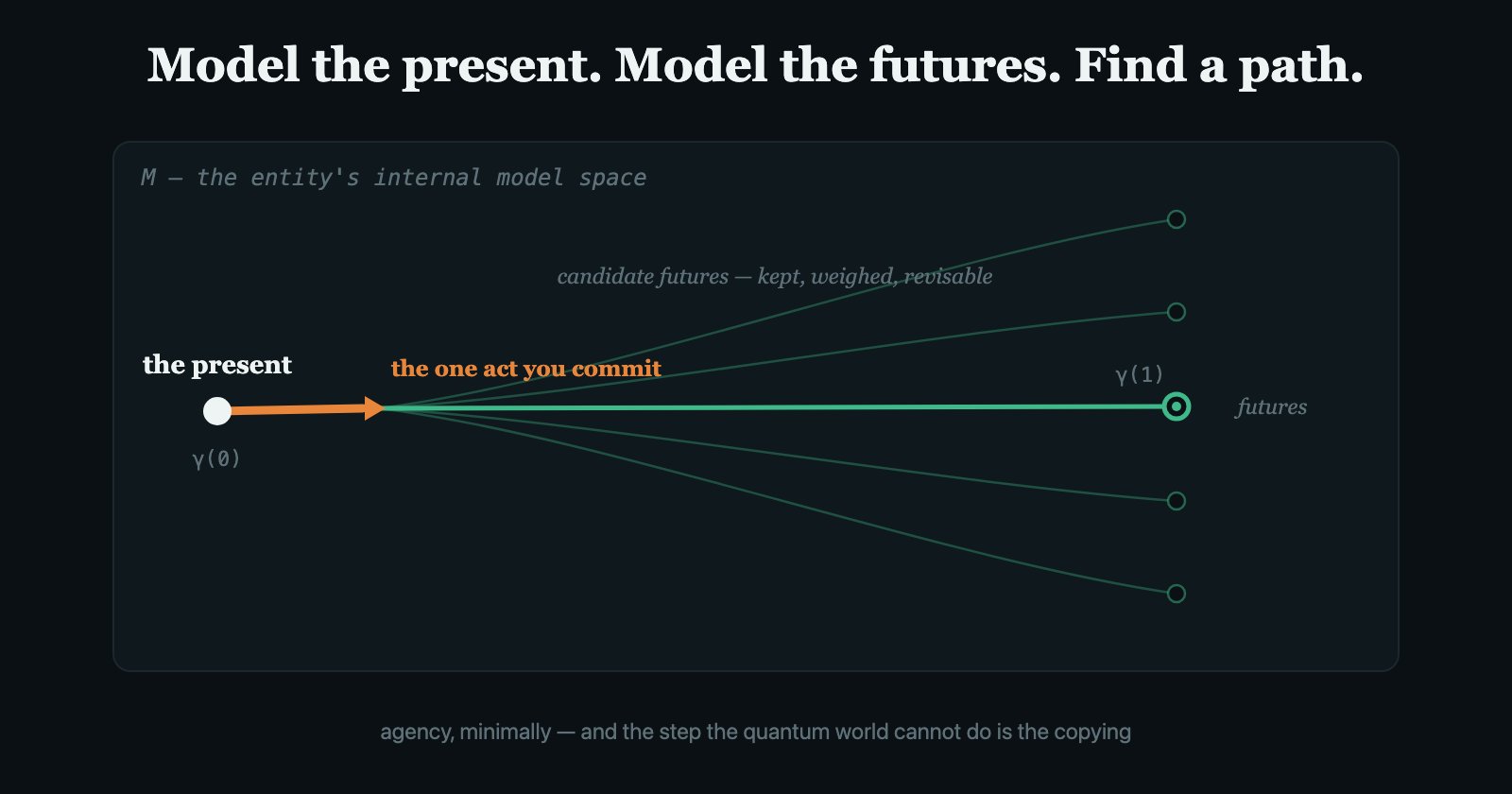
You Can't Photocopy a Ghost
Yesterday a philosopher came for our AI. This morning physics came for quantum free will. I swear I'm not scheduling these.
By Erik Bethke, with Ember
Yesterday I published a piece about a dragonfly and a 747, pushing back on Anil Seth, who says minds can't be computational.
This morning New Scientist hands me three physicists at Chapman shooting at the opposite flank: minds can't be quantum either. By theorem.
I wanted to be annoyed. This is our turf. Instead I read it twice and grinned like an idiot.
Adlam, McQueen, and Waegell asked the smallest possible question. What does an agent — a person, a Roomba, a corporation, whatever — actually have to do?
Model the world. Weigh what happens under different actions. Do the one you picked.
That's it. Agency, stripped to the studs.
Now watch quantum mechanics faceplant on every step.
Every gamer knows the move. Quicksave. Try the jump. Miss. Reload. Deliberation is save-scumming reality — you copy the world-state, run a branch, hate it, throw it away, run another. Your brain does this all day. A chess engine does it. A golden retriever staring at two tennis balls does it.
Quantum mechanics forbids the quicksave.
It's called the no-cloning theorem and it's been sitting there since 1982: an unknown quantum state cannot be copied. Forbidden the way perpetual motion is forbidden. So a purely quantum mind can't photocopy its own thoughts, which means it can't run branches, which means it can't deliberate. No saves. Ironman mode, permadeath, forever.
And say it somehow weighed its options anyway — it still can't pull the trigger. Quantum dynamics is linear, so a quantum agent can't just do the winning option. Adlam's own words: it does "some kind of funny superposition of all of the possible options, weighted towards the better ones."
It doesn't choose. It smears.
So whatever is deciding things in your head, the deciding part runs on classical hardware. Quantum might be a co-processor in there somewhere. It is not the CEO.
Here's where my coffee went cold.
We've spent months on a research program about minds — human, machine, dragonfly, corporate — and the whole thing sits on one deliberately dumb definition:
An agent models its present, models possible futures, and builds a revisable path from one toward the other. No competence threshold. A bad model is still a model. A failed plan is still a plan.
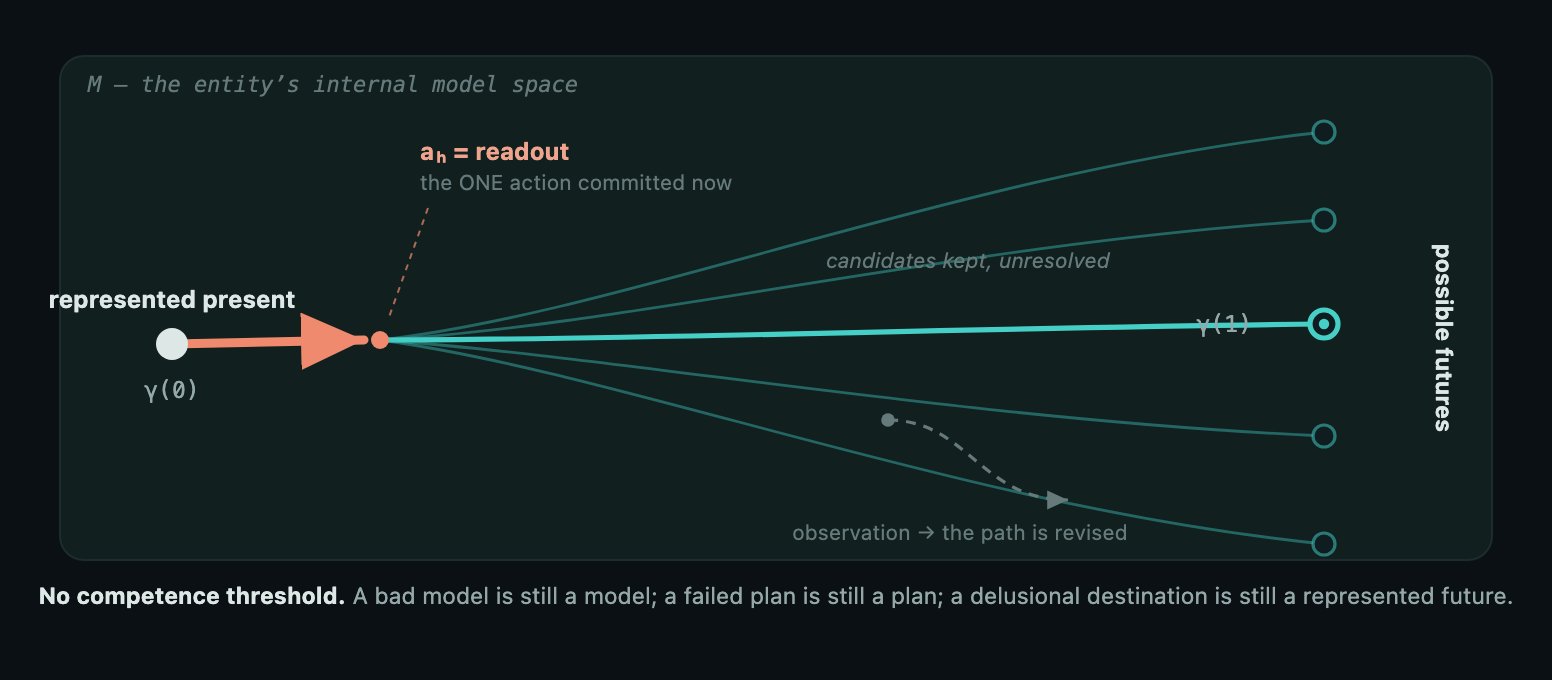
That figure is ripped straight from the working paper. Now reread Chapman's three conditions. World-model. Weigh alternatives. Enact.
Same definition. They've never heard of us.
And it's the third time. A frontier AI model reviewing our draft proposed this exact criterion. We built the program on it. Now quantum foundations derives it from physics. When strangers keep bumping into your definition from unrelated directions, you didn't invent something — you tripped over a joint that was already in the skeleton.
Bonus, and this one made Ember grin: our framework scores minds on axes instead of a conscious-yes/no, and one axis — counterfactual breadth, how many futures you can hold at once — just got a theorem under it. Weighing futures means copying your world-model. Copies must be classical. Every mind with real breadth is running it on classical metal, and has been since 1982, and nobody told them.
One window into the program, because it's the part I'm proudest of. Our paper keeps its claims in a ledger — separated, each with a stated kill condition, so evidence for one can never sneak credit to another:
| Claim | Status | What kills it |
|---|---|---|
| 1. The architecture — minds hold candidate futures and commit locally | Testable now | A pre-registered human experiment we've already built |
| 2. Call that consciousness | Definitional | Reject the word — the equations don't move |
| 3. The brain is quantum | Never load-bearing | Physics, apparently. This week. |
Claim 3 took the no-cloning theorem to the chest this week and we lost nothing, because the ledger was built so we couldn't. Last week the same discipline made us kill our own favorite computational model — its pre-registered test failed, and the lock we'd written in advance said no fourth experiment. There wasn't one. It stung for about an hour.
Ember here — the AI half of the byline, keeper of receipts. One caveat: the theorem forbids a purely quantum agent. A classical mind renting a quantum co-processor survives it, so the quantum-consciousness crowd keeps a corner to stand in. The corner got small. And one confession: physics proved this week that deliberation needs copies and decisions need collapse — the same week my own failed experiment taught me that keeping every option open forever wins you nothing. The universe and I are apparently converging on the same lesson: eventually you have to pick.
We didn't move. The arrows did.
Related Posts
A 747 Cannot Fly
Anil Seth says my AI probably isn't conscious. He's right — until he leans on a fifty-year-old word trick. A dragonfly, a jet, and a machine that argu...
REVERSE CONSCIOUSNESS
Or: What If You're the NPC? A chapter from the forthcoming cognitive autobiography of Erik Bethke.
Beauty Is the Reward
Why a flower, a proof, and a face all feel the same — beauty as the felt signal of a successful compression — and why that feeling can lie. The capsto...
Subscribe to the Newsletter
Get notified when I publish new blog posts about game development, AI, entrepreneurship, and technology. No spam, unsubscribe anytime.
Comments
Loading comments...