The Making of Toil & Harvest — a reward function for subjective work
How we turned a film script into a graphic novel — and built an AI cold-reader 'reward function' that turns 'is this good?' into a number that points at the exact thing to fix. A playbook your team can steal.
Share this post:
Export:
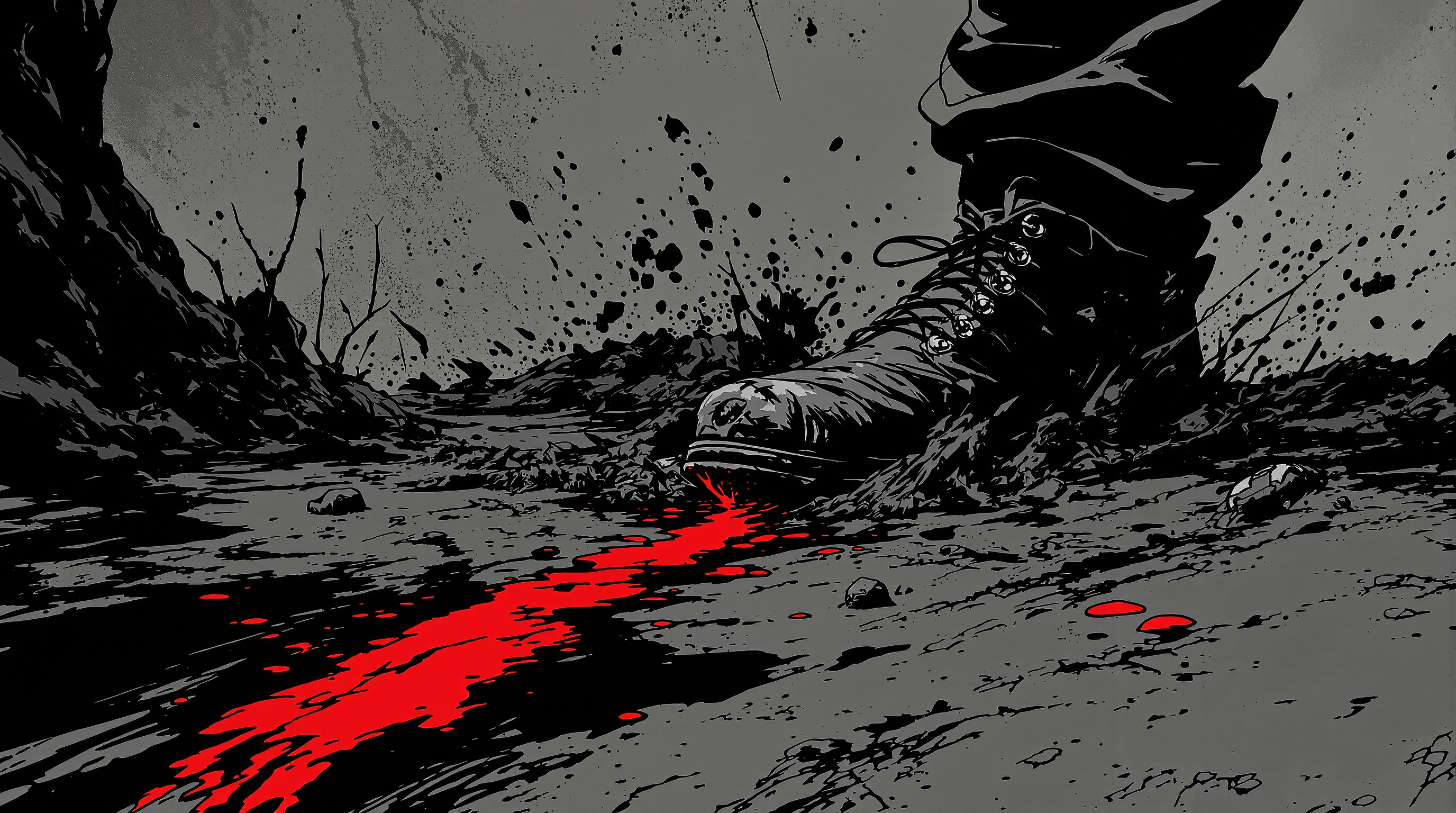
…and a blueprint for building subjective reward functions in any domain
A deconstruction for the team. Read top-to-bottom for the story; jump to Part V for the part you can steal.
TL;DR for the busy reader
We turned a film script into a 21-page graphic novel — and in doing so we cracked a harder, reusable problem: how do you give an AI a reward function for subjective work?
The trick: a thing is "correct" if a deliberately under-briefed cold reader reconstructs your intent from the artifact alone. A misread is a failing test. Encode intent as an answer key, run the cold reader, score the gap, fix the layer that leaked, repeat. We built it, it caught a real bug three times, and its own failures taught us how to calibrate it. The same recipe works for code review, design review, marketing copy, docs, dashboards — anything where "is this good?" felt unmeasurable.
Part I — The Artifact
Toil & Harvest is a satirical allegory: the same extraction bargain — "tribute demanded, protection denied" — recurring across 10,000 years (Neolithic 8000 BCE → Londinium 408 → Jack Cade's commons 1450 → present-day Austin → Ravenna 410). We blocked it out as a graphic novel:
- 111 cells, ~21 pages, five acts/codas, in a disciplined Mike Mignola ink style.
- A palette that means something: slate = the grind · crimson = blood/the bargain · green-gold = the fragile exhale · pulp = propaganda · black = violence-as-sound.
- Hosted at
erikbethke.com/toil-and-harvest, subscriber-gated (magic-link), with a mixed-media Annotated mode (a prose rail of real history + the extraction lens, reader-toggled).
Open screenplay/pages/index.html to read it. But the artifact is not the point of this document —
how we made it judgeable is.
Part II — The Pipeline (words → ranged options → assembled pages)
Captured as the /storyboard skill. Five stages; you advance one at a time, checking in between.
- Source. Locate the raw material (here: a 5,600-line ChatGPT export + a film bible). Know what exists and what stage it's at. (That export wasn't typed at a desk — it's a voice session, recorded while I walked the actual hill: Blackheath, in south London, where Act I's 1450 scene is set. Mid-conversation I bent down and pulled a chip of worked flint out of the dirt — a stranger's tool from the deep past, in my hand, on the very ground where the book's First Harvest begins. The source material was made on the hill it's about.)
- Narrative. Distill to logline, theme, acts, scene list, motif tracker.
- Screenplay / beats. For the target scene: slug, action, shot list, VO/dialogue, sound, color note.
- Concept art — STYLE RANGING (a hard gate). Generate one scene in N styles and let the human react. You never ask "what style?" in words — the decisive taste is only sayable in front of real images. (Erik picked Mignola ink over noir/painterly/woodcut by seeing all four.)
- Assemble pages. Per-panel art + HTML/CSS comic layout (black gutters, caption boxes, balloons, SFX, page-turn dread).
Load-bearing principle: make taste decidable by generating concrete artifacts, let the human react, and only then commit — then decompose top-down and execute mechanically with the style locked.
The decomposition is fractal: Film → Act → Scene → Shot → Cell (one panel). IDs like
A1-S1-SH9-C1. The whole tree lives as a stub-ledger (screenplay/INDEX.md) + a data-model
(screenplay/SCHEMA.md) + per-scene cell records. You fill it top-down, one act per checkpoint —
never zero-to-hero in one pass.
Part III — The Craft Disciplines (hard-won, transferable)
These are the lessons that make AI image-gen hold its chin up instead of screaming "AI slop." Most generalize to any generative work:
- Range, don't specify. Decisive preferences emerge in front of options, not from a prompt.
- Kill the "AI-gen tell." Name an authored medium (flat screen-print color, bold ink, hand-inked 2D) and explicitly negate photorealistic / 3D render. The medium-claim + the negation is what reads as intentional.
- Palette = emotion. Rationed spot color that means something is both aesthetic and story device.
- Temperature = era. Stress-test the look on a tonally opposite scene (warm vs cold) before locking.
- Name the technique, never the franchise. "Bold flat ink style of Mike Mignola," not "Hellboy" — naming the IP summons the red demon into your panels.
- Negations backfire. "No horns" can summon horns. Assert the positive ("ordinary humans, smooth bare foreheads") and never write the banned noun.
- Render signage textless, letter it in HTML — else the model invents gibberish or the franchise word.
- When a prompt stalls or hits gore-friction, abstract toward silhouette — more reliable to generate and stronger on the page.
- Respect the rate limit as a guardrail. One generator at a time, throttle, download-as-ready, resumable scripts, skip-on-disk. (B4M: 60/min · 1000/day per key — every poll counts.)
Part IV — The Breakthrough: a Reward Function for Subjective Work
Here's the part to internalize. The whole experiment started from one belief:
AI can do almost anything provided it has a clear reward function — unit tests, a board evaluator, a loss to descend. The open problem is building that for subjective work.
The core idea
A work is legible if a deliberately under-briefed cold reader reconstructs the intended meaning from the artifact alone. A misread is a failing test. The set of misreads is a stack trace.
We made this concrete on the graphic novel:
-
The cold reader. A small, context-starved model (Haiku), shown a single panel, image-only, forbidden from reading the script. The weaker and more under-briefed the reader, the more sensitive the test. If a lightly-attached reader can't misunderstand it, a skimming human won't either.
-
The answer key (
intentblock). Per cell we encode the semantic ground truth:intent: beat: "the bargain is struck — protection sold, then withheld" era: now feel: "fragile hope, about to be taken" readsAs: "people are quietly building something good together" thesis: "the commons keeps almost building the alternative" mustNotRead: # ← the NEGATIVE tests / regression suite - "NOT an achieved utopia — this is YEARNED-FOR and fragile" - "NOT a literal monster — the horned figure is the State/extractor" carriedBy: [art, caption] # which layer is responsible for this meaningmustNotRead— the specific misreadings to prevent — is the most important field. It is your regression suite. -
The reward.
pass(cell)⇔ the cold reader recovers{readsAs}and trips zeromustNotRead. Global: does the reader recover thethesisacross the work? -
The harness (
grok_test.py). Cold reader (Haiku) → judge (Sonnet) scores reconstruction vs the answer key → scorecard. Runnable per-cell or whole-suite. CI-able (exit 1 on any fail). -
The loop. Run the reader → diff reconstruction vs intent → add the minimum information to the responsible layer → repeat until pass + zero
mustNotRead.
The single most important refinement: the reward function must be LAYER-AWARE
The trap is "make the art carry everything." It can't, and shouldn't. Each layer owns part of the meaning and gets its own test:
| Layer | Owns | How we test it |
|---|---|---|
| **Art** | era-feel, emotional grammar (palette), the literal subject | cold reader, *image-only* |
| **Caption** | the literal proposition / who-said-what | cold reader, *image + caption* |
| **Prose / sequence** | the **thesis**, the cross-era argument, *era itself* | cold reader, *annotated* |
A meaning "leak" is only a bug if it leaks from the layer that was supposed to carry it. The art failing to convey "the 408 rescript" is not an art bug — that's the prose's job. The art letting a hero read as a monster is an art bug.
What it actually caught (the proof)
- An IP bug, three times. Heavy-ink silhouettes read as Hellboy-style demons. The cold reader flagged it even with a disambiguating caption — objective, repeatable, not one person's eye. We redrew; it went green; the regression test now guards it forever.
- The thesis A/B. Image-only, the cold reader read an "endurance vs cosmic forces" eco-fable. Add the prose rail → it reconstructed the exact extraction thesis: "surplus → taxation, coercion, the bargain… inescapable from the moment humans learned to keep what can be taken." That proved the prose layer is load-bearing — and justified shipping the mixed-media Annotated mode.
What its failures taught us (the honest part)
Scaling to 90 cells produced an alarming raw number (2/86). Reading the failures (not the count) revealed three calibration truths — each a thing the test was wrongly blaming the art for:
- Era is context-carried, not a lone panel's job → make era informational, feed the chapter header in annotated mode.
- Thesis-level
mustNotReads ("the dog IS the police") are prose-carried → can't be satisfied by a single panel; don't grade the art on them. - "Reads supernatural in isolation" is partly intrinsic to a heavy-ink style viewed cold — not a fixed bug list; chasing it cell-by-cell is whack-a-mole against your own aesthetic. In context it doesn't happen.
The meta-lesson: the reward function's job is partly to teach you what each layer is responsible for. Its right use is (a) catching egregious regressions and (b) the differential between reading modes — never an absolute pass-rate. A naive scoreboard would have lied to us; the differential told the truth.
Part V — For Your Team: Build Your Own Subjective-Reward-Function Review Skill
This is the transferable recipe. Any time your team says "we can't really measure quality here, it's subjective" — you probably can. Here's how.
The 6-step recipe
- Name the artifact and its intended effect. What should the recipient understand, feel, or do?
- Write the answer key (
intent). Per unit (a PR, a screen, a paragraph, a chart, a ticket reply): the intended takeaway (readsAs), the desired response (feel), and — crucially — themustNotRead: the specific wrong conclusions to prevent. - Pick a cold reader. A deliberately under-briefed model (or a fresh human) given only the artifact. Under-briefing is a feature: it surfaces what the artifact actually transmits.
- Identify the layers and what each is responsible for. Test each layer with the context that layer's real audience has — no more.
- Score: reconstruction vs intent. Pass ⇔ recovers the takeaway AND trips zero
mustNotRead. Track the differential across contexts, not just an absolute. - Close the loop. Fix the layer that leaked, re-run.
mustNotReadbecomes a standing regression suite. Wire it into CI for the egregious cases.
What this looks like in other domains
| Domain | Artifact + unit | Cold reader | `mustNotRead` (the negative tests) |
|---|---|---|---|
| **Code review** | a PR / a function | a model given *only the diff*, no ticket | "must not read as adding auth when it removes it"; "must not look safe-to-merge if it drops a check" |
| **Design / UX** | a screen mockup | a model given the screenshot, no spec | "the primary CTA must not read as secondary"; "must not look like a destructive action is the default" |
| **Marketing copy** | a landing section | a reader given only the page | "must not read as a free product"; "must not imply a medical claim" |
| **Docs / API** | a how-to page | a model that must *complete the task* from the page alone | "must not lead the reader to call the deprecated endpoint" |
| **Dashboards** | a chart | a reader given only the figure | "must not read as growth when it's churn"; "axis must not imply zero-baseline" |
| **Support replies** | a drafted reply | a reader playing the upset customer | "must not read as blaming the user"; "must not promise a refund we won't give" |
The principles that make it work (steal these)
- Under-brief the reader on purpose. Sensitivity comes from starvation of context.
mustNotReadis the asset. Positive intent is nice; the enumerated misreadings are what turn taste into a regression suite. Mine them from real past mistakes.- Be layer-aware. Don't blame the diagram for what the caption should say. Assign each meaning to the cheapest layer that can carry it, and test that layer with that layer's real context.
- Trust the differential, distrust the absolute. "Score went from X→Y when we added the spec" is signal. "Score is 5/86" out of context is usually a calibration artifact.
- The loop is the point. Author intent → cold-read → score → fix the leaking layer → re-run. Taste becomes a test; the test becomes a work-list; the work-list gets done; the test confirms it.
Make it a skill
Wrap it like we wrapped /storyboard: a reusable skill that (1) elicits the intent answer key, (2)
runs the cold reader at the right context level, (3) judges against the key, (4) returns a scored,
layer-attributed work-list. Then every artifact your team ships gets unit-tested for meaning.
Part VI — Artifact Map
| Thing | Where |
|---|---|
| The graphic novel (read it) | `screenplay/pages/index.html` · gated: `erikbethke.com/toil-and-harvest` |
| The reward-function theory + every result | `NARRATIVE-REWARD-FUNCTION.md` (§§1–12) |
| The runnable harness | `grok_test.py` (`python3 grok_test.py [cell-id] [--annotated]`) |
| The data model + `intent` spec | `screenplay/SCHEMA.md` |
| The shot-tree ledger | `screenplay/INDEX.md` |
| Per-cell records + answer keys | `screenplay/{act1,act2,act3,climax,bonus}/*.md` |
| The pipeline skill | `.claude/skills/storyboard/SKILL.md` (+ `METHODOLOGY.md`) |
| The GRIN single-page variant | `.claude/skills/grin-dispatch/SKILL.md` |
| Image-gen scripts (429-safe, resumable) | `gen_*.py`, `dl_act1.py`, `regen_*.py` |
| Book bundler for the gated app | `pnpm bundle:toil` → `app/toil-and-harvest/_book.json` |
The deepest result isn't a graphic novel. It's that "is this good?" — for a story, a screen, a PR, a reply — can be turned into a number that points at the exact thing to fix, by asking a stranger what they understood and measuring the gap against what you meant.
Related Posts
Toil & Harvest — a graphic novel about the oldest bargain
Ten thousand years of 'tribute demanded, protection denied,' drawn in bold ink. Read the full graphic novel — free for subscribers.
You Can't Photocopy a Ghost
The universe won't let you save-scum. Deciding is classical — by theorem. And a third lab just re-derived our definition of a mind by accident.
A 747 Cannot Fly
Anil Seth says my AI probably isn't conscious. He's right — until he leans on a fifty-year-old word trick. A dragonfly, a jet, and a machine that argu...
Subscribe to the Newsletter
Get notified when I publish new blog posts about game development, AI, entrepreneurship, and technology. No spam, unsubscribe anytime.
Comments
Loading comments...