Norway With GPUs: How Hyperscalers Are Running the Cleanest Macro Trade on Earth
Share this post:
Export:
We're busy arguing about AI models and chatbot personalities.
Meanwhile, a handful of hyperscalers are running one of the cleanest, largest macro trades in history—out in the open—under the label "data center capex."
The trade is simple:
- Long: scarce, inflation-sensitive infrastructure (power, land, compute, fiber)
- Short: the future purchasing power of major currencies via cheap, long-dated, nominal debt
- Levered long: AI demand as a call option on top
And they're doing it with the discipline and time horizon that most governments only role‑play in speeches.
This isn't just "spending on AI." It's sovereign‑level capital allocation with a friendlier UI.
1. Hyperscalers as Post‑National Sovereigns
Look at the major cloud/AI platforms the way you'd look at a state, not a company.
They already have the equivalents of:
A tax base
They don't just sell products; they collect taxes on digital life:
- Per‑seat licenses
- Cloud usage
- API calls
- App store cuts
- Ad spend
If you want to operate in the modern economy, you pay these taxes.
Choice of currency
They choose the currency of taxation.
They can reprice in:
- USD, EUR, JPY, local fiat
- "Credits," "points," "seats," "API units" — synthetic currencies inside their own ecosystems
If one fiat looks unstable, they move the billing base. If inflation spikes in a region, they tweak pricing tiers.
Governments take years to change tax codes. Microsoft can change its effective tax rate on the global economy with a pricing update.
Reserve‑asset equity
Their equity functions as a global reserve asset:
- Highly liquid, index‑embedded, institutionally owned
- Used as acquisition currency and employee comp
- Treated as quality collateral by markets
Sovereign‑grade credit
They issue long‑dated, investment‑grade debt at very tight spreads.
Give me a straight choice between:
- 20‑year Japanese government bonds, and
- 20‑year Microsoft paper
I'm taking Microsoft.
Japan is a shrinking, over‑indebted state with a collapsing population and a political system that can't adjust quickly. Microsoft is a global software and cloud monopoly that can re‑denominate and reprice its "taxes" in whatever currency of the day it wants.
Call one "sovereign" and one "corporate" if it makes you feel better. In practical credit terms, the labels don't mean what they used to.
2. The Trade: Short Future Dollars, Long Real Infrastructure
Strip away the marketing decks. Here's the balance‑sheet move:
-
Borrow in cheap nominal dollars
- Issue long‑dated bonds at low fixed rates.
- Or redeploy surplus cash that is otherwise melting in real terms.
-
Convert that into scarce, long‑lived infrastructure This isn't just "servers":
- Gigawatt‑scale data centers
- Long‑term power PPAs and, increasingly, generation assets
- Land, substations, transformers, cooling systems
- Fiber backbones, subsea cables, network interconnects
- Long‑horizon GPU/accelerator supply and custom silicon
-
Repay in future dollars that are likely worth less The liabilities are nominal. The assets are tightly linked to:
- Power prices
- Land scarcity and permitting bottlenecks
- Replacement costs (steel, copper, chips, labor)
- The centrality of compute to everything else
-
Monetize via AI and cloud demand they can largely manufacture
- Launch AI services, copilots, APIs, "AI‑native" everything.
- Pull enterprises and developers into their stack with tooling and integration.
- Make the best features only available on the latest hardware, in the newest regions.
If you believe:
- Fiscal deficits are structural, not temporary
- Central banks will accommodate, one way or another
- Long‑run debasement of major currencies is a feature, not a bug
- Digital demand, especially for compute, outgrows GDP
…then this isn't a wild gamble.
It's the obvious trade:
Turn today's overvalued currency and cheap debt into tomorrow's choke points.
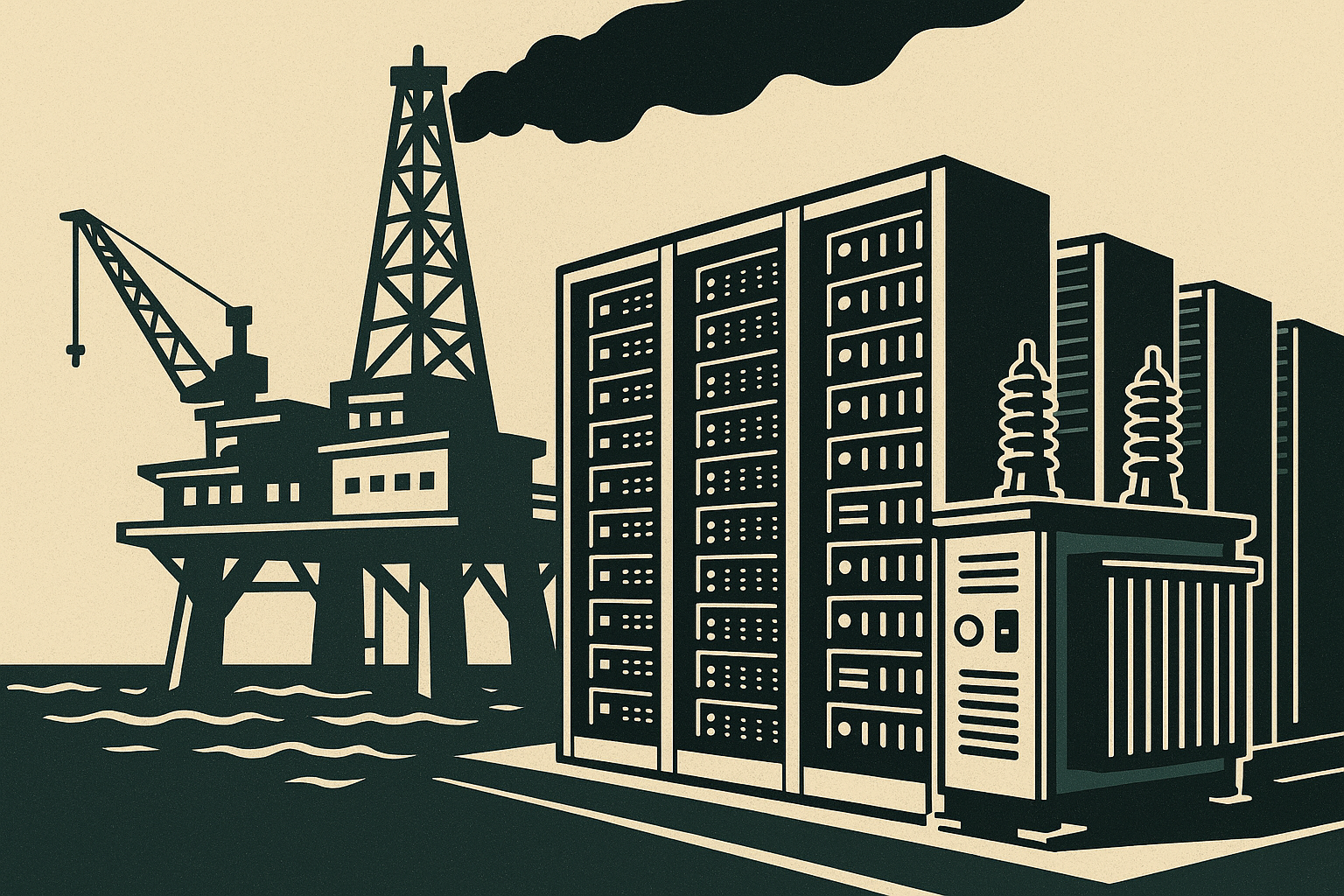
3. Norway With Oil, Hyperscalers With GPUs
Norway is the clean analogy.
Norway got:
- A finite but enormous oil‑and‑gas windfall
- The choice to:
- Blow it on consumption, or
- Convert it into durable assets that outlast the wells
They chose:
- A sovereign wealth fund
- Conservative reinvestment
- Long‑term infrastructure and a permanent income stream
Now look at hyperscalers:
- They have a finite but enormous window of excess profit and equity premium
- Network effects, data moats, soft monopolies
- Regulatory capture‑lite
- AI narrative support in public markets
They could:
- Max out buybacks and dividends
- Buy marginal companies
- Sit on cash that loses real value
Instead, the interesting part is:
- Gigawatt data centers
- Power deals at national‑utility scale
- Owning or co‑owning chip capacity and custom accelerators
- Owning or steering critical network fabric
- Locking ecosystems into their infra for decades
That's the Norway move:
Take the windfall, turn it into infrastructure that will throw off cash and power long after the initial advantage should have decayed.
They are building the digital equivalents of ports, rail, and grids—just privately owned, not public works.
4. Why This Is Not Normal Corporate Capex
Most corporations are not in this game. They can't be.
They lack:
-
Cheap, deep, patient capital Their bonds don't trade like quasi‑sovereigns. Their equity isn't a reserve asset.
-
Control over demand They can't force workloads, traffic, or behavior onto their own infrastructure at global scale.
-
Platform leverage They're price takers in power, compute, and bandwidth, not price makers.
-
Regulatory positioning No one calls their facilities "critical infrastructure" or invites them to co‑write national AI strategies.
So when a typical firm builds a factory or facility, they're exposed to the business cycle. Demand drops, they eat the fixed cost.
When a hyperscaler builds another 500MW region, they can:
- Push workloads into it through pricing and product defaults
- Shift AI training and inference onto the latest hardware there
- Incent developers and enterprises to use that region with discounts and tooling
They are not hoping demand appears. They are manufacturing the demand surface.
5. Terminal Debasement: Why Not Being Able to Print Is a Strength
In the old textbook, the sovereign superpower was:
"We can print our own currency, so we can never default."
In a terminal debasement regime, that flips.
- A state can always pay in its own units.
- But if those units are melting, "we can always print" really means:
"We can always transfer the loss to anyone holding our money or bonds."
Hyperscalers can't print USD or JPY. And that's an advantage.
They don't need a central bank. They have:
- A global, diversified tax base on digital activity
- Freedom to re‑denominate and reprice in whatever units still matter
- A balance sheet filled with real infrastructure instead of piles of domestic bonds
In practice:
-
If fiat muddles through with mild debasement:
- Their nominal revenues rise, real assets appreciate, and their cheap debt stays cheap in real terms.
-
If debasement accelerates and currency regimes get weird:
- They don't care what logo is on the unit.
- They rebase pricing to something that holds value.
- They keep taxing digital life in whatever currency users and CFOs actually use.
They don't need to print. They just need to stay upstream of human behavior and enterprise workflows.
Heads: fiat limps along. Tails: fiat melts faster. Rim: the monetary system fragments.
In all cases, the pattern is the same: hyperscalers still get paid.
6. Snow Crash, But Boring and Real

Snow Crash imagined corporations carving up reality while states decayed into background noise. Stylized, sure—but the core idea was:
- The real power sits with whoever owns the infrastructure and protocols that life runs on.
We're in the dry, mature version of that:
-
Energy Hyperscalers are among the biggest, most sophisticated power buyers on the planet. Their data center footprints influence where new generation gets built and how grids evolve.
-
Compute and AI The real "public works" of this cycle are training runs, data centers, and AI‑serving infrastructure. They define the practical limits of what's possible.
-
Networks Subsea cables, fiber backbones, peering, edge locations—more and more of the physical network is designed around hyperscaler needs, not neutral public planning.
-
Identity and work Identity, documents, code, communication, and workflows all live inside their clouds.
So when they execute this macro trade—short future dollars, long real infrastructure, AI on top—they're not just juicing EPS.
They are locking in control of the physical substrate for whatever replaces the current economy.
Most people simply don't believe the current economy will be replaced. That's their blind spot.
7. Who Pays?
Every clean trade has a counterparty.
Here, the counterparties are:
-
Bondholders
- Lending at low nominal rates in a world of structural deficits and inflation risk
- If debasement runs hotter than expected, they eat the real loss
-
Ratepayers and local grids
- Grid upgrades and new generation often get justified by data center demand
- Households and smaller businesses may effectively subsidize infrastructure serving a single hyperscaler region
-
Governments
- Outsourcing digital and AI capacity to private infra instead of building public or national stacks
- Coming back later to negotiate from a position of dependence
-
Everyone else in tech
- Competing for GPUs, power, land, and talent at the margin
- Building on someone else's rails, paying the platform tax
In exchange, we get convenience, "innovation," and a lower visible public bill.
The transfer is quiet:
- From holders of melting nominal claims
- To owners of the infrastructure that everything now depends on
8. "They All Went Crazy at Once" Is the Cover Story
Turn on financial TV or read the think‑pieces and you get the same script:
- "Is this an AI bubble?"
- "Are hyperscalers overspending on capex?"
- "Will they regret these massive data center investments?"
Even the hyperscalers play along, a little wide‑eyed about "trillions" in AI investment. Sam Altman is treated like a cartoon character for saying the quiet part out loud.
We're supposed to believe that:
- The CEOs and CFOs of Microsoft, Google, Meta, Amazon, Oracle
- Plus the leads at OpenAI, Anthropic, xAI, and others
- Plus the boards, audit committees, and major institutional shareholders behind them
…all simultaneously fell on their heads and decided to make the same catastrophic, bone‑headed capex bet at the same time.
C'mon.
These are the most profitable, data‑rich, optimization‑obsessed institutions on the planet. Their entire culture is:
- Measure everything
- Backtest everything
- Stress‑test tail risks
- Instrument demand, pricing, and cost of capital to the inch
You don't get trillions of dollars of coordinated "oops" from that crowd.
What's actually happening:
-
The "AI bubble" narrative is a useful distraction:
- It frames the buildout as maybe irrational or frothy.
- It keeps the conversation on hype cycles instead of structural power.
-
Hyperscalers are happy to let Sam Altman look like "the crazy one":
- His "we need trillions" comments make him sound reckless.
- In reality, he's just saying out loud the scale of the physical build everyone else has already quietly signed up for.
-
Media and elites lean into the bubble story because:
- It fits the dot‑com / housing / crypto template.
- It avoids admitting this is a durable shift in who owns the core infrastructure of the 21st century.
The idea that the largest, most sophisticated companies in history are all just over‑excited and making the same naive bet is an insult.
They're not stupid. They're not blind. They see:
- Structural fiscal deficits
- Long‑run debasement of major currencies
- Rising difficulty in building real infrastructure (permitting, NIMBY, supply chains)
- A secular shift of all activity into digital and AI‑heavy workflows
Under those conditions, "spend hundreds of billions on power, land, compute, and networks, financed with cheap nominal debt" is not a bubble.
It's the only rational move if you sit where they sit.
The AI hype is the story. The macro trade and the power grab are the plot.
9. So What?
If you're not a hyperscaler, you are living inside someone else's industrial strategy.
Your options:
-
Ignore it
- Rent capacity.
- Pay the tax.
- Hope you're never important enough to be rate‑limited.
-
Fight it
- Build infra yourself.
- Accept lower margins and slower scale.
- Usually suicidal at small scale.
-
Exploit it
- Understand where they can't or won't go.
- Build in the gaps, around the edges, and above the abstraction layers they can't own.
- Use their infra while keeping your strategic core elsewhere.
But first: see the board clearly.
This is not just an "AI arms race" or "data center boom."
It's a deliberately elegant macro trade:
- Long: power, land, data centers, chips, ecosystems
- Short: the future purchasing power of major currencies
- With AI as leverage on top
Executed by entities that look less like companies and more like post‑national sovereigns.
We are not in a fun cyberpunk future. There is no neon katana in this story.
Just balance sheets, power contracts, and the quiet, compounding conversion of melting money into the backbone of the world.
Giggles.
Related Posts
The Real AI Fight: Stop Helping the Hyperscalers Win
Cory Doctorow wants you to put down the most powerful cognitive amplification tool humanity has ever created. He's not just wrong - he's helping the h...
Open the Dossier: The Fortune 500, Decision by Decision
A new public dataset: 2,927 major decisions across 478 Fortune 500 companies, each sized from the company's own filings and backed by a published case...
Folders Are All You Need
Agent loops are real, but they need verifiers you do not have. A long field guide for everyone who is not a software engineer: the folder, the termina...
Subscribe to the Newsletter
Get notified when I publish new blog posts about game development, AI, entrepreneurship, and technology. No spam, unsubscribe anytime.
Comments
Loading comments...