Fighting Bots in the Age of Play-to-Earn
By Erik Bethke, GM Games & Founder at Million on Mars
Share this post:
Export:


Fighting Bots in the Age of Play-to-Earn
By Erik Bethke, GM Games & Founder at Million on Mars
People have been cheating at games since games were invented. In the modern age, sometimes those people control bots — pieces of software that automate playing a game in order to glean rewards for their owners.
At first blush, it might seem that bots shouldn’t matter in games. People seek out playing against bots sometimes — playing chess against a computer, for example. However, games that include bots by design allow players to set the difficulty level they are playing against. An online chess game that you played, against a bot that was consistently tuned at the level of the best chess player in history, would be a very frustrating game, and you would probably tire of losing quickly. That’s the experience that unauthorized bots force on players in multiplayer online games.
Botting Hurts Game Economies
When too many bots are present in a game, the experience is degraded for all human players. For example, if your game is built on a REST architecture, your endpoints are discoverable, and a bot network might hit certain endpoints programmatically, denying other players access to the same features or benefits. They accumulate resources and currency faster than human players, dumping them back into the in-game economy and trashing the natural balance of supply and demand.
The Problem is Worse in Play-to-Earn
Play-to-earn (P2E) is a new category of games that are on the blockchain, allowing players to buy and sell NFTs used in gameplay, and earn cryptocurrency. The model is similar to free-to-play (F2P) games. In F2P, players start for free and are offered a variety of in-app micro-transactions some cosmetic, some collectible, some unlock new skills, and others simply speed play. In F2P games there is a natural economy arbitrated between the time-rich players and the payers. In P2E, the tradeoff between time and money is the same, but players start by investing in NFTs, and when they reach the obstacles that require time or money, they can pay the developer for resources or other players directly. And, while players have long been creative about selling the fruits of their gaming labor via selling accounts, etc, in P2E the ability to cash out and reinvest is directly supported, on distributed exchanges (DEX) for currencies, and in NFT marketplaces.
Because of this very liquid resale market, P2E attracts bots more than other styles of gameplay. Even worse, the impact of bots on P2E economies is more severe: players may be frustrated by a trashed economy for their virtual goods in a F2P game, but in a P2E game they may risk losing their initial investment in NFTs, which can be substantial.
A healthy P2E game is an online multiplayer game that:
- provides one or more gameplay systems;
- that players are able to contest for prizes;
- that ultimately have some sort of value;
- that can be recognized on the blockchain;
- and exchanged for another coin.
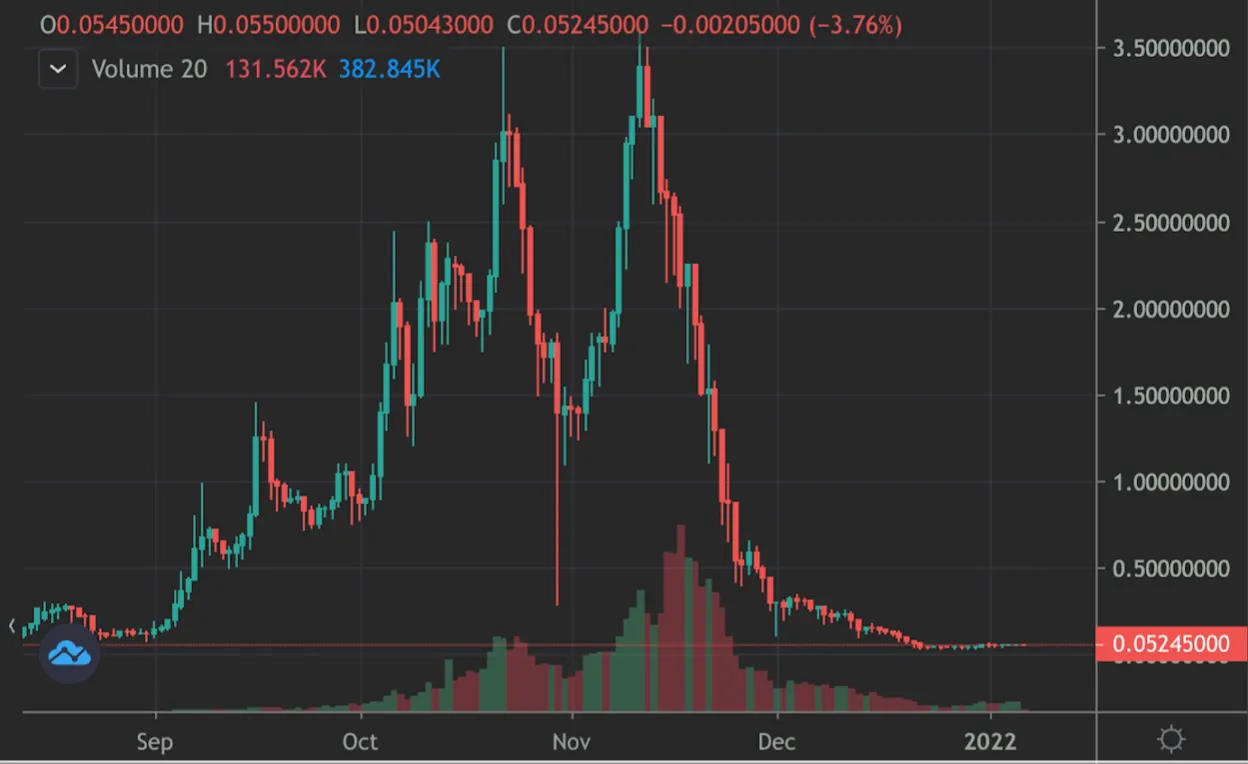
Bots attack every part of that value chain for humans, by unfairly accumulating large balances of currency through optimized gameplay in one or two areas, dumping that currency into a DEX, thus deflating the value, and removing all incentive for other players to work and grow the economy.
Bots are the dirty secret of P2E right now, which is why the currency value of most P2E games, post-launch, looks like this:
It’s still a pump-and-dump, even if it wasn’t intentional.
Techniques to Combat Botting in a Play-to-Earn Economy
The good news is that P2E also provides new opportunities for developers to combat bots in their games. Every player’s activity is tied to their crypto wallet, and all actions they take are publicly viewable on a blockchain ledger. At Million on Mars®, our game is on the WAX blockchain, so the tools listed below are all relevant for that chain. Similar tools exist for other blockchains as well.
Human Verification Up Front
There are a growing set of tools to help verify humans on the blockchain before they even start playing. The Million on Mars team uses honeycomb as a service in our Discord to verify player wallets. Combined with actual interaction with the player behind that wallet in our community, we can be confident about that player’s humanity. We automate whitelisting of our verified players to make available to them our best and first NFT drops.
Automation to Flag Suspicious Accounts
It’s a never-ending task to eliminate all bots in a game, but there are additional things you can do to find them in your player base before they can cause damage. At Million on Mars, we have a proprietary bot scoring algorithm that periodically scans player accounts and sends a list of suspicious accounts to our Player Experience (PX) team for investigation.
I don’t want to get too specific on how we do this and tip off the bad guys, but we look at a number of factors on a player account and assign a “humanity score” to each account. Accounts with very low humanity are flagged for investigation. Factors that affect the humanity score include the age of the account, number of NFTs for our game and other people’s projects that are held by the wallet, whether the account has triggered other soft warnings in our game (excessive speed in accessing certain features), if the email domain is on a known list for bad actors, lots of accounts on a single IP address, etc.
Player Experience Tools to Assist Banning Decisions
Play-to-earn games are MMOs, and MMOs require a good LiveOps strategy. Our PX team is the front line with all our players, supporting them in Discord, via email, and on Twitter. We never rely on automation alone to make banning decisions.
Our primary goal is to make sure that all human players are having a great time. So each flagged account is reviewed by a member of the PX team with additional decision-making before banning.
A key tool that our team uses is WAX Detective. This site allows us to input a suspicious wallet address, and see the whole network of wallets that it interacts with. We can then check those additional wallets against our player database, and get a pretty clear picture of a bot network.
Look at this spiderweb right here! Try looking up your own wallet in WAX Detective and see if you can spot the differences.
A Clear ToS Saves Heartache and Rallies The Player Base
Having clear Terms of Service (ToS) that spell out your anti-bot stance is a crucial part of the overall process. There are unscrupulous projects in the P2E space, and some players with large bot armies are genuinely surprised to encounter a P2E game with long-term ambitions. It’s an amusingly frustrating experience for the bot owner to be banned, and their complaints in your communities can be demoralizing.
Your player community is your best asset here, though! If you have a clear ToS (and even better, if you display its key points prominently in an in-game pop-up before you allow players to proceed to main gameplay), your player community will be galvanized by the knowledge that you’re working to give them the best possible experience and will rally to police the bad apples for you.
You should fear the players in our Discord if you show up claiming you thought botting was ok.
Game Design Techniques to Maximize Fun For Humans
Finally, there are techniques you can use in your game design to make it more fun for humans, and much more frustrating for bots.
For example, we initially created a feature to allow players that didn’t own land to “scavenge” for resources, by clicking a button in the UI. This simple system is designed to bring in new players at an affordable price, and let them earn their way up to land ownership. Unfortunately, it was heavily abused by bots, so we’ve made significant changes to the way scavenging works.
Now, a player has to acquire tools from other players in order to scavenge for resources. This must be done via our UI, so it frustrates efforts by botters. And, it’s a more engaging experience for humans!
The Results: A Fair Game, A Stable Economy, and a Happy and Growing Player Base!
A tough and consistent bot strategy is work to enforce, but it’s required to have a healthy P2E economy. Bots kill game economies. There are no exceptions.
On our most recent bot sweep, we banned about 1,000 bots from our game, and we immediately reaped results across the board. Our players reported that they could get jobs faster on the in-game jobs board, our currency, Dusk, started to gently rise in value on Alcor, and we increased game performance.
Don’t confuse the cheap flush of excitement of a pump on your inflationary currency, caused by bots, for real growth. In a properly managed game economy, you’ll use multiple currencies/tokens. I’ll write more on this topic in a later article. The takeaway for now, though, is that your inflationary token should remain stable, or with a gentle rise in value over the long term. Players who accumulate it see ROI because the supply increases as demand increases, and they have more of it.
Drive the main price pressure into your scarce token, and manage your inflationary token carefully for healthy gameplay.
This is what we like to see — steady and stable for the long term.
Ready to play Million on Mars?
Check us out! https://milliononmars.com Join our Discord at https://milliononmars.com/discord.
Originally published on Medium.
Connections Across Time
Subscribe to the Newsletter
Get notified when I publish new blog posts about game development, AI, entrepreneurship, and technology. No spam, unsubscribe anytime.
Comments
Loading comments...