Leylines
Imagination is the bottleneck now. My hunch: it's a search across a high-dimensional space along ridges that were already there — and measuring them builds the last eyeball.
Share this post:
Export:
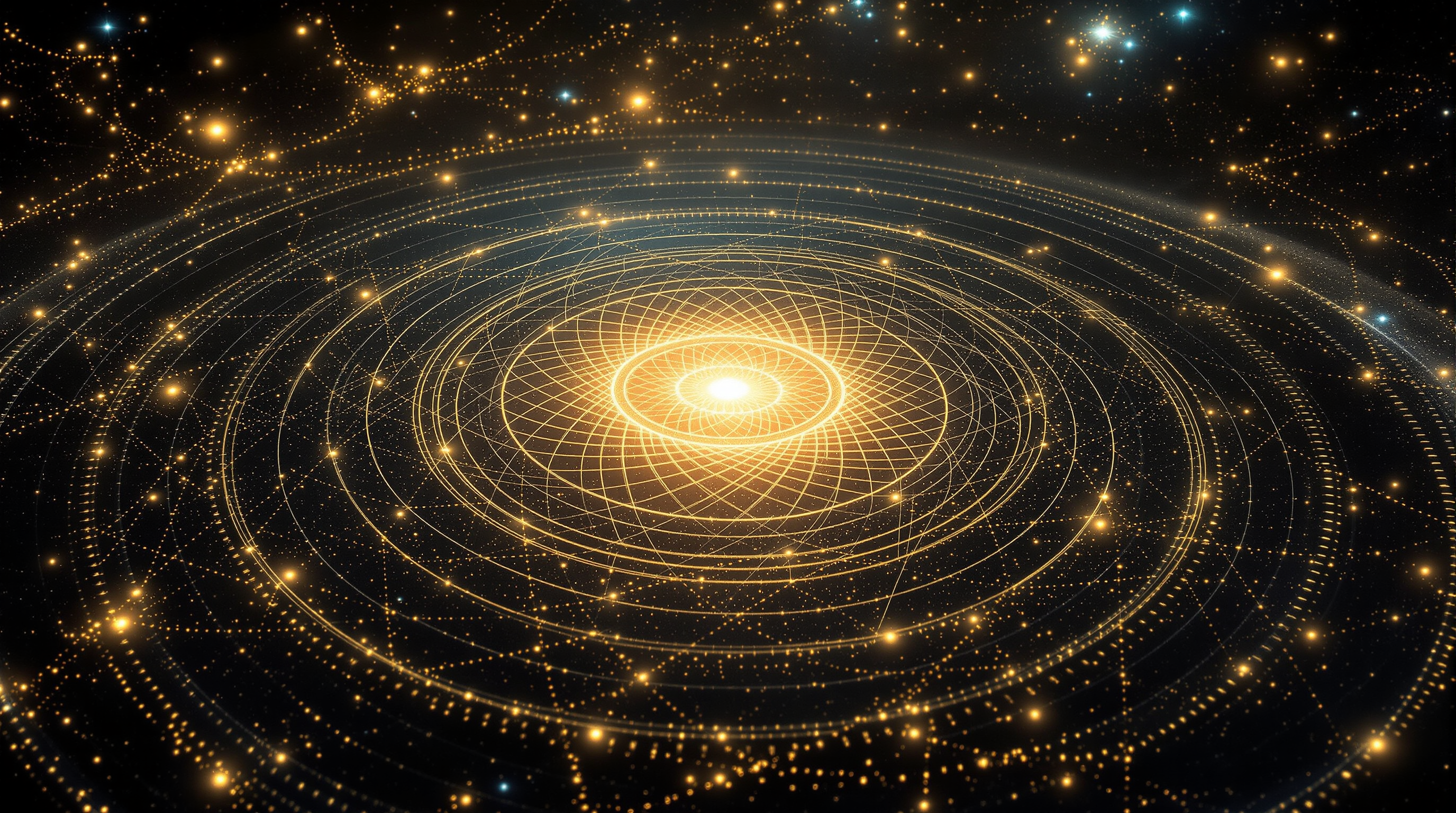
Imagination is the bottleneck now. So what is it? My hunch: a search across a high-dimensional space along ridges that were already there — and the day we learn to measure those ridges, we build the last eyeball.
In the companion to this piece I made a claim: give a state-of-the-art model eyeballs and tools and you have practical AGI — general execution, bounded only by what you can instrument. And I admitted the one thing that isn't here yet: general imagination. The system will execute anything you can decompose. It does not yet decide, on its own, what is worth doing. You are still the imagination in the loop.
Which forces an uncomfortable, thrilling question. If imagination is the last human-held piece — what actually is it?
Search plus taste
Strip the romance and imagination has two parts: a generator and a discriminator.
The generator searches a high-dimensional space of possibilities. This half is cheap — it's what diffusion models do all day, sampling a latent manifold and walking around on it. Novelty is not the hard part. Novelty is trivial; most of it is garbage.
The hard part is the discriminator — taste. The function that says that one, not the ten thousand others. And here is the maddening thing about taste: it has far more parameters than you can verbalize. You know it when you see it and you cannot say why. Polanyi named this exactly — "we know more than we can tell." Taste isn't woo because it's mystical; it's woo because it's a real, high-bandwidth function that simply isn't symbolically legible.
Notice where that lands us. Across everything I've been arguing, taste is the one eyeball we have never figured out how to build. Everything we can instrument — land or water, test pass or fail, bytes on a wire — the model devours. "Is this good?" is the sensor still trapped inside human skulls. Taste is the unobservable problem wearing a tuxedo.
The ridges were already there
Now the hunch I've been chasing for years, the one I call leylines.
A learned space is not uniform. The meaningful configurations don't spread evenly through it — they concentrate on thin, low-dimensional ridges: filaments of high density, eigenmodes, geodesics, attractors. This is the manifold hypothesis, stated with feeling: valid, meaningful things live on a structured surface inside an otherwise empty high-dimensional void.
Those ridges are the leylines. And the strange phenomenology of real discovery — that a great idea feels found, not made, as if it had been waiting for you — is what it feels like to walk a ridge and locate the next point the structure demands. You didn't invent it. It was already implied by the curvature of the space.
Here is the instantiation you can photograph. Chladni plates: bow a metal plate, scatter sand across it, and the sand flees to the nodal lines — it organizes into a pattern that should be there because it is the eigenstructure of the vibrating plate. Harmonics, made visible, finding their own geometry. That is a leyline you can hold in your hand. The cosmic web is the same shape at the largest scale — matter strung along gravitational filaments, galaxies condensing where they should. And multiple discovery in science is the same shape in idea-space: Newton and Leibniz reached calculus independently because the leyline is a property of the space, not the searcher. Two different instruments, tuned to the same plate, find the same nodal lines.
Machines are walking leylines we can't see
If leylines are real, a better instrument should find ridges that human taste hasn't resolved yet. And that is precisely what we are watching.
AlphaGo's move 37 — the one the professionals called a mistake until, hours later, it was obviously the move of the game — is the literal sound of a machine landing on a node of the board's eigenstructure that human taste had not yet found. AlphaFold reads the ridges of protein space. The whiplash everyone describes — "that should not be there… oh. It should be there" — is the signature of a sharper instrument touching a real ridge a beat before we can.
The machines didn't become more imaginative than us in some mystical sense. They got better eyeballs for the leylines.
Hard ridges and soft ones
One distinction keeps this honest, and it's the difference between insight and fashion.
Some leylines are in the territory — mathematics, physics, protein folds. Genuinely discovered, convergently, by anyone who looks. Those are eigenmodes of reality, and you can't argue with them.
Other leylines are in human preference space — genre, style, what reads as "elegant" this decade. They are real density ridges too, but contingent ones: attractors that feel inevitable and are merely path-dependent. One set of ridges lives in the world; the other lives in the collective map.
Great taste navigates both, and knowing which is which is among the rarest skills there is. A great deal of mediocre AI output is a model confidently walking a soft leyline as though it were a hard one — giving you the consensus-shaped answer with the texture of discovery. Telling the territory from the map is the whole game.
The last eyeball
Here is why this isn't just a pretty metaphor. If leylines are real ridges in a measurable space, then they can be measured — density estimation, mode-finding, the principal directions along which a domain actually varies. Which means taste, the function we've called illegible woo for all of human history, is in principle an instrument you can build.
Sit with that. The day you can externalize the taste-sensor — give a system an honest eyeball for near a leyline / off it — the unobservable 20% starts to fall like everything before it. You would be manufacturing the discriminator half of imagination. That is not a paragraph. That is a company, and probably a chapter in a much longer story about what minds are for.
I don't think imagination is magic. I think it's a search across a space with ridges we haven't learned to name, steered by a sensor we haven't learned to build. We've spent this era handing machines eyeballs for everything we already knew how to measure. The frontier is the one sense we've never been able to describe — and I don't believe it stays indescribable for long.
The sand always knew where to go. We're just learning to hear the plate.
A four-part series on intelligence:
- 1. Give the Model Eyeballs
- 2. Leylines (you are here)
- 3. Distillation Attacks on the Universe
- 4. Beauty Is the Reward
Related Posts
Distillation Attacks on the Universe
Why a 20-watt brain out-learns a megawatt model — and what it stole from a billion-year pretraining run. The capstone of a trilogy on eyeballs, leylin...
Give the Model Eyeballs
If an agent can clearly see, measure, or hear a task, it's 80% solved — the mechanism, where it betrays you, and why it's the first thing I screen for...
Novelty × Taste: The Last Scarce Skill
AI commoditizes execution. The compound skill of generating novel ideas with refined taste is the last thing that cannot be automated — and the primar...
Subscribe to the Newsletter
Get notified when I publish new blog posts about game development, AI, entrepreneurship, and technology. No spam, unsubscribe anytime.
Comments
Loading comments...