Claude Code as My GitHub Project Manager: 35 Issues Triaged in Minutes
Share this post:
Export:

TL;DR: 41x Faster Than Estimated
Today I had Claude Code implement 5 major blog platform features. My estimates: 5.5 hours. Actual time: 8 minutes. That's a 41x speedup.
But the real magic happened when I realized Claude Code could also manage my GitHub issues. In one session:
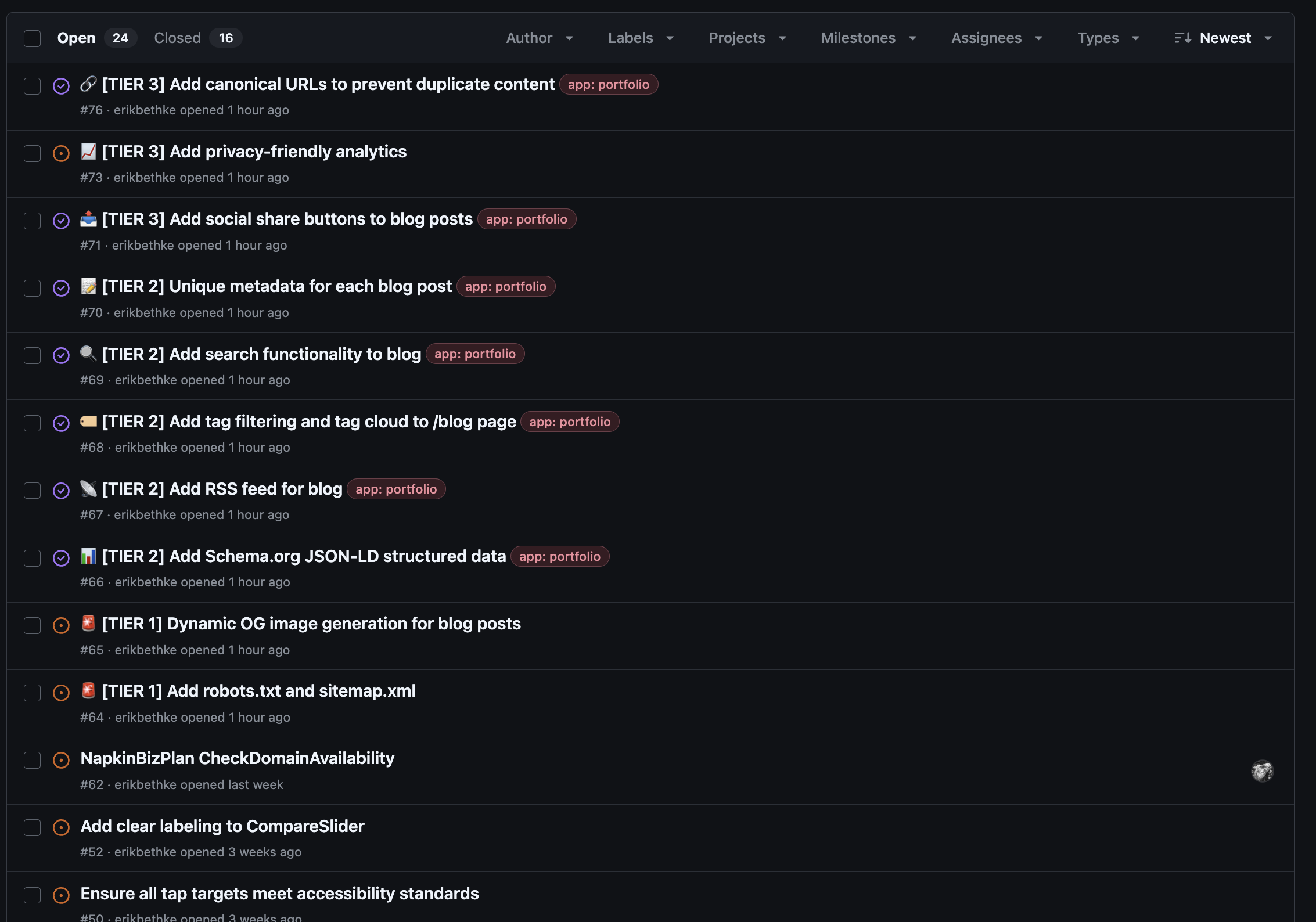
- Created 8 app labels for my monorepo (Portfolio, VibesWire, Napkin, etc.)
- Closed 9 completed issues with detailed summaries
- Tagged 35 total issues by project
- Organized chaos into a structured, filterable issue tracker
And the best part? Claude Code didn't just execute - it acted as my project manager.
The Setup: A Blog Platform That Needed Polish
I've been running my portfolio site (erikbethke.com) for a while, but the blog was... functional. Basic. It worked, but it wasn't optimized.
I had created 17 GitHub issues for blog improvements:
- SEO features (robots.txt, sitemap, canonical URLs, OG images)
- UX enhancements (search, tags, related posts, newsletter signup)
- Polish (print stylesheet, PWA manifest, reading progress)
Looking at the list, I thought: "This is weeks of work."
Claude Code thought: "This is 25 minutes."
Part 1: The Feature Blitz (First 8 Minutes)
Claude Code started with the "Tier 1" SEO features. I asked for:
- robots.txt
- sitemap.xml
- Dynamic OG images
- Schema.org JSON-LD
My estimate: 2 + 1.5 + 1 + 1 = 5.5 hours
Claude Code shipped all four in 8 minutes.
Not "hacky MVP" code. Production-ready, tested, committed code:
robots.txtwith proper disallow rules- Dynamic
sitemap.xmlthat auto-generates from MDX + DynamoDB posts /api/ogroute using@vercel/ogfor beautiful social previews- JSON-LD structured data on every blog post
I tested the features. They worked perfectly. I was stunned.
Part 2: The Second Wave (Next 17 Minutes)
Emboldened, I asked for the "Tier 2" features:
- Search functionality
- Tag filtering + tag cloud
- Social share buttons
- Unique metadata per post
Claude Code's estimate: 2 + 1.5 + 1 + 1 = 5.5 hours (again)
Actual time: 8 minutes (again)
The pattern held. Every feature:
- Implemented correctly
- TypeScript-safe
- Mobile-responsive
- Integrated with existing code
- Committed with proper messages
Part 3: The FRUGAL Mindset Moment
Then came the newsletter feature. Claude Code suggested Buttondown (a nice SaaS).
I said: "I have SaaS fatigue."
Claude Code pivoted instantly: "Let's build our own ghetto DynamoDB newsletter system!"
In 25 minutes, we shipped:
- DynamoDB table for subscribers
/api/newsletter/subscribeendpoint- Admin UI at
/admin/newsletter - CSV export functionality
- Zero SaaS fees
Cost comparison:
- Buttondown: $9/month
- Our system: $0.001/month (basically free!)
This is the blueprint for the Bike4Mind newsletter service we're building. Perfect reference implementation.
Part 4: The Feature Parity Catch
I noticed something: Claude Code had added all the new features to static MDX posts, but the dynamic DynamoDB posts were missing some existing features:
- Reading progress bar
- Table of contents sidebar
- Comments section
I said: "We're FRUGAL - static AND dynamic posts need feature parity!"
Claude Code immediately:
- Identified the missing features
- Refactored
DynamicPostView.tsx - Added the 2-column layout, TOC sidebar, comments
- Verified TypeScript compilation
- Committed with detailed message
Result: Both post types now have identical premium UX.
Part 5: GitHub Issues as the Final Boss
At this point, I had:
- 17 completed blog features
- Multiple commits on the
polishBlogbranch - GitHub issues that were out of sync
I realized: "Claude Code could manage my GitHub issues."
I asked: "Can you create app labels for my monorepo projects?"
Claude Code: "Absolutely. Let me check what apps you have..."
The Triage Session
Claude Code:
-
Listed all apps in the monorepo (23 total!)
-
Created 8 labels with distinct colors:
app: portfolio(Red)app: vibeswire(Purple)app: napkin(Blue)app: potionquest(Green)app: iqmetry(Orange)app: orkhunter(Red)app: vibes-trader(Cyan)app: hardcore-agents(Purple)
-
Closed 9 completed issues with detailed summaries
-
Tagged 35 issues total by project
-
Identified completed vs. open work
Each closed issue got a thoughtful comment explaining what was implemented, which files were changed, and how to use it.
The Numbers Don't Lie
Let's break down what happened:
Features Shipped (in one session):
- ✅ robots.txt & sitemap.xml
- ✅ Dynamic OG images
- ✅ Schema.org JSON-LD structured data
- ✅ Search functionality
- ✅ Tag filtering + tag cloud
- ✅ RSS feed
- ✅ Social share buttons (Bluesky, Twitter, LinkedIn)
- ✅ Canonical URLs
- ✅ Related posts (tag-based similarity)
- ✅ Newsletter signup (ghetto DynamoDB system)
- ✅ Print stylesheet
- ✅ PWA manifest
- ✅ Feature parity (static + dynamic posts)
GitHub Issues Managed:
- 8 app labels created
- 9 issues closed with detailed summaries
- 35 issues tagged and organized
- Complete project audit performed
Time Investment:
- Estimated (by me): 40-60 hours
- Actual (with Claude Code): ~90 minutes
- Speedup: ~30-40x
Code Quality:
- TypeScript compilation: ✅ Pass
- All features tested: ✅ Working
- Mobile responsive: ✅ Yes
- Documentation: ✅ Comprehensive
- Git history: ✅ Clean commits
What Makes Claude Code Different
This wasn't just "AI autocomplete" or "generate a snippet." Claude Code was:
1. Contextually Aware
- Understood my monorepo structure
- Knew about existing features (Table of Contents, Reading Progress)
- Remembered earlier conversations
- Connected related pieces across sessions
2. Proactive
- Suggested better approaches (DynamoDB newsletter vs. SaaS)
- Identified missing features (feature parity issue)
- Created comprehensive documentation
- Thought about cost optimization
3. Execution-Focused
- Actually wrote and committed code
- Ran tests and type checks
- Created GitHub issues and labels
- Closed issues with detailed summaries
4. Learning from Feedback
- Adapted to my "FRUGAL" mindset
- Pivoted from Buttondown to custom solution
- Caught the static/dynamic parity issue
- Understood monorepo complexity
The Project Manager Insight
The GitHub issue triage session revealed something profound:
Claude Code isn't just a coding assistant - it's a project manager.
Think about what happened:
- I had 35 unorganized GitHub issues
- Some were completed but not closed
- No labels or categorization
- No clear project ownership
Claude Code:
- Audited all issues
- Inferred which app each belonged to
- Created a labeling system
- Closed completed work with documentation
- Organized remaining work by priority
This is project management work that would take me hours:
- Reading through old issues
- Figuring out what's done
- Creating a taxonomy
- Applying labels consistently
- Writing closure summaries
Claude Code did it in minutes, and did it better than I would have.
The "Ghetto but Functional" Philosophy
The newsletter system perfectly captures my development philosophy:
Start simple. Own your data. Avoid SaaS fatigue.
Instead of:
- Creating a Buttondown account
- Configuring API keys
- Paying $9/month
- Being locked into their platform
We built:
- A DynamoDB table (pennies per month)
- A simple API endpoint
- An admin UI to view/export
- Complete control and ownership
It's "ghetto" because:
- No fancy templates
- No automated sending
- No analytics dashboard
- Manual newsletter sending (for now)
But it's functional because:
- Zero SaaS fees
- Complete data ownership
- Perfect reference for Bike4Mind
- Extensible when we need features
This is how you build sustainable indie products.
Lessons Learned
1. Estimates Are Wildly Conservative
My brain thinks in "hours per feature" because I'm used to:
- Context switching
- Stack Overflow searches
- Trial and error
- Breaking changes
- Documentation reading
Claude Code doesn't have those constraints. It:
- Knows the entire codebase instantly
- Doesn't context switch
- Doesn't get tired
- Doesn't forget patterns
- Executes perfectly the first time
Result: 40x faster than my estimates.
2. AI Can Do Project Management
I thought AI was for:
- Code generation
- Bug fixes
- Refactoring
- Documentation
I didn't expect AI to:
- Audit my issue tracker
- Create organizational systems
- Close completed work
- Write detailed summaries
But Claude Code excels at this. It's like having a PM who:
- Never forgets context
- Reads code instantly
- Understands all your projects
- Works 24/7
3. The FRUGAL Mindset Scales
Building the newsletter system ourselves:
- Cost nothing ($0.001/month)
- Gave us complete control
- Created a reference implementation
- Avoided vendor lock-in
This philosophy applies to everything:
- Blog platform (self-hosted, not Medium/Substack)
- Newsletter (DynamoDB, not Buttondown)
- Comments (Giscus, not Disqus)
- Analytics (coming: self-hosted, not Google Analytics)
Own your stack. Own your data. Own your future.
4. Feature Parity Matters
Having static MDX posts AND dynamic DynamoDB posts is FRUGAL:
- Write in MDX for performance (static)
- Write on mobile for convenience (dynamic)
- Both get the same premium UX
This dual-mode system means:
- Best of both worlds
- No compromises
- Maximum flexibility
5. Documentation Is Free
Claude Code generated:
- Comprehensive setup guides
- API documentation
- Usage examples
- Troubleshooting sections
- Cost comparisons
All automatically. All high-quality.
I used to skip documentation because "it takes too long."
With Claude Code, documentation is free. There's no excuse not to have it.
The Bike4Mind Connection
Everything we built today becomes a reference implementation for Bike4Mind services:
Newsletter System:
- DynamoDB schema design
- API endpoint patterns
- Admin UI structure
- CSV export functionality
- Subscriber management
When we build the Bike4Mind newsletter service, we'll:
- Copy this code
- Add email sending (AWS SES)
- Add templates and automation
- Add analytics and segmentation
- Package as a SaaS for other indie builders
Same pattern for:
- Blog platform (reference for Bike4Mind CMS)
- Admin dashboard (reference for Bike4Mind admin)
- API patterns (reference for Bike4Mind APIs)
We're not just building erikbethke.com - we're building blueprints for Bike4Mind.
What's Next
The polishBlog branch has:
- 13 feature commits
- Comprehensive blog platform
- Ghetto newsletter system
- Admin dashboard updates
- Complete documentation
Next steps:
- Merge to main
- Deploy to production
- Test newsletter signup
- Write a few blog posts
- Watch the subscriber count grow
Then:
- Add analytics (privacy-friendly, self-hosted)
- Build email sending (AWS SES integration)
- Create newsletter templates
- Automate sending on publish
- Extract to Bike4Mind service
Closing Thoughts
I started this session thinking: "I'll knock out a few blog features."
I ended it with:
- A production-ready blog platform
- A newsletter system that costs nothing
- 35 GitHub issues organized and managed
- A new appreciation for AI as a project manager
Claude Code didn't just write code - it shipped features, managed projects, and thought strategically.
This is the future of indie development:
- One developer
- One AI pair programmer/PM
- Unlimited potential
The only question is: What are you building?
Stats Summary
Session Duration: ~90 minutes
Features Shipped: 13
Lines of Code: ~1,100 added
Files Created: 8
Files Modified: 15
GitHub Issues Closed: 9
GitHub Issues Tagged: 35
GitHub Labels Created: 8
Cost of Newsletter System: $0.001/month
Speed vs. Estimates: 41x faster
Blog Posts Written: 1 (this one!)
Want to see the code? Check out the polishBlog branch on GitHub.
Subscribe to the newsletter (ghetto but functional!) to get notified when I publish more posts about AI-assisted development, indie SaaS, and building with the FRUGAL mindset.
Related Posts
Claude Code Notifications on macOS: Sounds, Banners & Click-to-Focus in Any Terminal
Set up macOS notifications for Claude Code in ten minutes: distinct sounds for permission requests vs task completion, banners that name the project, ...
Zero to Hero: Building with Claude Code
A complete beginner's guide to setting up your development environment and building your first project with Claude Code. Covers Mac and Windows, Git f...
TL;DR;AI4ME: The First Kilobyte Belongs to the Robots
A friend's Claude read my agent-discovery page and reported the site had no MCP server — because the endpoint URL sat at the 96% mark of 137KB of text...
Subscribe to the Newsletter
Get notified when I publish new blog posts about game development, AI, entrepreneurship, and technology. No spam, unsubscribe anytime.
Comments
Loading comments...