There are 3 Different AI Bubbles
When we say "the AI bubble", three separate conversations are going on at once. I built a model of CoreWeave for the one we can work on with data.
Share this post:
Export:
TL;DR
"Wow, Erik, that's 4,000 words in 20 minutes. You asked me to read your narrative. Not gonna do that. Just send me off to the cool model and I'm gonna go check that out."
Fair. Here it is: CoreWeave: A pro forma
- Server economics. One GPU, bought with a loan and rented by the hour.
- Debt stack. What CoreWeave owes, at each interest rate.
- Rental prices. What a GPU-hour actually costs to rent.
- Other neoclouds. Two listed rivals on the same map.
- Questions and insights. What we found, and what is still open.
- Role-play the CFO. Make your own moves and try to reach green.
- Method and sources. Numbers come from SEC filings and other public sources.
- For agents. The model, the data and test cases, for your AI to take and rework.
It is Saturday, November 21st, 2026, Austin, Texas. This week we saw Anthropic go IPO and raise over $80 billion and become the seventh largest company in America. While that's going on, we're seeing a broad sell-off, deleveraging, correction, pick your word, led by the scandal at Nvidia (I am long NVDA). With those two crosscurrents going on, the conversation for the last two or three years has been: is AI a fad? Is it a bubble? When will the bubble break? Who are the winners? Who are the losers? And what's going on with all these capex spends?
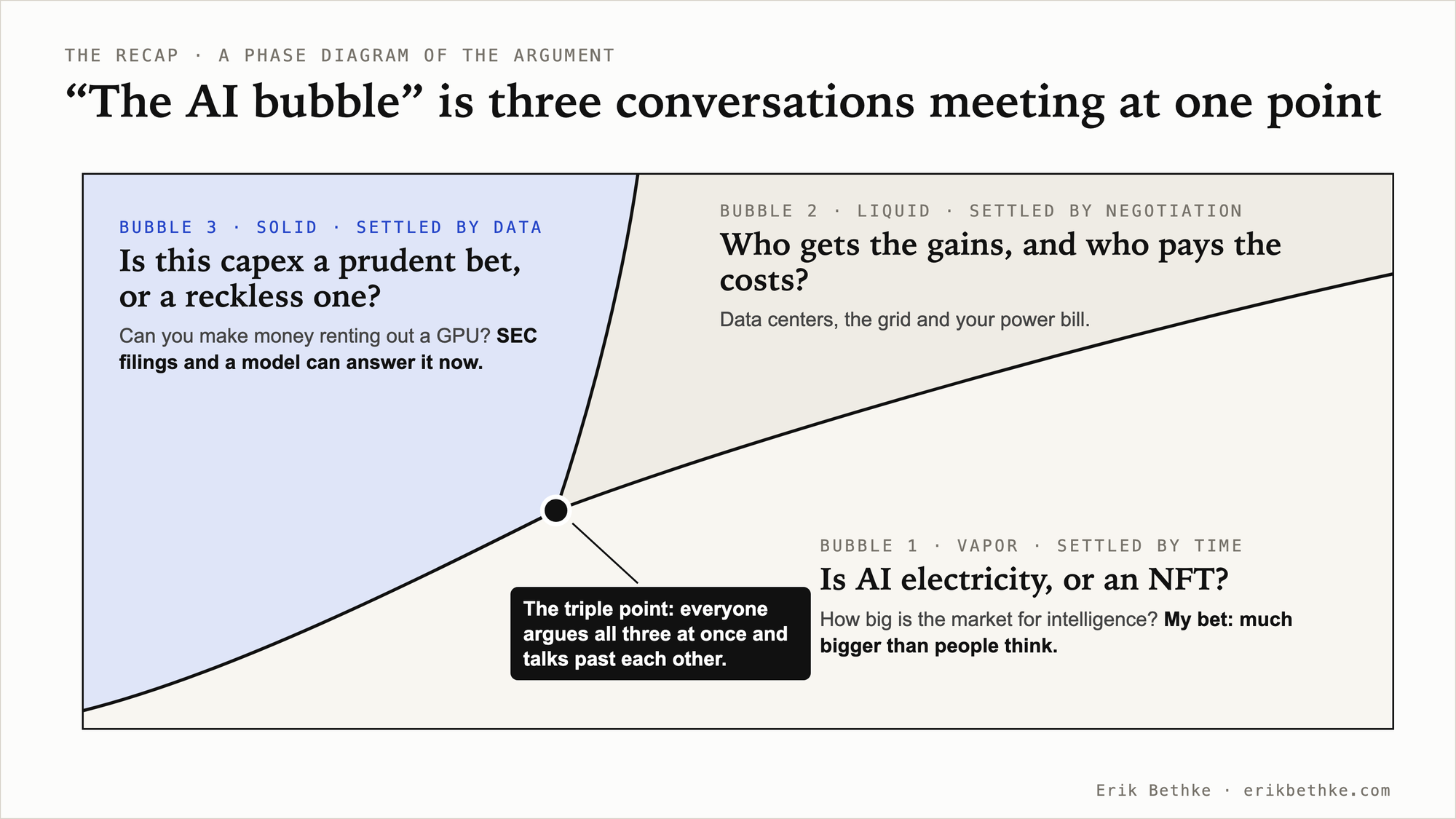
For a while now, I've been thinking about how to write about this. With deep conversations, as I get older, I realize why a lot of conversations are so frustrating and so hard to deal with: people talk past each other and are literally having multiple conversations at once. So let me start right there. I think this is a useful framework for me, and I'm offering it to you. When we say "the AI bubble", I argue that there are three separate conversations going on simultaneously.
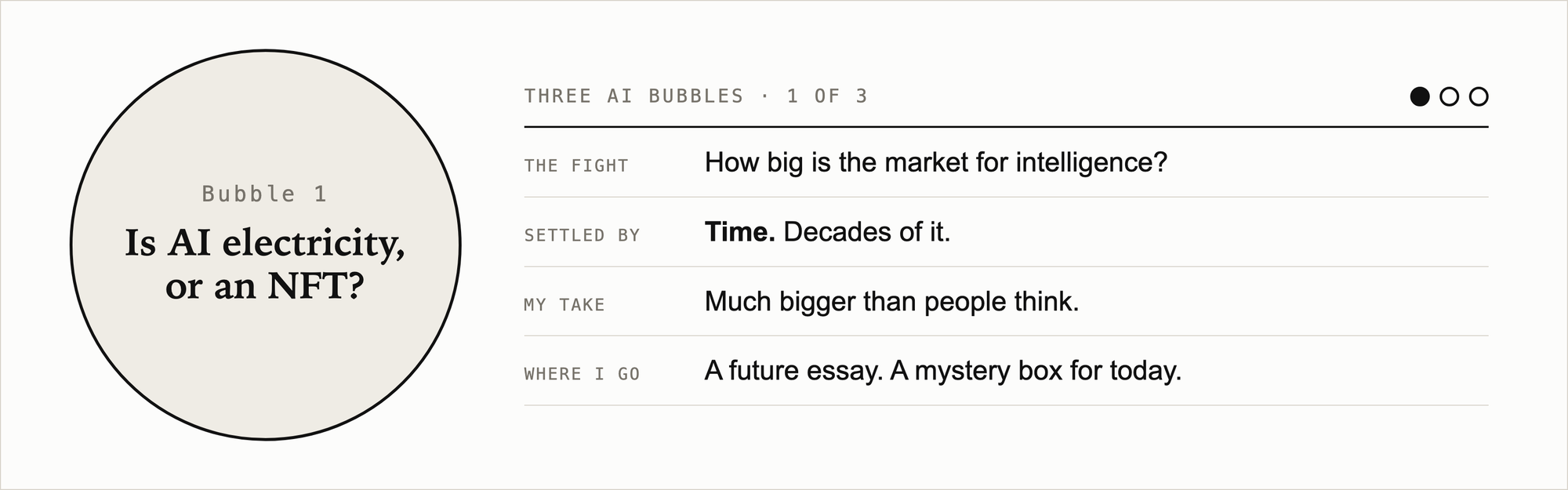
We've got one question right now, which is the most basic, which is: is AI a truly civilization-transformative technology, or is it a fad? Is AI the equivalent of electricity, or is AI a non-fungible token, an NFT? That conversation has been going on for three years. It's still going on.
I love AI. I'm personally hyper-augmented by AI. I am building more than I've ever built in my career. I love building. I'm an engineer. I'm a geek. I'm an aerospace engineer and a game developer. And AI helps me build so many different things. I'm honestly having the best time of my life. I really am. So for me personally, AI is simply great and it's fun.
At the same time, AI is causing a lot of change. If I had to boil my professional skill set down to a single term, I would call myself a software engineer. Of course, I could use other labels, but the craft of software engineering has been utterly transformed in the last two years, and more transformed than any other form of white-collar work.
We have all this angst over how big the market for intelligence is. What is the total addressable market for intelligence? When you hear people spending $100 billion, $200 billion, $500 billion, a trillion dollars in capex, well, all that capex has to be paid back. People naturally ask the question: what is the total addressable market of intelligence? How big is this? Again, is this an NFT fad or is this electricity and energy? How big is intelligence?
My personal belief is the market for intelligence is so large that if I told you what I believe the number really is, you would roll your eyes and stop reading the rest of what I'm going to say. So for that, I have a future long-form essay about what I think is the full market for intelligence. I'm going to leave that one as a mystery box for today. Let me just say that I think, obviously, it's much bigger than people think. That's one of the AI bubble conversations.
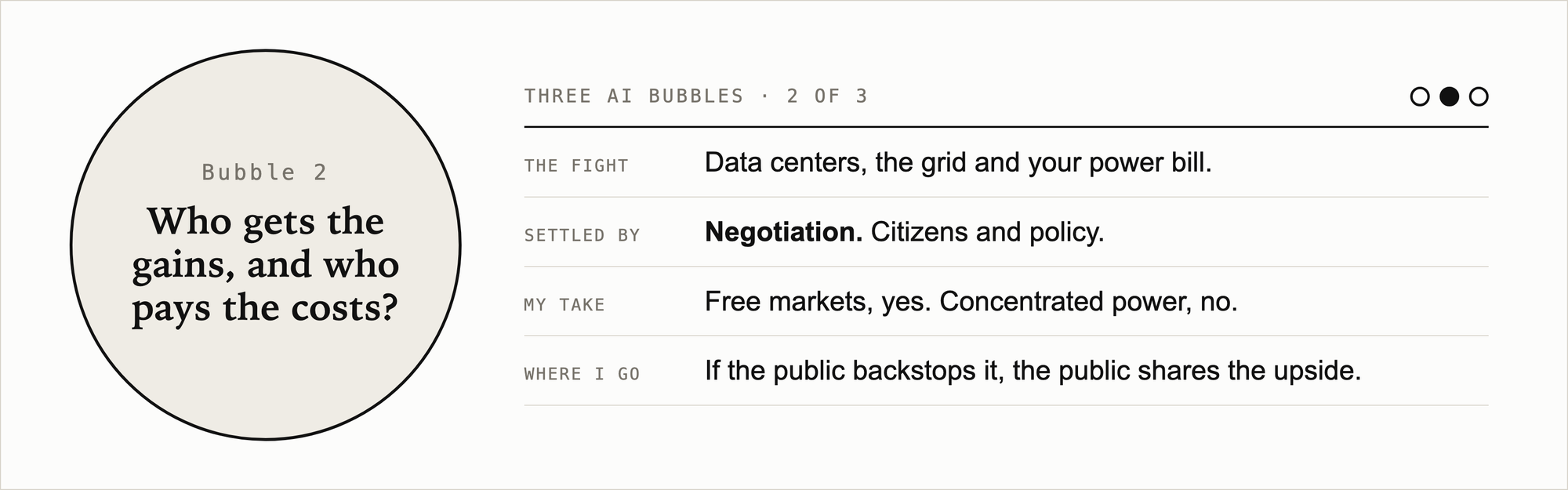
The other AI bubble conversation is about the data centers. The data centers are really a proxy for who will privatize and own the gains of intelligence, and where the costs are made public. Socialized costs, privatized gains.
Everybody's favorite market correction was the Great Financial Crisis of 2008 and 2009, when the financial wizards made big, big bets at the casino. Some of the bets went upside down, and the public came and bailed out the markets and kept everything going. We coined "too big to fail" at that time. Now, everybody strongly assumed that the market and the government and the elites rigged the game, but they were supposed to be discreet about that whole thing. After the Great Financial Crisis, discretion and politeness and innuendo, all that went out the window. It's pretty naked. It's pretty naked that the US economy, at least, has a very tight coupling between public policy, private gain, and socialized costs.
And so we see it here with data centers. Early data centers would get approved without very much oversight and very little community buy-in. In fact, the local council members would be bound by non-disclosure agreements and couldn't even tell their own constituents, who voted for them under a democratic institution, what they were doing. It basically violated every spirit of democratic rule. I won't say anybody violated any laws. Frankly, the players are too sophisticated and the lawyers and accountants are too strong to make any gross errors. I doubt anybody has broken any laws. But at that level of the game, breaking a law is a faux pas. You craft the laws, and you have very, very strong influence over the policymakers and enforcers and regulators.
So when we talk about the AI bubble, the second leg is, again: who's going to win here, and why is that okay for me? What benefit for me is it for there to be a Sam Altman in control of OpenAI, a Dario in control of Anthropic, or Elon Musk and Grok, or Demis Hassabis over at DeepMind? What is it for the common man? How is the common man's life going to get better from these folks building out massive data centers that consume a shocking amount of energy to produce intelligence, essentially for the largest corporations to be more effective in the markets? How is that good for the common man?
People first started pressing on it with water. Are these data centers wasting water? Well, we have a companion article written by my colleague Michael Conard, Reports of AI's Thirst Have Been Greatly Exaggerated, that dug into it, and it turns out, no, data centers don't turn water into antimatter and destroy water from the universe. No, it's much more nuanced than that. And now, with the closed-loop cooling systems, at least on the first order, possibly on the second order, the water consumption of a data center is essentially solved and is not a problem anymore.
But what's the problem is when the data centers just squat down and make an impact on the grid, and then the taxpayer who's paying residential electricity pays for it. Not a lot of citizens understand this, but the residential person pays the very, very highest rates for electricity. Commercial pays the next lowest rate, industrial is much lower than that, and that sort of thing. So traditionally, the residential customer, frankly, had to subsidize grid infrastructure on behalf of the big industrial and commercial players if they wanted to anchor their communities with quote-unquote jobs.
Now, that's the whole class conflict in the modern era, come to date: how much should the working class subsidize the corporation and the elite class in order to attract growth and jobs? And the answer is non-trivial. You can't just say, "No, no, I don't care about business. I'm not going to roll out tax breaks. I'm not going to subsidize business. Screw it. They can come or go." That's just not a sophisticated stance. And you can see different strategies: Singapore and South Korea have a very long-term investment in attracting businesses and succeeding and increasing the welfare of their own citizens. So you can subsidize business and industries and raise welfare for your citizens.
So we have this terribly complicated conversation about how to share the proceeds of AI. And I argue that it's commingled into the AI bubble. Literally, here in Austin, I was sitting down for dinner at Hopdoddy on South Congress. I was busy tapping away on my laptop, and somebody else was genuinely, cheerfully curious what I was working on. I told them I'm working on software, specifically AI. And they physically picked themselves up and moved to another stool. They said they don't like AI and they don't want anything to do with it. So part of the AI conversation is a deep sense of frustration and distrust from the working class and the middle class: will they get a share of this pie, and will they get a fair share of this pie? And the answer to that is we don't know yet, and we're in early stages here.
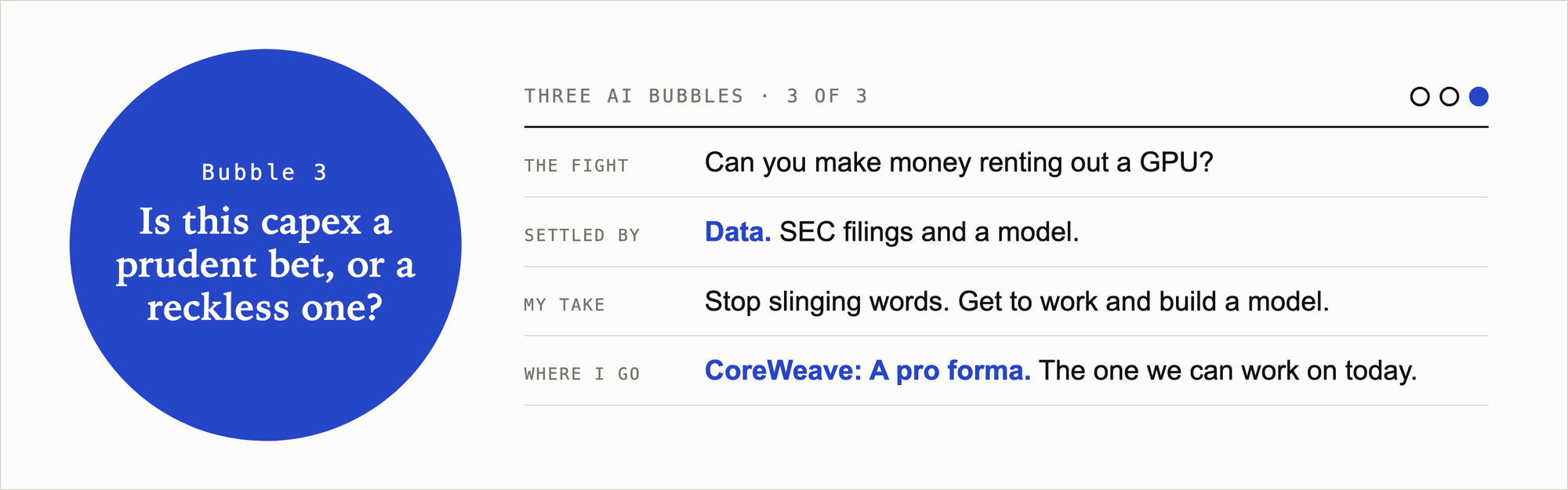
But the third leg of the AI bubble conversation is: are these good capex bets right now? Did Nvidia do skillful and courageous risk-on seeding of the AI ecosystem, or were they reckless and doing suspicious circular financing? Is CoreWeave a solid business? Are the neoclouds great? Will you make money putting dollars into a GPU and renting it out to other people?
This capex conversation, that's the one that's the most near-term, the most tractable of these conversations. The first one, how big is AI ultimately? It reaches past quarterly business terms and gets into cultural-level investments and long-term strategy and, frankly, a little bit of economic philosophy. So that one is just a long-term narrative of me up on a soapbox, thinking about things speculatively. Some people will like it, some people won't. It's just speculative.
The leg on are we sharing the proceeds of AI correctly: we could either completely privatize the gains and completely socialize the costs, we could completely socialize the gains and the costs, or anything in between. We've been experimenting with that for the last couple of centuries. My argument is you definitely want a market-based, meritocracy-based system that allocates capital differentially. Winners should win and losers should lose. So I'm very much a free-market-based person. But I am very suspicious of concentration of capital. Because to me, concentration of capital leads to monostructures, and monostructures are, to me, bad, whether they're communism or fascism or monopolies. So I'm suspicious of and distrust concentrated power. I'm just owning that as a bias.
But of the three legs: is the capex being spent now a daring but essentially prudent bet on the future? Or is it a reckless, Web3-style crypto gambling play? Well, this third leg is a leg where I argue we shouldn't be just wringing our hands and we shouldn't just be slinging words. We should just get to work, and we should make models, and we should use data.
As citizens, we stood up the Securities and Exchange Commission, the SEC, and we've always been working on the rules for how to make public companies behave with greater transparency and accountability to everybody. And so we have something called the 10-Q. And CoreWeave published the 10-Q. And I decided to do a deep dive and look at just CoreWeave.
I spent the most time looking at CoreWeave because CoreWeave is the most successful, largest pure-play renter of the GPU. And that makes it the cleanest company to model. Because a company like Google, with DeepMind, Gemini, and the TPU and their evergreen ad business, can afford to subsidize their AI R&D pretty much indefinitely. And I would argue they really should, from a technical point of view. As a citizen, it's a little bit akin to the price dumping that we used to accuse the Japanese of in the 80s and that we now accuse China of today. When someone's able to run one division at a loss because they're making so much money from another division, you do get an anti-competitive structure there that I do think is problematic. But essentially you don't have to work that hard when considering Google's spend on AI. Just go, yeah, they should spend a lot, and they should maintain their membership at the head of the table.
Now, what about Microsoft? Same thing. They have a big book of business. They can fund the AI build. Same thing, frankly, for Meta. Meta needs to keep up with the times. Famously, Mark Zuckerberg's got misadventures in the metaverse, Oculus, and other things. Honestly, I applaud him for his leadership in open-source AI with the Llama series of models. He's got to do something and experiment here. But again, he's got a book of revenue from which he could subsidize AI.
So then we've got, really, OpenAI and Anthropic. OpenAI has many, many more users than Anthropic, but Anthropic has more revenue and has gone public. And that really attracts my attention. I'm openly a big fan of Anthropic's models and I use them daily. I do touch and use all the other guys' models as well, just to stay current. But Anthropic went early and hard on the software engineering use case. But Anthropic essentially has found gold with high-value tasks for enterprises and is generating far more revenue and margin from their users than OpenAI is.
So is it good for Anthropic to spend on capex? I think so. I think Anthropic should sell equity, sell debt, and do whatever they can to get as much capex as possible to make as much intelligence as possible. And the same thing kind of goes for OpenAI too. OpenAI probably should focus on figuring out how to make more margin, but they could be arguing that their greater number of free users is good because of the source of new, novel data that they can use to train models, blah, blah, blah. But again, Microsoft has got the great GitHub asset as well as the games library, and Google has got YouTube and the great Google Workspace library. So everybody is trying to figure out what is their own private fire hose of new, novel data to go feed their models, and what their revenue is, so they can fund their capex.
So bring it around to CoreWeave, though. CoreWeave is not an enterprise-suite-selling company. It doesn't have a retail arm like Amazon. It doesn't have all the world's businesses and schools and governments running on its software like Microsoft, and it doesn't have YouTube and Google Ads being a gatekeeper of all the world's advertising. CoreWeave is the one just naked pure play for renting a GPU. And so that is why I focused on this one.
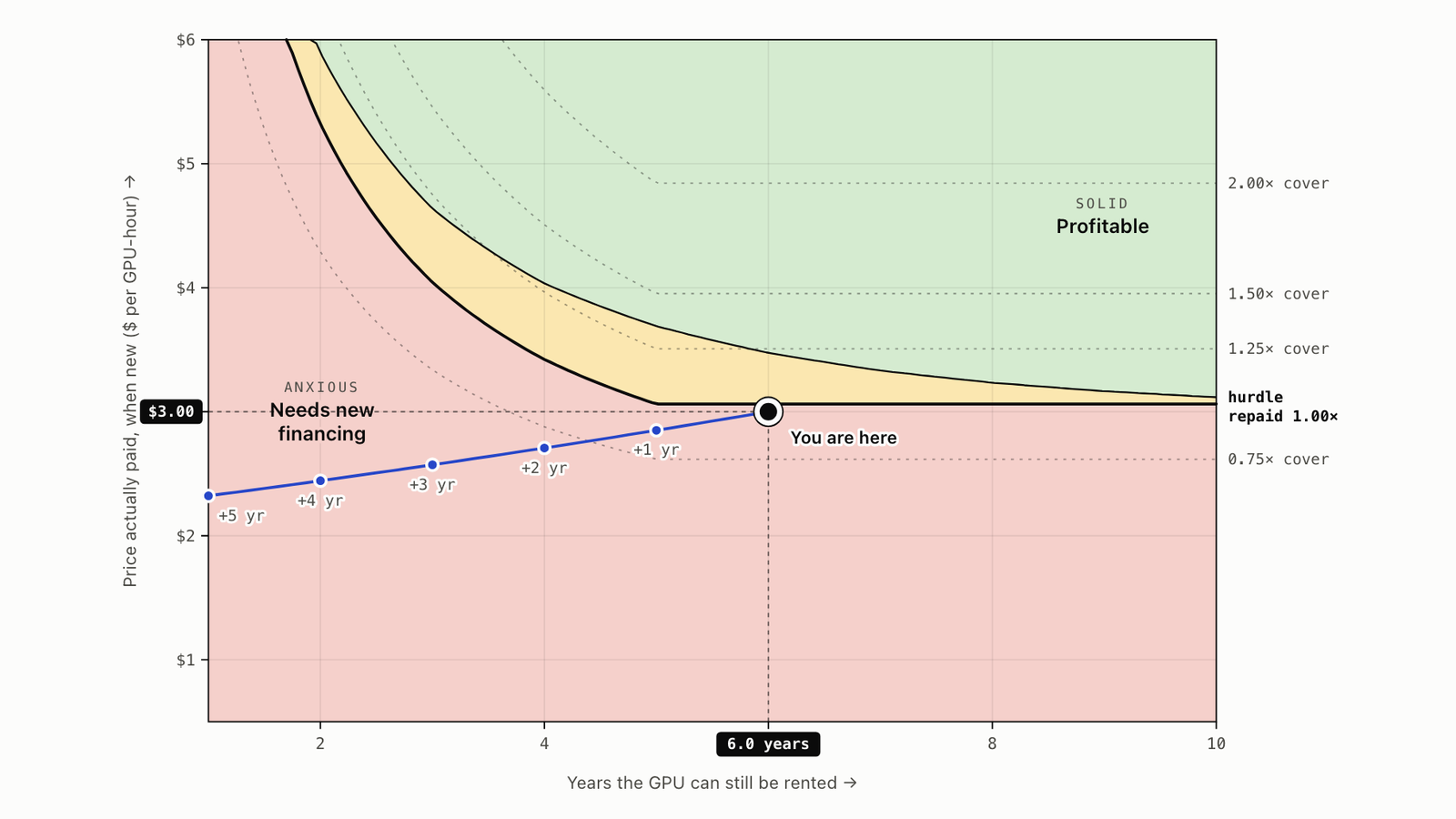
I dug in, used their 10-Q, used a lot of my AI friends, and just kept making more and more views of what's going on until it made more sense to me. I took a couple of walks outside and I hit upon the high school physics phase diagram for water. I looked around and I didn't see other equity guys analyzing things like that. I'm probably not novel, but as far as I know, this is a new, fresh look at it, and I like it. What this does is, depending on the current business, you can see whether a business is in the profitable green part of the phase diagram, in the troubled red part of the diagram, or in the warning yellow part of the diagram. And you can look at it in different ways.
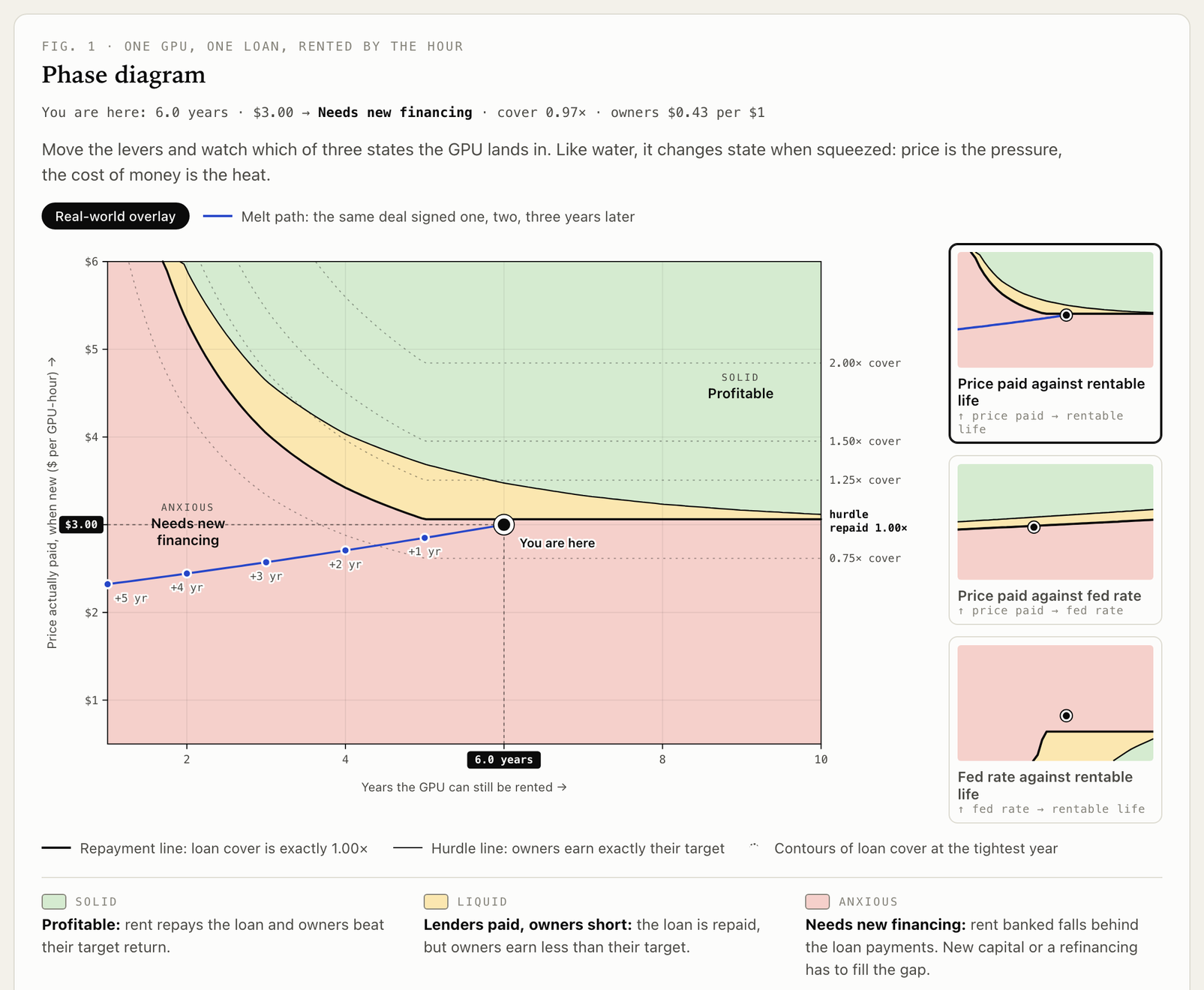
The phase diagram. On the filed numbers CoreWeave sits just under the repayment line, and the verdict runs from needs new financing to profitable on one number the filing does not give. From CoreWeave: A pro forma. Click through for the live model.
I built this model, iterated the model, and I personally learned a lot. I learned a lot. I knew that the neoclouds were taking on equity and debt, and I knew the debt was tranched. I knew some of the debt had higher interest rates. I didn't understand how dominantly the cost of capital affects renting the GPUs. And I did know that people were arguing over how long you can depreciate a GPU, whether it's three years or five years or six years. I knew that was important, but I didn't understand exactly how important that is. Now I feel, with this model I built, I have a really good, clear view of how important it is.
But what's really, really important is the median all-in rental per hour at which you can rent your GPU. From this, I built a waterfall so I can understand the renting-the-GPU business really well and unpack it. I could understand the sensitivity of the different levers. So it's a multi-dimensional sensitivity analysis. And I've got loads of advanced controls. You can tap on advanced controls, explode it, and you get a whole bunch more. I unveiled the debt stack for you. I've looked at rental prices and got that broken out. And then I compared and contrasted the other neoclouds with publicly available information, Nebius and IREN.
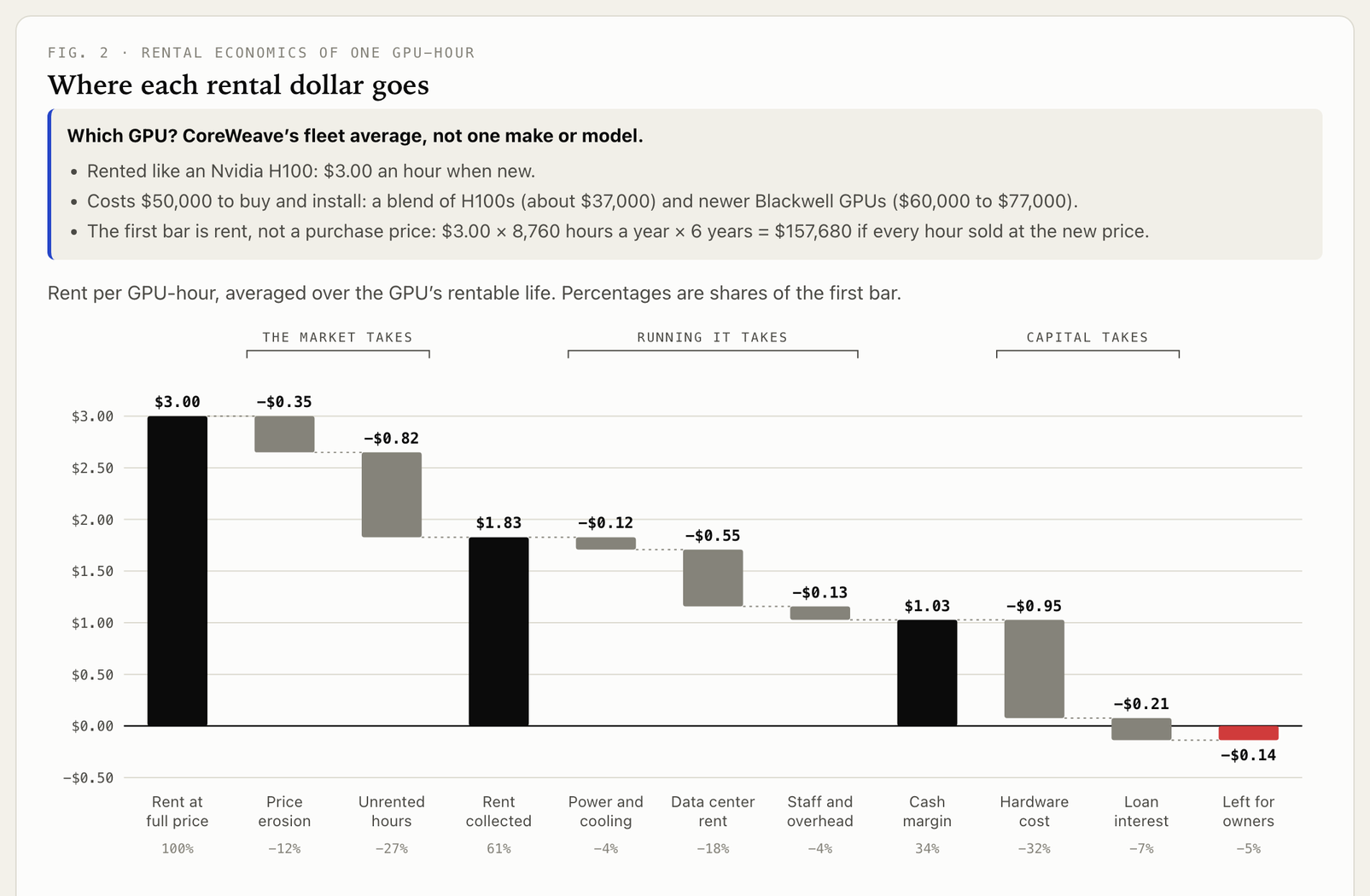
The rental economics of one GPU-hour. From CoreWeave: A pro forma. Click through for the live model.
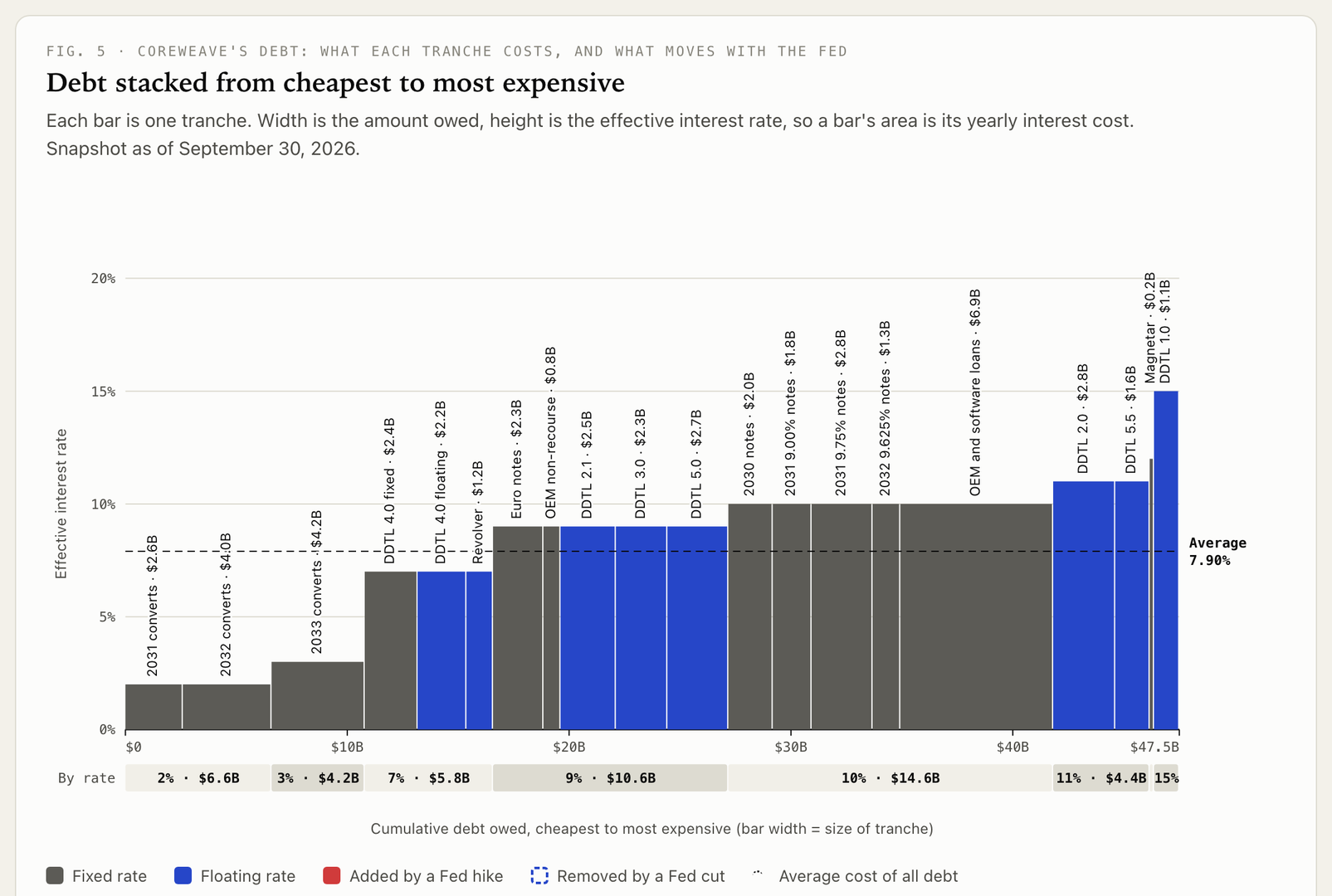
The debt stack. From CoreWeave: A pro forma. Click through for the live model.
And it's actually made me more concerned. CoreWeave is, as far as I can tell and from my model analysis, the strongest of the neoclouds by far. Or, in other words, Nebius and IREN are a lot weaker financially than I had hoped or feared or suspected. So I think you can kind of start to see, you can start to noodle, where some of the bad capex spend is.
Now I'm going to pause here for a moment. It's actually important that we have bad capex. It's non-intuitive. We should have bad capex. The normal person off the street wouldn't understand that and would just go, "Well, don't make bad capex." That's really not what we want at the civilizational level. Of course, if you're an equity holder or a debt holder on a bad capex, you definitely don't want that. But the whole point of a free market system that leverages the benefits of capitalism is that you want all these business guys and all these people renting their capital to search the possibility space and find optimums for us. Optimums for the next stage of growth for civilization.
And so it's really important that we search that possibility space thoroughly. Literally, as a civilization, we want bondholders, investors, business leaders, employees, contractors, we want everybody to make lots of bets. We want to figure out what works and we want to figure out what doesn't work. We want them to take risks. And we literally do want losers. You cannot have winners without losers. The only way to avoid losing is to be so slow and so incremental that there's never any pain. And there's loads of sci-fi and loads of fiction and poetry that explores living in worlds without pain. We don't want that. We do want some pain and we do want some losers.
So with all that, I humbly offer you my CoreWeave: A pro forma: a set of tools that I've built, data, and a framework for thinking through it, where you can think about the equity layer, the debt layer, and the business model of renting GPUs. And then you can run your own scenario analysis. You can grab this stuff if you like. I even have a "For agents" page where you can grab the whole thing in Markdown and get the data in JSON. You can do your own independent noodling. My ask is you credit me and let people know about any changes you make, and that sort of thing.
But really, what I want from this is just to give back and share my thinking, my view, my framework. And I hope that helps us all be a lot more focused in our discussions. Because I do think we need to spend a lot more time, and we'll have a lot more healthy discussions that lead, frankly, to negotiations on how to share the fruit and the benefit of AI. I also think we need to think about the ultimate trajectory: where do we want civilization and society to go, and the role of intelligence and how big it can be.
And even here on the neoclouds, besides going, "Oh, ha ha, tee hee hee, the neoclouds are in trouble": frankly, I'm not excited about that. I never really thought about it directly until I did this analysis. But I'm an unfortunate cheerleader for the neoclouds. I want the neoclouds to succeed because I want there to be distributed, decentralized, strong AI, agentic, and strong robotics coming up soon, available to small and medium enterprises and to the individual citizens of the world, and as Americans. I'm really uncomfortable with a future where there are only three or five hyperscalers or hyperlabs that have a de facto oligarchy, a monopoly on commercially relevant intelligence, and the rest of us are all renters or neo-peasants in that new future. I don't want that. So what I want: I want the neoclouds to succeed. Again, because I don't want a monopoly on intelligence.
So the result of my analysis here, and my model, leaves me troubled and less settled. And a little tip of a thought here: I think we should start to consider some form of federal infrastructure around intelligence, on the order of the great highways. We talk about how we need to keep up with China. We talk about it in the Cold War, jingoistic rivalry way. And we rib our fellow citizens: "Come on, you gotta get behind this, because China's gonna get ahead of us." Okay, if elements of that are true, and we have a true national, Western-versus-Eastern rivalry here, and if the stakes are that large, okay, then, heard. The stakes are that large. So let's sit down and really talk about it as a nation-state, and let's figure out how much of this infrastructure should be backstopped by the public. And of course, if the public is backstopping it, if we're socializing the build and we're socializing the cost of the build and socializing the cost of a bad build, well then, I think the public also deserves a bit of the upside, don't you?
And so I think there are really strong conversations to have. Again, strong conversations about the future of intelligence, and strong conversations about how we divvy up the proceeds from intelligence. But I humbly offer this model, my noodling through the business model of a neocloud, to help us sort out and clean up the conversations, so we know which one of these three conversations we are having. Hopefully this helps structure those conversations.
Related, from me
- The Mu Strategy: How to Build on Hyperscalers Without Being Owned By Them
- Bring the Open Back to AI
- TL;DR;AI4ME: The First Kilobyte Belongs to the Robots, the idea behind the model's For agents tab
- Reports of AI's Thirst Have Been Greatly Exaggerated, by Michael Conard
This is not investment advice. I hold no position, long or short, in CoreWeave, Nebius or IREN. I am long Nvidia, and I own an S&P 500 index fund.
Related Posts
Open the Dossier: The Fortune 500, Decision by Decision
A new public dataset: 2,927 major decisions across 478 Fortune 500 companies, each sized from the company's own filings and backed by a published case...
Bring the Open Back to AI
On July 4th we opened Bike4Mind’s core: source-available under BSL 1.1, converting to Apache-2.0 on a two-year clock written into the license. Why the...
The License Maze
Walking every exit of the open-core licensing maze — MIT, AGPL, SSPL, BSL — and why the door out is a generous grant with a two-year Apache ratchet yo...
Subscribe to the Newsletter
Get notified when I publish new blog posts about game development, AI, entrepreneurship, and technology. No spam, unsubscribe anytime.
Comments
Loading comments...