This Is Not a Representative Democracy (Part 1: The Diagnostic)
Yesterday four judges in Virginia threw out a referendum that 51.7% of voters had approved three weeks earlier. That's the news. The structure underneath has been engineered for 25 years. By every quantitative measure of representation — vote weight, district integrity, outcome proportionality — the United States now scores an F. Part 1 of a series. This part is the diagnosis. The next parts are the redesign.
Share this post:
Export:

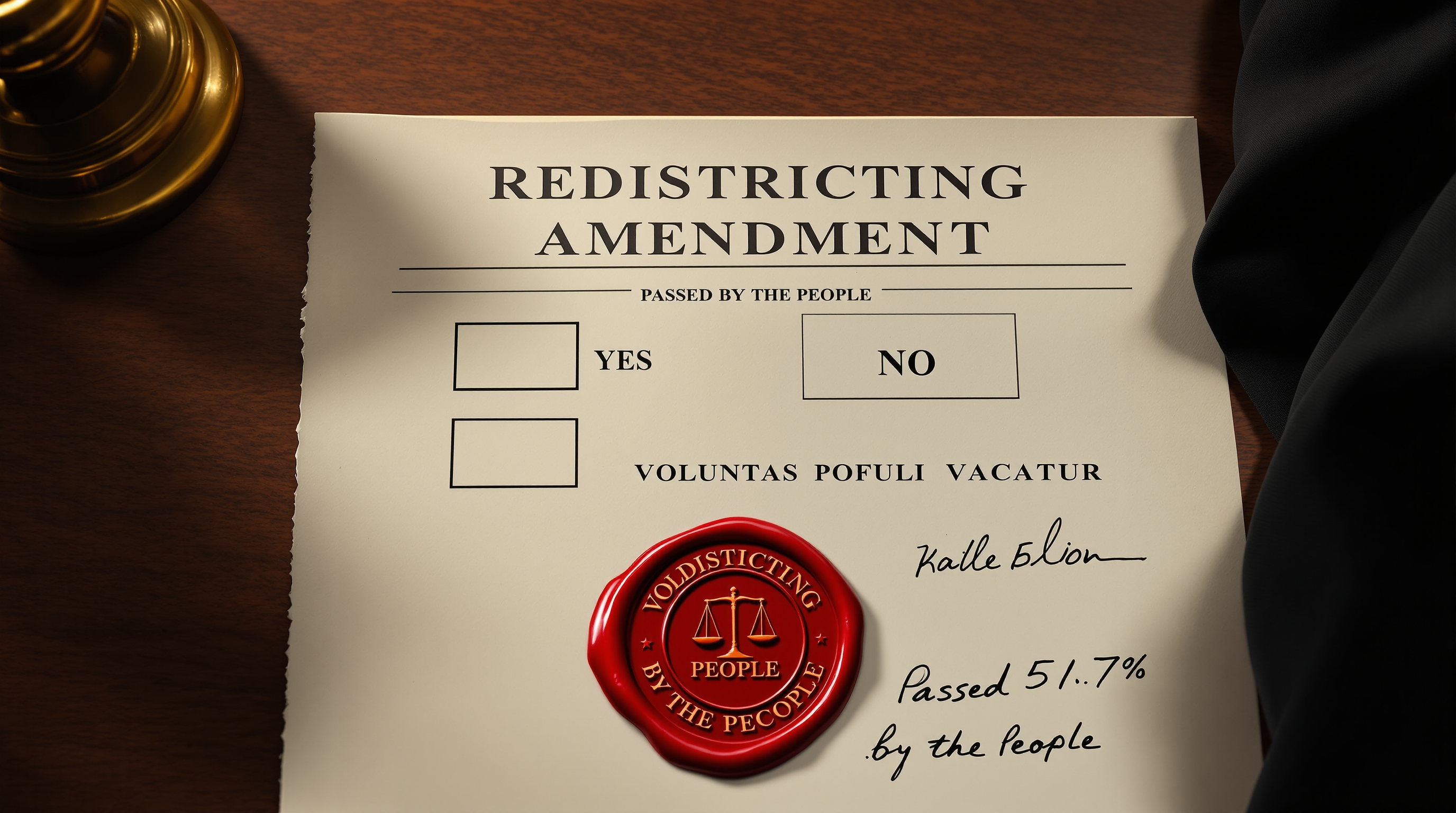
Yesterday — May 8, 2026 — the Virginia Supreme Court threw out a referendum that 51.7% of Virginians had approved three weeks earlier.
The vote was 4–3. The reasoning was a procedural reading of Article XII, §1 of the Virginia constitution: the General Assembly is required to allow "an intervening general election" between its first and second approvals of an amendment, so voters can size up candidates on the proposal. The court ruled that "general election" includes the early voting period, not just Election Day, and that the Assembly's second vote landed during early voting rather than after it. That timing, the majority wrote, "irreparably undermines the integrity of the resulting referendum vote and renders it null and void."
51.7% of voters said yes. Four judges said no. The current 6–5 Democratic congressional map, drawn by a Republican-leaning court in 2021, stays in place through 2030. The voter-approved map that would have produced a 10–1 Democratic delegation does not.
That's the news. The structure underneath has been engineered for twenty-five years. This post is the diagnosis. The United States is not a representative democracy. I will demonstrate that by the math, not the slogans. The next parts of this series are the redesign.
The wave: thirty days, six states, fourteen seats
Strip the rhetoric off and just look at the ledger.
| Date | State | What happened | Net seat shift |
|---|---|---|---|
| April 2026 | Federal | Supreme Court, 6–3, dismantles Voting Rights Act §2 race-conscious enforcement in Louisiana v. Callais | ~+4 R nationally |
| April 2026 | Tennessee | Splits Memphis into three districts, eliminates last majority-Black congressional seat (the only Democratic district in the state) | +1 R |
| May 2026 | Louisiana | Governor Landry suspends the May 16 House primaries; early votes already cast do not count. Pushed to July 15 pending new maps. | +2–3 R |
| May 2026 | Florida | Mid-cycle redraw signed by DeSantis; Cook updates ratings as several leans-D districts flip to likely-R | +3 R |
| April 21, 2026 | Virginia | Voters approve mid-cycle redistricting amendment 51.7% | (would be +4 D) |
| May 8, 2026 | Virginia | State Supreme Court, 4–3, voids the referendum on procedural grounds. Map does not take effect. | +0 D (the +4 D is wiped) |
Aggregate ledger across the six states currently doing mid-decade redistricting: Republicans +14, Democrats +6. Without the Virginia nullification it would be +14 R and +10 D. With it, the Democratic counter-math no longer cleanly offsets the Republican gerrymander wave. California's +5 from the 2024 ballot measure is now load-bearing for the entire blue-state response.
This sequence took less than thirty days.
Two answers to "why is this happening"
The first answer is the obvious one. Trump publicly told friendly state legislatures in March to redraw their districts before the 2026 midterms. Tennessee, Louisiana, Florida, and Virginia's GOP all moved within weeks. Louisiana v. Callais gave them legal cover by gutting Section 2 of the Voting Rights Act ten days before the first state map landed. The President asked, the legislatures complied, and the court vacated everything that didn't comply.
That's a true story. It is also superficial.
The deeper answer is that the runway for this maneuver was poured over twenty-five years, one Supreme Court ruling at a time, by both Republican-appointed and Democratic-appointed justices, and that the constitutional design itself has structural defects that make the current outcome possible without anyone breaking a law.
If you only see the first answer, you think the problem is one administration. You are going to lose. The problem is the runway.
The runway: a 25-year demolition, ruling by ruling
The Roberts Court did not start the project, and Citizens United was not the first stone. The pattern goes back to the late Rehnquist Court and is traceable as a sequence of discrete-but-cumulative rulings, each of which removed one of the brakes on the system that the post-1965 reform period had bolted on.
| Year | Case | Vote | What it removed |
|---|---|---|---|
| 2000 | Bush v. Gore | 5–4 (per curiam) | Halted the Florida recount; decided the presidency. Explicitly disclaimed precedential value, which is itself a tell. |
| 2004 | Vieth v. Jubelirer | 4–1–4 plurality | Pluralities suggest partisan gerrymandering claims may not be justiciable. The signal: federal courts will not save you. |
| 2008 | Crawford v. Marion County | 6–3 | Voter-ID laws upheld. Opens the door to a wave of state-level voter-ID statutes targeted at lower-propensity voters. |
| 2010 | Citizens United v. FEC | 5–4 | Corporate and union political spending uncapped under the First Amendment. Money becomes speech with no upper bound. |
| 2013 | Shelby County v. Holder | 5–4 | VRA §5 preclearance gone. The mechanism that required jurisdictions with a history of discrimination to clear changes with the federal government before implementing them: gone. Roberts: "things have changed in the South." |
| 2014 | McCutcheon v. FEC | 5–4 | Aggregate individual-donor contribution limits gone. A single donor can now max-contribute to as many candidates as they want. |
| 2019 | Rucho v. Common Cause | 5–4 | Partisan gerrymandering claims are non-justiciable in federal courts. Period. This is the holding that lets a state legislature draw any map it wants, no matter how distorted, with zero federal recourse. |
| 2021 | Brnovich v. DNC | 6–3 | VRA §2 vote-denial framework narrowed; "usual burdens of voting" carve-out introduced. |
| 2026 | Louisiana v. Callais | 6–3 | VRA §2 race-conscious enforcement on districting effectively ended. The closer. |
Read each row alone, and you can convince yourself it's a discrete legal question reasonable people disagreed about. Read the column as a sequence and the only honest description is engineering.
The runway works in three stages:
- Money flows in unimpeded. Citizens United (2010) plus McCutcheon (2014) make corporate and individual political spending effectively uncapped.
- Federal protections come out. Shelby County (2013) ends preclearance. Brnovich (2021) narrows §2 vote-denial. Callais (2026) ends §2 race-conscious districting enforcement.
- Federal courts refuse to police what's left. Rucho (2019) declares partisan gerrymandering non-justiciable. Vieth (2004) had already signaled it.
Stack the three: unlimited money + dismantled VRA + federal courts that won't look at partisan gerrymanders = exactly the wave we are watching this month. There is no part of this that requires a single bad-faith actor in 2026. The 2026 actors are operating inside a system that was carefully cleared of obstacles ahead of them.
This is not a slip. It is not an accident. It is not the unintended consequence of judicial restraint or originalism or any of the other hood ornaments. It is a built thing. The runway works, because it was built to work.
The structural defects: the design itself fails
Even if every one of those rulings were reversed tomorrow, the United States would still not be a representative democracy. The structural design has four defects so large that no amount of doctrinal cleanup can fix them.
Defect 1: The House froze in 1929
The Permanent Apportionment Act of 1929 capped the US House of Representatives at 435 seats forever, regardless of population.
The arithmetic that follows is not subtle:
| Year | US population | House seats | Constituents per representative |
|---|---|---|---|
| 1789 | 3.9M | 65 | ~60,000 |
| 1929 | 122M | 435 (cap) | ~280,000 |
| 2026 | ~340M | 435 | ~782,000 |
A US House member today represents roughly thirteen times as many people as a House member did when George Washington was sworn in. This is not how the framers expected it to scale. Article I §2 originally tied House size to one representative per 30,000 inhabitants and was implicitly designed to grow with the country. The 1929 cap froze a colonial-scale legislature onto a continental-scale population.
Compare to peer democracies in 2026:
| Country | Population | Lower-house seats | Constituents per legislator |
|---|---|---|---|
| United Kingdom | ~67M | 650 | ~103,000 |
| Germany | ~84M | 736 | ~114,000 |
| France | ~68M | 577 | ~118,000 |
| Canada | ~40M | 338 | ~118,000 |
| Japan | ~125M | 465 | ~269,000 |
| United States | ~340M | 435 | ~782,000 |
A US House member represents roughly seven times as many people as a UK MP, German Bundestag member, French deputy, or Canadian MP. Even Japan — the worst peer comparable — is ~3x more representative on a per-capita basis than we are.
The standard political-science heuristic for healthy lower-house sizing is the cube-root rule: legislatures should scale to roughly the cube root of population. Cube root of 340 million is about 698. We have 435. We are roughly 38% smaller than the rule predicts, and the gap widens every census.
The consequences are not theoretical. A House member with 782,000 constituents physically cannot meet most of them. Cannot read most of their letters. Cannot know what their districts actually want. The structural under-representation pushes power upward — to leadership, to lobbyists, to the small number of staffers who function as gatekeepers — because no individual member has the bandwidth to represent the population assigned to them. We did this to ourselves in 1929 and have not undone it.
The House of Representatives is, structurally, the least representative House any peer democracy operates.
Defect 2: The Senate is malapportioned by orders of magnitude
Wyoming has 581,000 people and two senators. California has 39 million people and two senators. A Wyoming voter has 67 times the per-capita Senate representation of a California voter.

This is not a bug; it's the original deal. Article I §3 — two senators per state regardless of population — was the price of getting small states into the union in 1787. The compromise was justifiable when the population ratio between the largest and smallest state was about 13:1 (Virginia to Delaware). It is not justifiable when the ratio is about 67:1.
Run the disparity across the full Senate, and the picture is starker than the headline number suggests. The 26 senators representing the 13 least-populous states represent about 12.5% of the US population. Those 26 senators can block any legislation in a 50–50 Senate. They can block any constitutional amendment. They can confirm or reject any Supreme Court justice. They are a structural minority veto, by design.
Compare to peer democracies' upper houses:
- Germany's Bundesrat: weighted by state population. Larger states get more votes. Disparity capped.
- Canadian Senate: appointed, with regional balance, but not strict equal-state apportionment.
- Australian Senate: equal-state apportionment, but the population ratio between most- and least-populous states is about 16:1, far below the US 67:1.
- UK House of Lords: non-elected and limited in power; the elected Commons is dominant.
No peer democracy maintains a malapportionment ratio approaching 67:1 in a chamber with co-equal legislative power. The US Senate is the most extreme upper-house malapportionment in the developed world.
Two senators per state is in the Constitution. It is also, by any quantitative measure of representation, a structural reason the US fails the test.
Defect 3: Four million Americans have no vote
A Permanent Resident of New York City who isn't a citizen, and a US citizen living in San Juan, are equally invisible to the federal government — except the New Yorker has the option of becoming a citizen. The Puerto Rican already is one.
| Jurisdiction | US citizens | Voting House reps | Senators | Electoral votes |
|---|---|---|---|---|
| Puerto Rico | ~3.2M | 0 | 0 | 0 |
| District of Columbia | ~700,000 | 0 | 0 | 3 (23rd Amendment) |
| US Virgin Islands | ~85,000 | 0 | 0 | 0 |
| Guam | ~150,000 | 0 | 0 | 0 |
| American Samoa | ~45,000 (US nationals, not citizens by default) | 0 | 0 | 0 |
| Northern Mariana Islands | ~50,000 | 0 | 0 | 0 |
| Total | ~4.2M | 0 | 0 | 3 |
That is more US citizens disenfranchised than the entire population of seven of the fifty states (Wyoming, Vermont, Alaska, North Dakota, South Dakota, Delaware, Rhode Island).
The argument against statehood for Puerto Rico and DC has been made on partisan grounds for decades. Let's be plain about it: both jurisdictions trend Democratic, so admitting them as states would shift the Senate. That's the actual fight. No serious person disputes that the citizens are citizens. The only thing keeping them disenfranchised is the seat math.
When the seat math is the reason 4M Americans don't vote, "we are a representative democracy" stops being a coherent claim.
Defect 4: The Electoral College compounds defects 1 and 2
Electoral votes per state = House seats + Senate seats. So the structural distortions of both chambers carry forward into the presidency.
- Wyoming: 1 House seat + 2 Senate seats = 3 electoral votes for 581,000 people. One EV per ~194,000 residents.
- California: 52 House seats + 2 Senate seats = 54 electoral votes for 39M people. One EV per ~722,000 residents.
- A Wyoming voter has roughly 3.7x the per-capita presidential representation of a California voter.
Forty-eight states allocate their electoral votes winner-take-all. Win California 50.01%–49.99% and you take all 54 EVs. The losing 49.99% — about nineteen million voters — count for nothing in the presidential outcome.
The mechanical consequence: in two of the last six presidential elections (2000, 2016), the candidate who received fewer popular votes won the presidency. Among major democracies, this is anomalous. The popular vote and the formal outcome diverging twice in twenty-four years is not a feature of a representative democracy. It is a feature of an institution misnamed.
The 2024 cycle reinforced the point in the other direction: Trump won both the popular vote and the Electoral College, but he won the EC by a substantially larger margin than the popular vote, because of the Wyoming-vs-California per-capita distortion. The system rewards geographic distribution, not vote totals.
The math of representation
What does "representative democracy" mean as a quantitative claim? Three measurable conditions, none of them controversial:
- Equal voting weight. Every citizen's vote should carry equal weight at every level of federal government.
- Districts that reflect communities. Legislative districts should track real geographic and demographic communities, not partisan optimization.
- Outcomes proportional to votes. The aggregate political outcome should reflect the aggregate vote, within the constraints of single-member districting.
Score the United States, May 2026, against each:
| Condition | Status | Evidence |
|---|---|---|
| 1. Equal voting weight | F | 67× Senate disparity. 3.7× Electoral College disparity. 4.2M citizens with zero federal vote. Frozen 1929 House cap means 7× under-representation per peer democracy. |
| 2. Districts reflect communities | F | Six states actively mid-cycle redistricting in May 2026 alone. Rucho immunizes partisan gerrymandering from federal review. Callais ends VRA §2 race-conscious enforcement. Tennessee just split Memphis into three districts to dilute one community. |
| 3. Outcomes proportional to votes | F | Two of the last six presidential elections went to the popular-vote loser. The current redistricting wave is netting Republicans 14 seats vs. 6 for Democrats from a population that splits roughly even. Senate produces 50/50 outcomes from electorates that are nowhere near 50/50. |
A system that scores F on every quantitative test of representation is not a representative democracy. It is something else, and refusing to name what it is means we cannot fix it.
Names already exist for what we now are
We don't need to invent vocabulary. The comparative-political-science literature has names for systems with regular elections, formal institutions, written constitutions, and mass disenfranchisement-by-design. They are well-developed terms with rigorous definitions:
- Electoral autocracy — regular elections held under conditions that systematically advantage the incumbent group, with formal democratic institutions present but hollowed out.
- Hybrid regime — mixed authoritarian and democratic features; competitive elections with significant structural distortions.
- Competitive authoritarianism — Levitsky and Way's term for systems where elections happen but the playing field is sufficiently tilted that opposition victory is structurally constrained.
- Defective democracy — Merkel's term for democracies missing one or more of the standard pillars (free elections, representative legislature, independent judiciary, rule of law, civil rights).
The V-Dem Institute downgraded the United States from "liberal democracy" to "electoral democracy" in May 2026 — its first such reclassification in fifty years. Eurasia Group named US political revolution its #1 global risk for 2026. Trust in the federal government among Americans 18–29 hit 15% — a record low. The share of 18–29 Americans who believe the 2026 midterms will be conducted fairly: 33%.
This isn't a forecast. It's the present tense.
What this is not
I want to head off three predictable misreads.
This is not a partisan grievance. The Republicans are running the current play because they have the Court, the executive, and the trifecta in enough states to execute it. If the partisan positions were reversed and the Democratic Party had a 6–3 friendly Court and twelve red-state legislatures eager to flip blue overnight, the Democratic establishment would run the same play. The structural defects cut against representation regardless of who exploits them at any given moment. The fix is structural, not partisan.
This is not an argument for despair. A system that scores F on three quantitative tests is not unfixably broken. It is misdesigned for the conditions it now operates under: capture, mid-decade redraws, oligarchic spending, demographic concentration in unrepresented territories, and twenty-five years of accumulated case-law pointing one way. The diagnosis is precise. The diagnosis is also the first step.
This is not the same conversation as "polarization." The polarization framing assumes the underlying institutions work and the citizens are the problem. The data say the opposite: the citizens still believe in juries (50% trust juries vs. 23% trust judges), still vote when given a real choice (Virginia, 51.7%), and consistently outperform their captured institutions on simple questions of fairness. The institutions are the problem. The citizens are not.
The diagnosis
Pull it together.
A nation calling itself a representative democracy is one whose votes are counted, whose districts reflect the people who live in them, and whose outcomes are proportional to the will of the population.
The United States in 2026:
- Has a House frozen at 1929 size, with members representing seven times more constituents than peer democracies.
- Has a Senate where small-state voters carry 67× the weight of large-state voters, structurally vetoing the majority.
- Disenfranchises roughly 4.2 million of its own citizens by territorial status alone — more than the population of seven full states.
- Routes presidential outcomes through an Electoral College that has handed the office to the popular-vote loser twice in twenty-four years.
- Has watched its Supreme Court spend twenty-five years methodically dismantling the legal infrastructure that braked partisan capture.
- Is, this month, watching six state legislatures redraw districts mid-decade with no federal recourse, no preclearance, and full Court cover.
- Yesterday watched four state-supreme-court judges nullify a referendum that 51.7% of voters had approved three weeks earlier, on a procedural reading of when "early voting" counts as part of "general election."

That is the data. The label "representative democracy" does not survive contact with the data.
The United States is, by every quantitative measure of representation that comparative political science has developed, a defective democracy — a system with regular elections, formal institutions, and a written constitution, structurally hollowed out by accumulated design choices that no longer track the will of the population. We have a name for what we are. We should use it.
That's Part 1.
Part 2 is what to do about it. The answer is not despair, and it is not waiting around for the existing institutions to fix themselves — they will not, because the structure of the captured system rewards the people who run it for keeping it captured. The answer is a redesign, beginning from the one institution Americans still trust: each other. The polling on that point is not subtle, and the cross-national pattern is not subtle either. But that is the next post.
For now, the diagnosis. This is not a representative democracy. It used to be closer to one. It is currently something else. Naming it is the first move.

References
Recent rulings and state actions cited
- Louisiana v. Callais (2026), 6–3 — Supreme Court ruling effectively ending VRA §2 race-conscious enforcement on districting. Wikipedia (case page being maintained as of this writing).
- Virginia Supreme Court ruling, May 8, 2026, 4–3 — voiding the April 21 voter-approved redistricting referendum. Virginia Mercury · NPR · Ballotpedia News · Wikipedia: 2026 Virginia redistricting amendment.
The Supreme Court runway (chronological)
- Bush v. Gore, 531 U.S. 98 (2000). Oyez · Wikipedia.
- Vieth v. Jubelirer, 541 U.S. 267 (2004). Wikipedia.
- Crawford v. Marion County Election Board, 553 U.S. 181 (2008). Wikipedia.
- Citizens United v. FEC, 558 U.S. 310 (2010). Oyez · Wikipedia.
- Shelby County v. Holder, 570 U.S. 529 (2013). Wikipedia.
- McCutcheon v. FEC, 572 U.S. 185 (2014). Oyez · Wikipedia.
- Rucho v. Common Cause, 588 U.S. ___ (2019). Wikipedia.
- Brnovich v. Democratic National Committee, 594 U.S. 647 (2021). Oyez · Wikipedia.
Constitutional structure
- Permanent Apportionment Act of 1929 (a.k.a. Reapportionment Act of 1929), 46 Stat. 21. U.S. House Historical Highlights · Wikipedia.
- U.S. Constitution, Article I §2 — House composition and apportionment.
- U.S. Constitution, Article I §3 — Senate composition (two senators per state regardless of population).
- Twelfth Amendment — the Electoral College.
- Twenty-Third Amendment — the District of Columbia's three electoral votes (and its lack of voting representation in Congress).
Comparative-democracy assessments
- V-Dem Institute, Democracy Report 2026 — downgrade of the United States from "liberal democracy" to "electoral democracy," cited in the post. V-Dem press release · V-Dem Institute.
- Eurasia Group, Top Risks 2026 — Risk #1: U.S. Political Revolution. Top Risks 2026 — Risk #1 · Top Risks 2026 overview.
- Pew Research Center, Multiple indicators show a decline in the health of America's democracy (April 2026). Pew Research.
On the cube-root rule and House size
- Rein Taagepera & Matthew S. Shugart, Seats and Votes: The Effects and Determinants of Electoral Systems (Yale University Press, 1989) — the canonical empirical case for the cube-root rule of legislative sizing.
- FairVote, The Case for Enlarging the House of Representatives.
- American Academy of Arts & Sciences, Our Common Purpose: Reinventing American Democracy for the 21st Century.
On comparative regime classification
- Steven Levitsky & Lucan A. Way, Competitive Authoritarianism: Hybrid Regimes after the Cold War (Cambridge University Press, 2010).
- Wolfgang Merkel, "Embedded and Defective Democracies," Democratization 11(5), 2004.
- V-Dem's regime typology: closed autocracy, electoral autocracy, electoral democracy, liberal democracy. V-Dem Democracy Indices — Wikipedia.
Subscribe to the Newsletter
Get notified when I publish new blog posts about game development, AI, entrepreneurship, and technology. No spam, unsubscribe anytime.
Comments
Loading comments...
Published: May 9, 2026 7:55 PM
Last updated: May 9, 2026 7:55 PM
Post ID: e1503eb2-0bdb-49af-b47d-70d18f972be8